The views and opinions expressed on this site and blog posts (excluding comments on blog posts left by others) are entirely my own and do not represent those of any employer or organization with whom I am currently or previously have been associated.
Academic Version: Applying my personal experiences and academic research as a professor of Sociology and Asian American Studies to provide a more complete understanding of political, economic, and cultural issues and current events related to American race relations, and Asia/Asian America in particular.
Plain English: Trying to put my Ph.D. to good use.
I’m sure you have heard by now about the tragedy in Binghampton, New York this past week, when Jiverly Wong (a Vietnamese American of Chinese ancestry) shot and killed 14 people at the American Civic Association immigrant assistance center, then shot himself. I join others in offering my sincere condolences to the family of those killed and to all affected by these shocking events.
In trying to understand this tragedy from a sociological point of view, I am reminded of just how similar this latest incident of violence is to the Virginia Tech shootings in 2007, when troubled Korean American student Seung-Hui Cho killed 33 students and professors before killing himself. Both cases involved a lone gunman who was personally very troubled and perhaps even mentally ill, who felt ridiculed and demeaned by others around him, and who had trouble fitting into mainstream American society.
And of course, both the killers were Asian American.
Inevitably, there will be those who will generalize these and other incidents that involved violence and murder committed by other Americans of Asian descent that have made the news in recent years, and conclude that Asian Americans are inherently socially awkward, emotionally and mentally unstable or inferior, and/or prone to violence. In fact, I felt the same kind of dread that I felt back in 2007 when I heard that the shooter in the Binghampton murders was identified as being of Asian descent.
Let’s put that unfortunate and misguided generalization to rest right now — as the official FBI statistics show, in 2007, in cases where the race/ethnicity of murder offenders is known, those classified as “Other” (the category that includes Asian Americans) represent only 2% of all murder offenders (keeping in mind that Asian Americans comprise 5% of the total U.S. population). More generally, research consistently shows that immigrants actually have lower crime rates than their U.S.-born counterparts (see Reid et al., (2005), “The Immigration-Crime Relationship.” Social Science Research 34:757-780).
Back to more realistic issues, from a sociological point of view, the most interesting difference between the Virginia Tech and Binghampton shootings is the race/ethnicity of the victims. At Virginia Tech, almost all of the victims were White and U.S.-born, whereas here in the Binghampton case, almost all of the victims were non-White and immigrants. Does this mean anything — is this difference significant?
Immigration (both undocumented and legal) is still a very hotly-debated and controversial issue in our society these days, and I’m sure there are some Americans who — consciously or unconsciously — downplay the significance of these Binghampton murder victims by rationalizing that as immigrants, they weren’t “real” or “legitimate” Americans anyway and that therefore, their lives are somehow devalued.
But I hypothesize that the overwhelming majority of Americans do not distinguish between the racial/ethnic identities of the murder victims and that as victims of a senseless tragedy, there is no distinction based on any status.
Ultimately, I actually think that it is this kind of unity of compassion regarding the victims of such tragedies that can serve to bring all Americans closer together. That is, as Americans and as human beings, we can hopefully all share in sympathizing with the families of these senseless shootings. Further, again as Americans, we probably also share the same worries about how the current economic recession will affect our lives and our future, a factor that, along with his apparent mental issues, may have contributed to pushing Jiverly Wong over the edge when he lost his job a few months ago.
In other words, even though we don’t contemplate shooting people after losing our jobs, many of us share the same worries when it comes to how we will pay our bills and save for our children’s future in these tough financial times. Through these kinds of difficulties, a few may unfortunately snap like Wong did, but many more will remember the humanity in us all and the need to help and support others like us so that we can all come out better in the end, like these examples below show us.
You don’t need me to tell you that undocumented immigration is one of the most controversial and emotional issues in American society today. It is an issue that cuts across and divides members within a particular racial, ethnic, or cultural group. In fact, some of the most heated arguments that I’ve had about undocumented immigration has been with other Asian Americans.
Many critics of undocumented immigrants argue that the only realistic or effective solution is mass deportation of the estimated 12 million undocumented immigrants currently in the country. Scholars call this approach the “enforcement only” approach. On the other hand, others believe that in order to “cure the disease” rather than simply treating the symptoms is through the “comprehensive reform” approach.
Such proposals include securing points of entry at the border and criminal punishment for the most dangerous undocumented immigrants but just as important, emphasizes ways to deal with the undeniable need for immigrant labor within the U.S. economy, settling the status of the undocumented immigrants already in the country in a fair and humane way, working with sending countries on policies that reduce the push their citizens feel to come to the U.S.
Many Americans might assume that law enforcement officials around the country, particularly in the border states of California, Arizona, New Mexico, and Texas, are more likely to support the “enforcement only” proposals. But as Seth Hoy at the Immigration Policy Center writes in their blog Immigration Impacts, many in the law enforcement community are pleading for comprehensive reform:
In a recent Washington Post editorial, Phoenix Police Chief Jack Harris asserts that focusing his attention on real criminals rather than economic migrants has not only lowered the city’s crime rate, it has also enabled police to maintain a closer relationship with the communities they serve. For Harris, who likened border enforcement to bailing an ocean with a thimble, “the answer is not in Phoenix. The answer is in Washington.â€
Don’t give me 50 more officers to deal with the symptoms. Rather, give me comprehensive immigration reform that controls the borders, provides for whatever seasonal immigration the nation wants, and one way or another settles the status of the 12 million who are here illegally — 55 percent of whom have been here at least eight years. For those whose profession it is, law enforcement sometimes seems like bailing an ocean with a thimble.
No one disagrees that violence, drug cartels and human smuggling on the border are real problems that warrant real and sensible solutions, but conflating drug smugglers with economic migrants is not effective or helpful. Effective border enforcement needs to be carried out in consultation with border communities—communities whose resources are currently being diverted from arresting actual violent criminals to “chasing bus boys around the desert.”
Most state and local police departments will tell you that in order to do their jobs effectively, they rely on community policing policies which encourage immigrants to step out of the shadows, report crimes and access police protection. According to the Major Cities Chiefs Association, a committee made up of police chiefs from across the country, cooperation from the immigrant community keeps crime rates lower.
Without assurances that contact with the police would not result in purely civil immigration enforcement action, the hard won trust, communication and cooperation from the immigrant community would disappear…Such a divide between the local police and immigrant groups would result in increased crime against immigrants and in the broader community, create a class of silent victims and eliminate the potential for assistance from immigrants in solving crimes or preventing future terroristic acts.
Certainly, the debate about the best way to address the undocumented immigration issue will continue. Nonetheless, I think the opinions of law enforcement officials on how they would like to see our government best address the issue carries a lot of weight.
On a lighter and not-quite-related note, Jon Stewart from The Daily Show recently had a brief video segment on patrolling the border, embedded below.
As news organizations are reporting, the Senate has confirmed Gary Locke as the new Secretary of Commerce. Below is an Associated Press news clip of President Obama introducing Secretary Locke:
If you’re keeping track, Sec. Locke is the third Asian American in President Obama’s cabinet, following Secretary of Veteran Affairs Eric Shinseki and Secretary of Energy Steven Chu. Three Asian American cabinet secretaries is unprecedented in American history and needless to say, I join many others in expressing my elation and gratitude at President Obama’s picks for his cabinet.
For those who haven’t heard of Sec. Locke before, as Governor of Washington between 1997-2005, he was the first Chinese American governor in American history and the first Asian American governor of a mainland state. He was seen as a rising star in the Democratic Party and a possible Vice Presidential candidate. However, he declined to run for Governor after his second term and returned to private life thereafter.
As illustrated in PBS’s excellent 2005 documentary Searching for Asian America, Sec. Locke is known for being very intelligent and detail-oriented and as such, in many ways personifies some common cultural assumptions about Asian Americans. That’s not to say it’s good or bad, just to say that he represents a “safe choice” for President Obama in that way and was an attractive option since Obama’s first two nominees for the position both dropped out.
But I think another reason that President Obama chose Gary Locke is because, as also pointed out in the PBS documentary, Sec. Locke has many ties to the land of his ancestors, China. Therefore, it’s probably safe to assume that President Obama felt those personal and professional ties to China would come in handy as our nation and its economy tries to navigate through this recession and the 21st century global economy in general, one in which China will play a major role.
As such, Sec. Locke is the latest example of a theme that I’ve been writing about for some time — how Asian Americans are forging a new identity for themselves, one in which our “foreignness” or more specifically our transnational cultural ties and networks back to Asia, are seen as assets, rather than liabilities as we assert our identities as legitimate Americans in the 21st century.
In other words, in this era where American society is inevitably becoming more racially, ethnically, and culturally diverse and where economic issues are likely to be a paramount concern for Americans individually and American society institutionally, we as Asian Americans now have the opportunity to make a significant contribution to American society. In the process of doing so, we can also help to reshape the image and definition of what it means to be an “American.”
This expanded definition of being an American includes not just emotional attachment and patriotic loyalty to an American identity, but also involves helping to achieve greater economic prosperity for American society. As we’re seeing right now, economic issues have emerged as significant factors and challenges to American society and its overall sense of national identity.
Within this contexts, Asian American are poised to make significant contributions to rebuilding the American economy and helping it become more competitive in the 21st century. These opportunities can involve many different examples. First, we know that at the aggregate level, Asian American households have the highest median income of all the major racial/ethnic groups.
Even when it comes to personal/per capita level, as data is beginning to show, US-born Asian American have matched or even exceeded the income level of Whites. Of course, we have to be careful and recognize that not all Asian Americans are economically successful, but overall, I think our community is doing well.
There was also the recent commentary in the NY Times which suggested, slightly tongue-in-cheek, that one way to stimulate the economy is to let in more Asian immigrants, who would buy up all he sub-prime homes, work 14 hour days to do it, improve the national savings rate, and start up businesses that will employ American workers.
More realistically, we’ve already seen examples of Asian enclaves proliferating around the country — in both urban and increasingly suburban areas — that have resulted in these areas becoming revitalized, with new businesses, jobs, homes, and other amenities being created.
The point is, the economic contributions of Asian Americans to the American economy is undeniable.
The second way that Asian American can contribute to a new and stronger American society relates more to the cultural level. As I mentioned earlier, it is clear that the world in general and American society in particular is becoming more diverse, globalized, and transnational. With that in mind, Asian Americans occupy a very central role in this evolving process.
As the U.S. seeks to maintain its influence around the world, it has no other choice but to embrace these global trends and to build more mutually-respectful connections with countries around the world, particular in Asia. In fact, Hillary Clinton has been doing just that as Secretary of State — in February she made high-profile visits to Japan, South Korea, China, and Indonesia.
So with this mind, Asian Americans can serve as a valuable facilitators in these connections because on the individual, community, and institutional levels, we still have strong ties and networks to Asian countries. This can take many different forms — maintaining relationships with friends and family and sending remittances back there, or using our bicultural skills and resources to do business back in Asia, or bringing our educational expertise to work on issues and projects focused on environmental sustainability, social equality, or human rights.
In the case of Secretary Locke, I think he represents this new form of Asian American identity — a “real” American of Asian ancestry but whose Asian ancestry can be a significant asset and advantage in terms of making significant contributions to strengthening our country, our economy, and our society.
Many Asian Americans (and for that matter, Americans from all kinds of backgrounds) are in a similar situation and as such, also have the same opportunity to become leaders in their community and in our society in the 21st century.
In these tough economic times, Americans from all kinds of backgrounds are hurting financially. There seems to be depression reports in the news almost every day. Reports in the media have also focused a lot of attention on layoffs at large corporations, many of whom are shedding employees by the thousands. With that in mind, it may lead many of us to presume that middle class Whites are getting hit the hardest in this recession.
Certainly, many middle class Whites and their families are feeling the brunt of the recession and many find themselves struggling to make ends meet for the first time in their lives. However, as MSNBC reports, the data shows that on the aggregate level, it’s actually Blacks and Latinos that are being hit the hardest by the current recession:
Last hired, first fired: This generations-old cliche rings bitterly true for millions of Latinos and blacks who are losing jobs at a faster rate than the general population during this punishing recession. Much of the disparity is due to a concentration of Latinos and blacks in construction, blue-collar or service-industry jobs that have been decimated by the economic meltdown. . . .
Since the recession began in December 2007, Latino unemployment has risen 4.7 percentage points, to 10.9%, according to the Bureau of Labor Statistics. Black unemployment has risen 4.5 points, to 13.4%. White unemployment has risen 2.9 points, to 7.3%. . . .
William Darity, a Duke University professor, said that “blacks and Latinos are relative latecomers to the professional world … so they are necessarily the most vulnerable.” . . .
“Not saying that it’s racism,” [an executive search consultant] said, “but if a manager or a senior executive is looking at a slate of individuals and has to let one of them go, chances are he or she will not let the person go that they spend a lot of time with at the country club or similar places.”
My point is not to play the “Oppression Olympics” and to argue that this group is much better off than another group, or one group is more oppressed than another. Instead, I would like to place these findings in a larger sociological context.
Many Americans feel that our society, while still not a perfect meritocracy, offers Americans from all backgrounds the best opportunities for success and achieving the American dream than at any time in our history — that the playing field is more level and equal now than it’s ever been.
I would agree that the opportunities for socioeconomic success are the most equal that they’ve ever been in American history. But that does not mean that everybody is on an equal playing field. Instead, what this MSNBC article and other sociological studies have shown is that Blacks and Latinos continue to experience particular institutional disadvantages in their efforts to achieve economic equality with Whites.
Specifically, as the article points out, Blacks and Latinos tend to be disproportionately located in service and manual labor industries. Beyond the fact that these industries tend to pay lower wages in general, they are also highly vulnerable in times of economic recession and we’re seeing this play out right now. As such, Blacks and Latinos experience their first disadvantage.
Their second disadvantage is that even for Blacks and Latinos who have professional occupations that normally are well-paying, again as the article points out, they are relative newcomers to such occupations and as such, when layoffs come, they are more likely to lose their jobs due to the “last hired, first fired” principle.
The third point of disadvantage is that due to the legacy of systematic discrimination in the past, Blacks and Latinos have been unable to accumulate the same level of family wealth compared to Whites. This is even despite the fact that while the income gap between Whites and Blacks and Latinos has declined, the wealth gap has actually increased in the past several decades.
This wealth gap is important because it provides a cushion or barrier to soften loss of employment and other financial difficulties. Therefore, because Blacks and Latinos have less accumulated wealth than Whites, they have a much smaller cushion to fall back on and therefore, are more susceptible to financial catastrophes.
Ultimately, these institutional disadvantages play a large part in why Blacks and Latinos seem to struggle more than Whites or Asian Americans when it comes to achieving economic success. They may be well-educated, motivated, and hard-working, but they also have to overcome more structural inequalities and barriers that make them more financially vulnerable in times of recession.
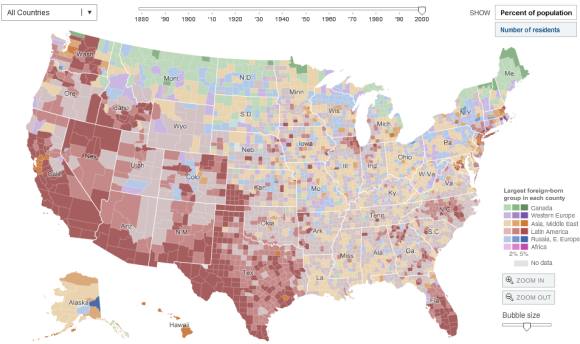
I just came across a nifty interactive infographic from the New York Times that tracks geographic settlement patterns of major racial/ethnic immigrant groups throughout the United States by decade, from 1880 to 2000: the Immigration Explorer.
For every group included in the graphic, you will notice that as the decades pass, their settlement patterns become more dispersed throughout the country. In other words, in the past, immigrants would concentrate in the traditional major metropolitan areas of New York, Los Angeles, San Francisco, and Chicago.
But these days, immigrants have spread out and are settling into new “gateway” areas — areas that aren’t used to having large immigrant populations. And unfortunately, these demographic shifts can and have led to some tensions between old-time residents and the new arrivals. For more research on the new settlement patterns of contemporary immigrants, I recommend books such as:
It doesn’t take a Ph.D. to recognize that Barack Obama is not like most of his predecessors. This can be applied not just to the obvious fact that he’s our nation’s first African American President, but also in regard to his “style” or more specifically, the way he expresses himself, verbally and non-verbally.
On his pre-inaugural visit to Ben’s Chili Bowl, a landmark for Washington’s African-American community, President Barack Obama was asked by a cashier if he wanted his change back. “Nah, we straight,†Obama replied. The phrase was so subtle some listeners missed it. The reporter on pool duty quoted Obama as saying, “No, we’re straight.â€
But many other listeners did not miss it. A video of the exchange became an Internet hit, and there was a clear moment of recognition among many blacks, who got a kick out of their Harvard-educated president sounding, as one commenter wrote on a hip-hop site, “mad cool.â€
On matters of racial identity, many observers in the African-American community say he benefits from what’s known as “dog-whistle politics.” His language, mannerisms and symbols resonate deeply with his black supporters, even as the references largely sail over the heads of white audiences. . . .
“The code words matter, how you dress matters, how you speak matters; it’s all subliminal messaging, and all politicians use it,†said Michael Fauntroy, professor at George Mason University. “Ronald Reagan used to talk about making America the shining city on a hill, which is about America as divinely inspired, and it has a deep vein in the evangelical conservative movement.” . . .
[George W.] Bush used phrases lifted from church hymns and the Bible to signal an affinity for like-minded Christians. The phrase “culture of life,†became part of the political lexicon when Bush used it weeks before the 2000 election — it was a less political, more evangelical version of “pro-life.†. . .
Beyond speech, blacks have picked up certain of Obama’s mannerisms, particularly his walk, that signal authenticity. Bush had his cowboy strut, and Obama has a swagger — a rhythmic lope that says cool and confident and undeniably black.
The article basically notes that virtually all Presidents have their own unique “style” of verbal and non-verbal expression and they use subtle words, phrases, or mannerisms that reflect and appeal to a particular group of constituents to let them know that he’s “one of them,” but without making it so obvious that it turns off more mainstream Americans.
What makes Barack Obama’s style different of course, is that it’s a “Black” style, something Americans have never seen before from our President (Bill Clinton came as close as any previous President could, but obviously he had his limitations).
So what should we make of Obama’s unique style, or should it even matter? As a fervent fan and supporter, I personally love his style and find it to be a welcome change and a breath of fresh air for Washington DC and our country as a whole. But does it risk alienating White Americans who aren’t used to it?
That’s a hard question to answer. On the one hand, we’ve already seen and I’ve written before about the ways in which some Whites are reacting negatively to his victory and the growing racial, ethnic, and cultural diversification of American society in general. So it’s possible that these particular White Americans will use such examples of Obama’s “blackness” to reinforce their extremist and racist views of him and non-Whites like him.
But on the other hand, I’m confident that most others will recognize that different doesn’t have to mean bad or inferior. That is, I hope that the vast majority of Whites in this country will understand that America is inevitably changing — politically, economically, and culturally. With that in mind, there is now more room for different forms of an American identity to emerge, one that expands on the “traditional” image of American as being White, middle class, and Protestant.
Rather than denying or resisting such an evolution of American society and our national identity, my hope is that we can embrace them and use them as a source of strength and unity to create an inclusive collective identity as Americans in the 21st century. Sure, we’ll still have our differences, but my point is that such differences are good for America and will make our society stronger, not weaker.
As part of this blog’s mission of making academic research and data more easily accessible, understandable, and applicable to a wider audience and to practical, everyday social issues, I highlight new sociological books about Asian Americans and other racial/ethnic groups as I hear about them. As always, please remember that I do so for informational purposes only and do not necessarily endorse their entire contents or perspectives.
Home to 33,000 Filipino American residents, Daly City, California, located just outside of San Francisco, has been dubbed “the Pinoy Capital of the United States.” In this fascinating ethnographic study of the lives of Daly City residents, Benito Vergara shows how Daly City has become a magnet for the growing Filipino American community.
Vergara challenges rooted notions of colonialism here, addressing the immigrants’ identities, connections and loyalties. Using the lens of transnationalism, he looks at the “double lives” of both recent and established Filipino Americans.
Vergara explores how first-generation Pinoys experience homesickness precisely because Daly City is filled with reminders of their homeland’s culture, like newspapers, shops and festivals. Vergara probes into the complicated, ambivalent feelings these immigrants have—toward the Philippines and the United States—and the conflicting obligations they have presented by belonging to a thriving community and yet possessing nostalgia for the homeland and people they left behind.
We all know by now that the previously underdog movie Slumdog Millionaire is a huge hit around the world, but particularly in the U.S., having just won eight Academy Awards and grossing over $120 million dollars in North America. As MSNBC writes, the movie also symbolizes the cultural/popular emergence of Indian Americans as a community:
The past few weeks have underscored their increasingly high profile: Louisiana Gov. Bobby Jindal gave the Republican response Tuesday night to President Barack Obama’s speech to Congress, while Dr. Sanjay Gupta is under consideration to be Obama’s surgeon general.
Model and cooking author Padma Lakshmi finished another “Top Chef” TV season, then became the celebrity face for a new Procter & Gamble Co. Pantene shampoo line as well as a Hardee’s hamburger promotion. Anoop Desai, dubbed “Noop Dogg,” drew fans with his singing on this year’s “American Idol,” and Aziz Ansari was in TV’s medical comedy “Scrubs” before moving to a regular role in the upcoming comedy series “Parks and Recreation.” . . .
Indian-Americans have been one of the fastest-growing and most successful immigrant groups, though [Sreenath Sreenivasan, a professor and dean of student affairs for Columbia University’s journalism school] and other Indian-Americans are quick to point out that some Indians continue to struggle economically and socially in this country. . . .
For years, they have proliferated in this country in the fields of health care, information technology and engineering, with higher education levels and incomes than national averages. And recent years have brought more Indian heads of major U.S. companies — PepsiCo Inc.’s Indra Nooyi is among about a dozen current CEOs.
They also are making their presence felt in journalism. Gupta, a neurosurgeon and medical correspondent, and Fareed Zakaria, editor of Newsweek International, have their own weekend shows on CNN, for example.
Slumdog Millionaire’s extraordinary success is well-earned, although we should note that not all Indians and Indian Americans are enthralled by its story. Nonetheless, I agree with the MSNBC article that the film’s success does have cultural, as well as economic, significance for American society and the Indian American community in general.
Among other things, the article also spends some time discussing the political emergence of Bobby Jindal, who despite his less-than-successful televised response to Barack Obama’s recent address to Congress, is undoubtedly being groomed to be a high-profile national leader for the Republican party for years to come. By the way, CBS’s 60 Minutes just did a very interesting profile segment on him, embedded below (about 12 minutes long):
The part of the segment that I found most interesting was that he and his wife hardly identify as Indian American at all — they clearly prefer to think of themselves as just plain “Americans” and “Louisianians.” That is their prerogative of course — not everyone who has non-American ancestry should be compelled to identify with that particular ethnicity. But I am interested to hear what Indian Americans think of Jindal’s sense of his identity (apart from his politics) — does it bother Indian Americans that one of the most high-profile Indian Americans in the country has little if any personal attachment to his ethnic roots?
In the meantime, back to the Indian American community as a whole, the MSNBC article is not really groundbreaking news. As my article on Socioeconomic Statistics and Demographics show, Indian Americans are clearly the most socioeconomically successful of the major Asian American ethnic groups. As such, it should be no surprise that, along with their socioeconomic success, their cultural prominence would soon increase as well.
At the same time, I also wonder what effect political events back in India will have on Indian Americans and the perception that others have of Indian Americans. Specifically, there is still a lot of suspicion and even hostility towards India and the perception that is largely responsible for many jobs being outsourced away from the U.S. and that India is profiting from globalization at the expense of American workers. This is likely to continue being the case as the current recession gets worse before it gets better.
Second, the recent and continuing terrorist attacks and related violence in India have many people worried not just about the physical safety of people inside of India, but also of India’s political stability and even its future economic development. Both of these concerns affect Indian Americans both here in the U.S. and around the world in terms of their public image and of course, the well-being of friends and relatives back in India.
Nonetheless, I for one welcome this cultural emergence of our fellow Americans of Indian descent. Our society and its diverse mosaic of culture is enriched even further by it.
Here are some more links out that have come my way relating to Asians or Asian Americans. As always, links to other sites are provided for informational purposes and do not necessarily imply an endorsement of their contents:
The following is a description of a unique project relating to immigrants in America that I hope you will find close to your heart both personally and professionally. This project offers a special opportunity for immigrants in the United States – New and old – to tell their story.
Our concept is to disseminate this information to as many immigrants as possible in search of the best material. Please help us convey this information to the Asian community living in the US and beyond: writers, educators, seniors, students, professors, colleagues and friends, community leaders and organizers as well as to community groups and organizations and to anyone who you believe can contribute to this project.
Yours sincerely,
Ricky Friesem (An award winning writer, screenwriter and filmmaker)
Lia Friesem (Journalist, writer, screenwriter, and documentary filmmaker)
The Choosing America Project
America is a nation of immigrants. Albert Einstein, Alexander Graham Bell, Henry Kissinger, Mikhail Baryshnikov, Greta Garbo, Martina Navratilova, Hans Bethe, Madeleine Albright, Gloria Estefan, Michael J. Fox ,Arnold Schwarzenegger, Carlos Santana, Sammy Sosa, Hakeem Olajuwon.
None of them was born in America. All chose America. Like you.
Whether you came from Germany, England, Italy or the Czech Republic, Mexico, Nigeria, Pakistan, China, or Cuba, whether you immigrated to America as a child, a young adult, or with your own children, whether it was your decision or your parents’, whether you immigrated in the 20’s, 50s’ the 80s’ or just yesterday, you must have one special story to tell. And we want to hear it!
We are looking for authentic dramatic anecdotes, short stories (1500-4000 words) that epitomize your experience as immigrants who CHOSE to live in America.
Think of something that has happened to you as an immigrant – We are looking for those special moments, encounters, surprises, experiences, disappointments, which vividly convey what it’s like to be an immigrant in America. The good, the bad, the sad, the miraculous, the joyful— every anecdote is welcome as long as it’s authentic and well told.
The goal of our project is to turn some of these stories into short films that will be shown in the movies and broadcast on TV. Send your story to: stories@choosingamerica.com
Casting Call for Multi-Racial, Blended Family For Reality/Documentary Television Show
Left/Right TV is a New York City-based production company currently seeking a blended family for a new reality television show. We are looking to find a ‘Brady Bunch’ style group; meaning kids from separate, previous marriages, now living in together as a whole new family but without the ‘Brady Bunch’ attitude!
We are particularly interested in racially diverse unions. African-American father with African-American children married to White mother with white children, or any combination of different races in one household). But this is not all that we are looking for: we are truly looking for real families dealing with real issues: step-sibling adjustments, financial stresses brought on from the current economy, distribution of labor and any other issues that come up in a modern American home.
We are looking for articulate, intelligent parents and children who live in suburban environments and live middle-to-upper-middle-class lives anywhere in the United States of America. We also would like to ideally find a family that has only lived this new and blended life for a year or less.
If you and your family are interested in being a part of this timely project – please get in touch by sending a letter describing your family as well as a recent photo of everyone to: castingfamiliesnyc@gmail.com. And please feel free to send this notice to anyone you think may be interested in being a part of this opportunity.
Please call Michael Sutton 212-695-1625 ext. 340 if you have any questions or advice on how to find a great family.
Pioneering Graphic Novel Collection Brings Together Top Comics Creators, Authors and Filmmakers to Tell Thrilling, Hilarious and Provocative Original Tales of Asian American Caped Crusaders and Masked Marvels
Imagine, if you will, a young man — quiet, unassuming, with black hair and thick glasses. He’s doing his best to fit in, in a world far away from the land of his birth. He knows he’s different, and that his differences make him alien, an outsider—but they also make him special. Yet he finds himself unable to reveal his true self, his hidden self, to the world…
For many Asian Americans, this chronicle is a familiar one, because many of us have lived it. But it also happens to be the tale of a mild-mannered reporter named Clark Kent — better known to the world as Superman. And the parallels between those stories help explain why Asian Americans have become such a driving force in the contemporary comics renaissance, as artists, writers — and fans.
But there’s one place where Asians are still underrepresented in comics: Between the four-color covers themselves. That’s why, in Secret Identities, Jeff Yang, Parry Shen, Keith Chow and Jerry Ma have brought together 66 top Asian American writers, artists and comics professionals to create 26 original stories centered around Asian American superheroes—stories set in a shadow history of our country, from the opening of the West to the election of the first minority president, and exploring ordinary Asian American life from a decidedly extraordinary perspective.
The anthology, from leading independent publisher The New Press, will be available in bookstores and comic book specialty retailers everywhere beginning April 15. A regularly updated website (secretidentities.org) and blog (secretidentitiesbook.blogspot.com) feature weekly video teasers and exclusive behind-the-scenes news, interviews and character art from the book.
“We wanted to use the conventions of the superhero comic book to expose the real face of the Asian American experience, usually hidden behind the mask of misperception and stereotype,” says Parry Shen, managing editor of the anthology.
“Our hope was to use this unique lens as a way to examine issues that all too often go overlooked or unspoken — things like the challenges faced by new immigrants, gender roles and race relations, and parental and peer pressure,” says Keith Chow, education and outreach editor, who is also developing a teacher’s guide to be used as a companion to the book.
“We also saw it as an opportunity to showcase some of the amazing talent present in our community, and unleash that talent to create the kinds of heroes we always wanted to be when we were kids,” says the book’s art director, Jerry Ma.
The book’s editors and contributors will be going on a nationwide tour in support of the anthology, currently planned to include stops in New York, NY; Boston, MA; Chicago, IL; Durham, NC; Austin, TX; Tacoma and Seattle, WA; Los Angeles, CA; Baltimore, MD; and San Diego, CA. Updated tour dates and details can be found on the Secret Identities website. Watch the official trailer:
As many news outlets such as the Boston Globe are reporting, Dr. Jim Yong Kim, a world-renown medical anthropologist at Harvard, has just been named President of Dartmouth College, becoming the first Asian American president of an Ivy League school:
Kim, a 49-year-old expert in AIDS and tuberculosis, is internationally renowned for his groundbreaking work delivering healthcare to developing countries. . . .
[Dartmouth’s Board of Trustees] . . . praised his record in heading international agencies such as Partners in Health, a nonprofit he founded with colleagues while students at Harvard Medical School, and for his ability to prod countries for funding while overseeing the World Health Organization’s first major effort to promote AIDS treatment.
Dr. Paul Farmer, a co-founder of Partners in Health who has worked with Kim for 25 years, said he expects Kim to use his new post as a bully pulpit to address the problem of medical care delivery to underserved communities, from urban America to rural Africa. . . .
His was awarded a MacArthur “genius” grant in 2003, and he was elected in 2004 to the Institute of Medicine of the National Academy of Sciences. Born in Seoul, Kim grew up in Muscatine, Iowa. His father, a dentist, taught at the University of Iowa and his mother received her doctorate in philosophy there.
Kim was valedictorian and president of his senior class, as well as quarterback for his high school football team. . . . His wife, Dr. Younsook Lim, a pediatrician at Children’s Hospital, gave birth to their second son on Friday night. The couple’s oldest son, Thomas, is 8.
Dr. Kim’s appointment as Dartmouth’s new President, and his distinction as the first Asian American President of an Ivy League school, continues the recent accomplishments of Asian Americans around the country, from President Obama’s cabinet members Steven Chu, Eric Shinseki, and just-nominated Gary Locke, to Joseph Cao, the first Vietnamese American member of Congress, to Don Wakamatsu, the first Asian American professional sports head coach, to Mindy Yip, recently named an Educator of the Year.
Dartmouth College is generally known to be the most “conservative” and most predominantly White of the Ivy League schools, so picking Dr. Kim is quite interesting from that perspective. As the Boston Globe article points out, Dartmouth’s Board of Trustees was apparently most impressed by his ability to consistently raise money wherever he went, so that was most likely the primary factor in hiring him, rather than making a social statement by hiring the first Asian American Ivy League president.
Nonetheless, it is a very significant moment for Asian Americans, especially in higher education. I think we should also note that Dr. Kim is Asian American, as opposed to Asian. As the article notes, while he was born in Korea, he grew up in Iowa and was actually quarterback for his high school football team. In other words, he is what sociologists consider part of the “1.5” generation of Asian Americans — born overseas but raised and socialized as American. As such, Dr. Kim precisely represents the kind of American who can embrace diverse sets of cultures and be the bridge that connects the U.S. to our increasingly globalized world around us.
I congratulate Dr. Kim on this important accomplishment and wish him the best success at Dartmouth.
———————–
Update: A colleague at Dartmouth forwarded me a mass email that was apparently sent by an anonymous student or group of students at Dartmouth regarding Dr. Kim’s appointment:
This is the Generic Good Morning Message for March 3, 2009.
Yesterday came the announcement that President of the College James Wright will be eeplaced by Chinaman Kim Jim Yong. And a little bit of me died inside.
It was a complete supplies.
On July 1, yet another hard-working American’s job will be taken by an immigrant willing to work in substandard conditions at near-subsistent wage, saving half his money and sending the rest home to his village in the form of traveler’s checks. Unless “Jim Yong Kim” means “I love Freedom” in Chinese, I don’t want anything to do with him. Dartmouth is America, not Panda Garden Rice Village Restaurant.
Y’all get ready for an Asianification under the guise of diversity under the actual Malaysian-invasion leadership instituted under the guise of diversity. It’s a slippery slope we are on. I for one want Democracy and apple pie, not Charlie Chan and the Curse of the Dragon Queen. I know I sure as shit won’t ever be eating my Hop dubs bubs with chopsticks. I like to use my own two American hands.
As I noted in my post, Dartmouth is generally known to be the most conservative of the Ivy League schools. It is good to know that some there are working diligently to maintain that reputation — and to show the world that racial ignorance and prejudice can exist in a “world class” institution of higher education.
———————–
Update #2: My colleague at Dartmouth has forwarded me the apology of the student who wrote the offensive email:
I would like to apologize to the entire Dartmouth community for the offense and harm that I caused by writing the Generic Good Morning Message listserv on Tuesday morning. I was the anonymous GGMM intern cited in the D as “Lozar Theofilactidis,” and the words were all mine.
I understand that the message I wrote was very hurtful and insensitive. I know that no apology can make up for the pain I’ve caused, but I hope that it can be a start. I also know that no matter what justification I can attempt to provide for my actions, I’ve directly harmed the College, and I’m sorry for that.
I hope you can all understand that my intent was never one of malice against the Asian community, but an extremely crass attempt at hyperbolic satire. I was initially trying to criticize what I perceived to be surprise among many at the naming of an Asian-American President-Elect, Dr. Kim. I then tried to broaden my attack to encompass all of the reactionary, xenophobic, neo-Patriotism that exists in our post 9/11 America.
I tried to create a narrator that would be viewed as ignorant, and I hoped that by removing any semblance of subtlety, this voice would not be taken seriously. I realize now that somewhere in that transformation, the specific target of my satire was lost, and all that remained on the page were my extremely racist words.
That being said, I now know that I can’t hide behind my “intent.” Intent and execution are two entirely different things. I know I hurt many people personally, and damaged the reputation of the College publicly. I deeply regret my actions and the harm I have caused. I had no right to spread a message that alienated and belittled one ethic group, particularly one to which I do not belong.
I also realize that this reaction of surprise that I perceived among some students was not racist or xenophobic at all, but rather appropriate. Come July, we will have the first Asian-American Ivy League President, proudly breaking a tradition of largely Caucasian male Presidents. I know the entire College community is very proud of this fact.
The student body’s response in defense of Dr. Kim, both privately and publicly, has been overwhelmingly positive. The D’s article yesterday, “E-mail on Kim stirs controversy,” clearly showed that my misinterpreted words do not represent Dartmouth’s actual opinions of Dr. Kim’s election. I know that my message seemed to act as a flagship of student opinion outside of Hanover, and I apologize for giving that a chance to happen.
I have started, along with the rest of the GGMM staff, to try to find ways that the whole community can learn from this experience. We are meeting with OPAL and the Pan-Asian Council to try to find a constructive strategy moving forward. Among the comedy groups at Dartmouth, I hope we can find a way to try to prevent offensive lines in satire from being crossed again, as they have been in the past. I hope that my incendiary message at least provoked some discussion about race and inclusively on campus, but I am ashamed that it required so much offense and hurt for this to happen.
I know I can never take back what I wrote. I am sorry if I hurt you personally, and I am sorry for affecting the College in such a negative way. If you would like to speak to me individually about this, I would love to do so. Perhaps at the beginning of next term, after finals, would be the best time. I promise you I am going to learn as much as I can from this mistake.
Sincerely,
Tommy Brothers
Class of 2011
From reading his apology, it sounds like Mr. Brothers is sincerely and genuinely sorry for his actions and I certainly hope that is the case. Nonetheless, I still think that he and others like him at Dartmouth and around the country still believe some of the sentiments that were expressed about the email, especially about Americans losing their jobs to “foreigners.”
As I’ve said on numerous occasions, when people to feel economically unstable and threatened, in most cases, one of their first reactions is to lash out at those who they perceive to be benefiting at their expense. And inevitably, that scapegoat is usually a person of color.
As I’ve discussed numerous times on this site and blog, there is no denying that American society is becoming increasingly racially, ethnically, and culturally diverse, despite the apprehension that some Americans have toward these demographic trends. With that in mind, it is also inevitable that the number of multiracial Americans is also increasing, with our own President Barack Obama being the most prominent example.
With that in mind, the question for many sociologists is, where will this burgeoning population of multiracial Americans fit into the American racial landscape? Many sociologists have documented — and others can surely attest — that American society tends to be structured around monoracial identities. That is, on the institutional and individual levels, our culture and our thinking has historically revolved around using distinct, “clear cut” racial categories (although of course, these categories exists only culturally, not biologically).
With this social constraints in mind, is it better for multiracial to choose one identity more than the other? As Time magazine reports, a new study suggests that rather than being forced to choose one identity over another, multiracial Americans may be happiest and best-adjusted when they identify with both/all of their identities:
In the early years, research on these kids highlighted their difficulties: the disapproval they faced from neighbors and members of their extended families; the sense that they weren’t “full” members in any racial community; the insecurity and self-loathing that often resulted from feeling marginalized on all sides.
That simple but harsh playground question — “What are you?” — torments many multiracial kids. Psychologists call this a “forced-choice dilemma” that compels children to claim some kind of identity — even if only a half-identity — in return for social acceptance.
But the new Journal of Social Issues paper suggests this dilemma has become less burdensome in the age of Tiger Woods and Barack Obama. The paper’s authors . . . write that those kids who identified with multiple racial groups reported significantly less psychological stress than those who identified with a single group, whether a “low-status” group like African-Americans or a “high-status” group like whites. . . .
The writers theorize that multiracial kids who choose to associate with a single race are troubled by their attempts to “pass,” whereas those who choose to give voice to their own uniqueness find pride in that act. “Rather than being ‘caught’ between two worlds,” the authors write, “it might be that individuals who identify with multiple groups are better able to navigate both racially homogeneous and heterogeneous environments than individuals who primarily identify with one racial group.” . . .
In short, multiracial kids seem to create their own definitions for fitting in, and they show more psychological flexibility than those mixed-race kids who feel bound to one choice or another.
For me, the most important part of this study is the finding that multiracial Americans are able to “create their own definitions for fitting in.” In other words, they are actively shaping their own identity, rather than waiting around and letting others dictate to them what their identity should be.
For many of us, this idea may not sound new or significant. That is, isn’t it a given that we shape our own identity? Well, yes and no. Ultimately, we are responsible for choosing how we identify ourselves (“Am I Asian, Asian American, Vietnamese American, or just plain American?”). But, others around us and our society and culture in general exert a very strong influence on our choice, more than most of us realize.
So in that sense, it is somewhat innovative and significant when someone steps out of these conventional identity boundaries and instead, creates their own identity that actively includes elements of both or many cultures.
Having said that, I would like to point out that in fact, Asian Americans (and Latino Americans) have been doing something like this for many generations, as we reconcile our identities as both Asian and American. So actually, we might say that multiracial Americans are now doing through the same process that we as Asian American have been going through for years.
I point this out not to diminish or minimize the cultural significance of multiracial Americans or their increasing population size. Rather, it’s just the opposite — I hope that sharing this common process of actively shaping our own identities that combine elements from diverse cultures is a way for our communities to connect with each other.
This is especially important as the racial dynamics in American society continue to evolve and from time to time, lead to confusion and even conflict. In such times of cultural adjustment, it’s always helpful to have similarities that can bridge any such differences.
As part of this blog’s mission of making academic research more easily accessible, understandable, and applicable to a wider audience and to practical, everyday social issues, I will be mentioning new sociological books about Asian Americans and other racial/ethnic groups as I hear about them.
As always, please remember that I highlight them for informational purposes only and do not necessarily endorse their entire content or arguments. If you know of a recent book that I should mention, just let me know. With that in mind, here is the first such mention:
Once They Hear My Name is a step forward in our collective understanding of the cultural hurdles international adoptees tackle every day. In their own words, the nine Korean adoptees of Once They Hear My Name’ talk about how they became the adults they are today, speaking candidly about acceptance and rejection, about life struggles and successes, about experiences unique to each yet connected by common threads.
At their core these stories chronicle adoptees’ ongoing, and often difficult, quests to discover who they are. Growing up, they initially viewed themselves as typical American kids at home with baseball, pizza, playing with dolls and the rest. But often their peers – and sometimes members of their own families – saw them as strangers, good targets for ugly stereotypes.
Many of the nine adoptees chronicle their trips as adults back to Korea to find their roots and, in some cases, their birth families. These journeys yield mixed emotional results. The narratives illustrate the wide variety of ways all adoptees, not just those from Korea, and all Americans with cultural roots in Asia, wrestle with identity issues.