The views and opinions expressed on this site and blog posts (excluding comments on blog posts left by others) are entirely my own and do not represent those of any employer or organization with whom I am currently or previously have been associated.
Academic Version: Applying my personal experiences and academic research as a professor of Sociology and Asian American Studies to provide a more complete understanding of political, economic, and cultural issues and current events related to American race relations, and Asia/Asian America in particular.
Plain English: Trying to put my Ph.D. to good use.
New California Media just released a comprehensive survey entitled, the National Poll of Asian Pacific Islanders on the 2004 Election. The survey included interviews with 1,004 Asian American respondents with detailed information on their ethnicity, their age, educational attainment, residence in a “battleground state,” voting pattern in the 2000 election, opinions on the Iraq War and domestic issues, and experiences of discrimination, to name just a few.
The main findings are that, as of the end of August 2004, Kerry holds a 43 percent to 36 percent lead over Bush among their sample respondents, but with a large 20 percent still undecided. Further, the survey found that Vietnamese and Filipinos are the most likely to vote Republican while Chinese, Asian Indians, and Hmong are much more likely to vote Democratic. Further, the NCM survey notes that young APAs and those with at least a college degree tend to support Kerry while older APAs and those with less education tend to be Bush supporters.
While it would have been nice to have even more detailed cross-tabulations on various respondent characteristics and their voting preferences, the survey seems to be very well constructed, administered, valid, and reliable — not to mention quite interesting. On the one hand, some Asian American commentators see these results as an indication that the APA population is more divided these days than ever. If true, this would seem to hurt efforts to organize the APA vote into a unified voting bloc in the same manner as Blacks and Jews.
While I may not describe the situation so pessimistically, it does make me wonder whether it is realistic to expect the Asian American community to be a united voting bloc. The results of the survey also confirm for me that ultimately, a person should be judged not for who s/he is (i.e., an Asian American) but for what s/he believes and acts (i.e., supports liberal causes). In that sense, it would seem that more “progressive” Asian ethnic groups such as Asian Indians, Hmong, and Chinese may have more in common with people groups like MoveOn.org than with more conservative Asian ethnic groups such as Vietnamese and Filipinos.
Michelle Malkin is a ultra conservative Filipino American commentator and writer who, among other things, has just written a book entitled “In Defense of Internment: The Case for ‘Racial Profiling’ in World War II and the War on Terror.” In it, she claims that there was enough information about attempts by the Japanese government to establish a spy network in the U.S. prior to the U.S. entering World War II to justify the eventual internment of 120,000 Japanese Americans.
The Magic cables were reviewed by the Commission on Wartime Relocation and Internment of Civilians, a fact-finding commission created by the President and Congress in 1980. Following a thorough examination, the commission found no evidence connecting the decision to intern Japanese Americans to any of the information contained in the cables. Furthermore, a finding in the commission report, Personal Justice Denied, stated that “not a single documented act of espionage, sabotage or fifth column activity on the mainland was committed by an American citizen of Japanese ancestry or by a resident Japanese alien on the West Coast,” a view consistently substantiated by independent scholars and researchers for almost half a century since World War II.
In writing the book, Malkin states that her purpose is to debunk the internment as “racist” and “unjustified.” By her own admission, Malkin makes no claim to expertise on the subject, admits that her work is not thorough, fashions conclusions to suit her political views, all the while asking her readers to “reject political correctness… and the ability to view the writing of history as something other than a therapeutic indulgence,” a criticism that fails to escape her own work.
It would be easy for me to denounce Malkin and label her a “sellout,” “whitewashed,” and/or “brainwashed.” Rather, I am left to wonder how anyone, in the face of overwhelming evidence to the contrary, can still claim that the imprisonment of Japanese Americans during World War II was anything but a kneejerk reaction, rooted solely in war hysteria, and led by a few zealots with personal vendettas? Hmmm, come to think of it, some people might describe the war in Iraq in similar terms . . .
Annie Jacobsen was a passenger on a Northwest Airlines flight from Detroit to Los Angeles when she witnessed what she interpreted as fourteen Middle Eastern men acting suspiciously — talking amongst themselves, frequently looking around the cabin of the plane, and using the restroom quite frequently. Apparently she interpreted these events as the beginnings of a terrorist attack and was so freaked out by these “traumatic” events that she wrote,
What I experienced during that flight has caused me to question whether the United States of America can realistically uphold the civil liberties of every individual, even non-citizens, and protect its citizens from terrorist threats.
As it turns out, these fourteen men were Syrian musicians who were on their way to pay a concert at a casino and resort in San Diego, CA. Nonetheless, she wrote an article that has received extensive attention and has led to strong reactions from both sides of the ideological debate on homeland security. On the one hand, many ultra-conservatives have applauded her reaction as perfectly legitimate and appropriate.
Well, guess what. I (and millions of others) happen to disagree. Instead, we think Ms. Jacobsen severely overreacted and let her racial/ethnic prejudices override her sound judgment. Once again, we see another example of how racial profiling gets played out in American society and of how the actions of a few become transposed and associated with all members of a certain group.
To me, her reaction is no different than the hate crimes and physical attacks on Muslim Americans and their property that occurred immediately after the September 11 attacks — the actions of a group of ignorant, hysterical, and/or close-minded people who, in the absence of any proof that the subjects of their anger or suspicion are guilty of anything except being Muslim, are so quick to immediately jump the gun and conclude that they must be evil terrorists out to destroy America.
Instead of wondering if the U.S. can uphold civil liberties, perhaps Ms. Jacobsen should instead wonder how she became so hopelessly prejudicial and xenophobic in the first place.
Bill Parcells, head coach of the Dallas Cowboys, recently used the racial slur “Jap” in an interview with reporters. As described in this article, Parcells tried to preface his comments by saying, “Mike wants the defense to do well, and Sean, he’s going to have a few … no disrespect for the Orientals, but what we call Jap plays. OK, surprise things.” To his credit Parcells and the Cowboys organization quickly issued an apology over the remarks.
It’s clear that Parcells’ comments were insensitive and inappropriate and I give him credit for owning up to his mistake. I certainly hope it was sincere and that he’s learned that it’s never appropriate to dehumanize people in that way. At the same time, what struck me most was reading this excerpt in a related article:
Akira Kuboshima, the editor of Japan’s American Football Magazine who was in the room, said he wasn’t offended but believed some people would be. He also said he was surprised more by the reaction of other reporters than the comment. “There is a lot of chance for someone to feel offended,” Kuboshima said. “To me, it was no big deal.”
Excuse me? No big deal? At first, I was shocked to read that this Japanese reporter who heard Parcells’ comments firsthand was not offended. But the more I thought about it, the more I realized that unfortunately, it’s not that surprising after all. That is, this Japanese reporter’s reaction (or lack thereof) is a perfect example of how Asians are not the same as Asian Americans. He probably has little understanding of Japanese American history, their imprisonment during World War II, and the context of these racial slurs that are still being used against Japanese Americans.
Also, this reporter lives in a country that has a well-remembered history of brutally oppressing its Asian neighbors during World War II — remembered by everyone except the Japanese themselves, of course, who continue to treat their actions during World War II as basically “no big deal” — there’s that term again. Japan also has a well-documented history of past and continuing discrimination against its citizens of Korean ancestry and of its Ainu and Okinawan ethnic minority groups.
I’m not saying that all Japanese are insensitive to these prejudices and discrimination in their own backyard. However, in many ways, much of Japanese society can learn a thing or two about owning up to their misdeeds and recognizing that their actions can be seen as insensitive and discriminatory by racial/ethnic minorities. Maybe this is the story that the Japanese reporter should write about.
Anna Mae He is a five-year old Taiwanese girl who has been raised by a White family since she was a few months old. Her birth parents have been trying to win back custody of her, claiming that they were misled into giving away full custody of Anna by the Baker family. Rather, Anna’s birth parents claim that all they agreed to was for the Bakers to take temporary custody of Anna until they were able to straighten out some legal issues.
Recently, after four years of legal proceedings, a Tennessee judge recently ruled in favor of the Bakers and terminated the parental rights of the Hes. As described in a New York Times article,
Judge Robert Childers of Circuit Court said that the couple, Shaoqiang and Qin Luo He, had “failed to establish a meaningful relationship” with the girl, Anna Mae, because of “neglect and inattentiveness” and that the “physical environment of the Hes’ home is unhealthy and unsafe.” Judge Childers said they sought custody only so that they would not be deported.
I’m not completely familiar with all the details of this case, but the judge’s decision strikes me as rather biased and even ethnocentric. He makes some prejudicial and seemingly personal remarks about the Hes and their motivations for wanting Anna back. In fact, if I recall, this judge has been accused before of being rather biased against the Hes. As the Times article describes, not only is this a case over different legal interpretations but also one over differences in culture as well.
Unfortunately I see this case and this recent decision as another example of how Asian Americans, more often than not, get the short end of the stick when it comes to who gets the benefit of a doubt in the judicial system. I could be crazy but it seems to me that the parental rights of the birth parents would only be take away in extreme circumstances, such as child abuse, deliberate endangerment or negligence, etc. But here, the judicial system is willing to take the drastic step of terminating the Hes rights as Anna’s birth parents over a disputed contract.
Is this another example of Asian American being screwed by the White-dominated judicial system, similar to what Vincent Chin and Wen Ho Lee experienced? If you think so, show your support for the Hes by visiting these sites:
Update: In 2007, the Tennessee Supreme Court finally awarded custody of Anna back to her biological parents. In February 2008, the reunited He family moved back to China. Unfortunately, Anna’s mother and father filed for divorce a few months after their arrival back in China amid allegations of abusive behavior by the father. The following ABC Nightline video chronicles Anna’s bittersweet new life in China.
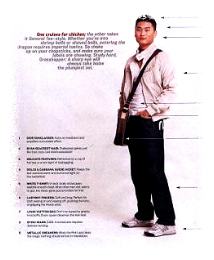
In its May 2004 issue, Details magazine included a piece entitled “Gay or Asian,” as another installment of their “Gay or __” series. Purporting to be an “anthropology” piece, the author, Whitney McNally, writes such things as “Whether you’re into shrimp balls or shaved balls, entering the dragon requires imperial tastes” and “Ladyboy fingers: Soft and long. Perfect for both waxing on and waxing off, plucking the koto, or gripping the kendo stick.”
Naturally and almost immediately after it was circulated, the Asian American and gay communities reacted with outrage, describing the piece as a tasteless, insensitive, and hurtful example of all the worst cultural stereotypes against both Asian Americans and gays. Similar to the reactions against the Fox tv show Banzai and the Abercrombie & Fitch t-shirts, several Asian American community groups, led by Asian Media Watchdog, quickly organized a campaign demanding that Details magazine recall all issues, issue a formal apology, and fire the author.
They conducted a well-attended and well-publicized protest outside of Details‘ offices on April 16. You can read about the results of the protests in detail, but it appears as though it was quite a success. They succeeded in speaking with the Editor-in-Chief of the magazine, along with other representatives of the company and in getting most of their demands met, including an official apology from Details.
These series of events once again show (1) that many groups in society (especially media outlets) still apparently feel that Asian Americans are ripe targets for sterotyping and demaning portrayals and underestimate our collective outrage, and (2) when Asian Americans unite and fight against these blatantly racist and homophobic portrayals, we can move mountains.
As we shatter the myth that Asian Americans are apathetic or powerless, we give American society a first-hand example of the kind of power we can generate as a collective community and that they we are not going to sit idly by when others try to portray us against in whatever way they want. Bravo to everybody involved!
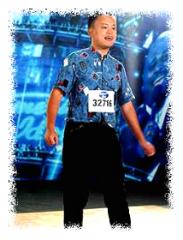
William Hung is a college student at U.S. Berkeley, majoring in engineering. Several months ago, he decided to appear on the tv show “American Idol,” singing Ricky Martin’s song “She Bangs.” The problem is, William can’t really sing that well. Combined with the Simon Cowell’s famous reputation for being blunt, the results were rather predictable. As expected, Simon ridiculed William by telling him, “You can’t sing, you can’t dance, what do you have to say for yourself?”
William’s response was basically, “I did my best and I have no regrets.” The public’s response to William since then has been anything but predictable. Literally overnight, William became an instant celebrity, not for his singing, but for his upbeat attitude and honest and genuine attempt to do something he always wanted to do, no matter who thought he was good enough to do it or not.
Since then, he has been signed to a record contract and now appears on his own music CD, has been written up and featured in several major media outlets, and has made appearances on such tv shows as The Tonight Show and the Jimmy Kimmel show.
However, not all Asian Americans have been enamoured by all this attention William has been getting. Some have started to question whether all this notoriety and publicity that he’s received is a genuine expression of appreciation and inspiration, or if it’s a form of ridicule and public humilation — sort of like a clown or freak show being paraded around for people to laugh at and that he’s reinforcing the image of Asians as geeky and nerdy.
In response, others have defended William as someone who’s not afraid to just be himself — flaws, quirks, and all. They also point out that in criticizing William and feeling embarrassed by him, his detractors seem to be wrestling with their own images of Asian masculinity, not William’s image of himself.
Where do I stand? As I’ve described repeatedly throughout Asian-Nation, both Asian and non-Asians cannot expect all Asian Americans to be alike — there is just too much diversity within our community as they apply to demographics, culture, politics, socioeconomic attainment, etc. That includes people (or more specifically cultural images) such as William.
Are some APAs embarrassed by him? Sure. I personally can’t tolerate more than about 15 seconds of his singing before I cringe. But is he doing a disservice to the APA community? I don’t think so. Rather than expecting all Asians to be the same, we should embrace the diversity within our community, even as we disagree on its ultimate meaning.
On January 31, 2004, as the Iowa City Press Citizen reports, second-year University of Iowa law student Janis Chang and her White boyfriend were attacked by four White male UI college students who yelled racial slurs at them, called her a “chink” and her boyfriend a “chink lover,” and made monkey sounds at them.
As the couple tried to walk away, both were attacked and Chang’s boyfriend was repeatedly hit and kicked in the head. Weeks after the attack, he is still coughing up blood, is unable to eat, speak, or sleep well, and Chang is still too traumatized to return to class. The Iowa City police department is still investigating the incident and will likely turn over its evidence to prosecutors soon so that they can determine what, if any, charges to bring against the assailants.
As news of this hate crime became publicized, it turns out that racially-motivated incidents like these were just another example of how Asian American college students at the University of Iowa and elsewhere continue to be targets of racial slurs, intimidation, and acts of violence in and around campus.
Beyond the fact that White males are now being targeted for being in interracial relationships, what makes these events even more worse is when university administrators are slow and ineffective in first reacting to the specific incident at hand and second, at addressing the causes of these incidents in general. Many times these causes involve how Asian American students and other students of color are made to feel marginalized on these predominantly White college campuses.
In this case, we don’t even know if the prosecutors are going to charge the assailants with any kind of hate-cime related crimes, even though that’s clearly the case. If the prosecutors don’t bring hate crimes charges against the attackers (or any charges at all!) or if the university fails to discipline the attackers, it will stand as another example of how our country’s principle of “equal protection under the law” is only selectively applied to certain privileged groups.
If there is no justice in this case, there will be hell to pay, one way or another.
CBS News reports that the City Council of San Mateo, California, has issued a temporary ban on the use of private rooms in karaoke bars, arguing that drug use, gambling, and prostitution are rampant in these private rooms.
Naturally, the karaoke business owners are up in arms about the ban and argue that just because some isolated incidents of illegal activity occurred in these types of places, that does not mean that a whole group has to pay the price for the actions of a few.
The owners are absolutely right. I’ve said it before — you cannot condemn an entire group of people because of the actions of one or a few individuals who are identified with that group. That is called discrimination and racial profiling, plain and simple. What makes this case even more interesting is that one quarter of San Mateo’s population are Asian American, part of an emerging demographic trend in California of upscale and affluent Asian American suburban enclaves.
It makes me wonder whether this ban by the City Council members (most of whom are White, I presume) is a conscious or unconscious form of backlash against the belief that Asian Americans are “taking over.” Update: In early March, city officials apparently ended the ban (although with some stipulations) after much protest from the Asian American community and accusations that they were being culturally insensitive. Moral to this story: don’t punish an entire group for the actions of a few — that’s called scapegoating.
The President recently unveiled a plan to reform the U.S.’s immigration laws to allow undocumented workers to stay in the U.S. as “guest workers” in jobs that U.S. workers do not want, for a period of three years, during which time they could also apply for a green card and become a permanent resident. I find this is to be a very interesting political situation because of all the different competing factions that have an interest in this proposal.
Specifically, conservatives and Republicans seem to be split on this proposal — many say that in effect, this plan would offer amnesty to illegal aliens and would reward those who came here illegally and technically, are therefore criminals. On the other hand, businesses strongly support such a plan, which would enable them to continue paying their largely Mexican workers less money than American workers, and would free them from worrying about their workers’ legal statuses.
Of course the Democrats, who are traditionally strong supporters of immigrants’ rights, don’t think the plan goes far enough. They feel that regardless of someone’s legal status, if that person has been law-abiding and has contributed to the nation’s economy through hard work and paying taxes, s/he should be allowed the opportunity to become a legal permanent resident and eventually a U.S. citizen. Recent public opinion surveys show that most people do not support Bush’s plan — many think that immigrants take jobs away from U.S. workers and that too many immigrants come to the U.S. each years.
How does this plan affect APAs? At first glance, it doesn’t appears that it affects them much at all, since very few are here illegally, at least not compared to the proportion of immigrants from Mexico and Central America who are undocumented. However, many Asian businesses owners would probably benefit under this plan, since many of them employ large numbers of low-wage Latino workers. At the same time, several APA organizations have criticized the plan for not addressing backlog of family reunification immigration applications, which tend to be more important to the APA community.
My personal opinion? While I support the concept of granting “amnesty” to undocumented workers, I think the specifics of his plan would in effect, create a permanent underclass of low-wage workers whose legal status will still remain in limbo. Perhaps not surprisingly, I support the Democrats’ proposals of granting them amnesty and giving them the opportunity to become American citizens.
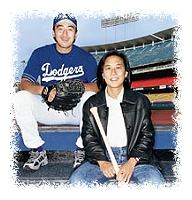
Bill Singer was (emphasis on “was”) a special assistant for the New York Mets until he directed some racist remarks at Kim Ng, an Asian American executive for the Los Angeles Dodgers, formerly employed by the New York Yankees, and widely respected as the most powerful Asian American in baseball. As this article from the A.P. via Yahoo describes, Singer repeatedly asked Ng “Where are you from?” even after Ng said that she was born in Indiana and grew up in New York and then Singer mocked the Chinese language by blurting out the all-too-familiar “ching-chong” sounds.
Sadly, this kind of racist treatment happens all too frequently against Asian Americans in the workplace, whether it’s in an ordinary office environment or in this case, among high-profile baseball executives. I commend the New York Mets for reacting swiftly and decisively in firing Singer, especially after Singer gave the pretty laughable excuse that he was slightly delirious due at the time, due to being on a low carb diet combined with a little too much alcohol. All I can say is that he absolutely deserved it — what an idiot.
Apparently he had no clue that he worked for a team located in perhaps the most multicultural city in the world, its stadium located right next door to one of the largest Chinatowns in the country, and in a sport that is increasingly welcoming Asian baseball players into its ranks. Major League Baseball teams have fired or severely disciplined many other people for racist comments against Blacks and it makes perfect sense that the same consideration is given to Asians in baseball as well.
David Chang, a Chinese American entrepreneur, had an idea that he could create a version of the classic board game Monopoly, except his version is centered on an inner-city ghetto theme and features caricatures of Blacks holding sub-machine guns, bottles of malt liquor, crack houses, prostitutes, etc. Needless to say, his idea of “fun and games” touched off an overwhelming torrent of criticism and charges of racism.
After being bombarded by protests, Urban Outfitters, eBay, and Yahoo! recently decided to pull the game from their shelves and sites. Recently, Hasbro (the company who makes the original Monopoly) filed suit against David Chang for copyright and trademark infringement.
David Chang claims to be completely surprised by all the criticism and says that he is trying to unite racial/ethnic groups together in laughter while exercising his rights to free speech at the same time. Unfortunately, he apparently doesn’t understand that in the same way that he can express his views, we also have the right to tell him what a dumb ass ignorant idiot he is.
It’s been gratifying to see that people, groups, and organizations of all races and ethnicities have united to condemn this game and its reinforcement and perpetuation of demeaning stereotypes. This collective outrage also shows that just because one Asian American does something wrong and stupid does not mean that our entire community is somehow behind it and should be blamed for his actions, a lesson that a Black radio show host learned recently after telling her listeners to call in with demeaning racial slurs for Asians in support of her idea for a “Chinkopoly” game as a protest response to Ghettopoly. Fortunately, she apologized soon after making those comments.
The lessons here are: (1) being Asian American does not give you the right to demean and slander other groups of color and, (2) the acts of one person should not be blamed on an entire community.