The views and opinions expressed on this site and blog posts (excluding comments on blog posts left by others) are entirely my own and do not represent those of any employer or organization with whom I am currently or previously have been associated.
Academic Version: Applying my personal experiences and academic research as a professor of Sociology and Asian American Studies to provide a more complete understanding of political, economic, and cultural issues and current events related to American race relations, and Asia/Asian America in particular.
Plain English: Trying to put my Ph.D. to good use.
Have you ever really thought about what exactly does being an “American” mean? What does that identity include, or not include? A new study finds that for many Americans, behavior is more important than origin:
Ninety-four percent say that having US citizenship makes someone “truly American.” Also more than 9 out of 10 people report that speaking English well and a willingness to pledge allegiance to the flag are important in defining someone as truly American. Seventy-six percent said that having an education and training matters.
But those answers do not include what has been central in the past. For example, 70 percent said it was not important that one’s ancestors came mostly from Europe to be considered American, while 30 percent said it was. . . .
Yet the public was split over some issues, including religion. The fact that 39 percent strongly agree that being a Christian makes a person more American while 32 percent strongly disagree leads Straughn to conclude that religious divisions have become more apparent in recent decades. . . . Nonetheless, a solid majority, 86 percent, believes immigration improves America with new ideas from different cultures.
So apparently (and in very simplistic terms), Americans generally have become more accepting of multiculturalism, just as long as everybody is Christian. The bottom line seems to be that religion has emerged as the most prominent social division in American society, much more so than race, ethnicity, nationality, social class, or immigrant status.
In other words, we’ve just traded one form of difference for another . . .
For the first time in history, the largest racial/ethnic group admitted to the University of California universities were Asian American — even surpassing the number of Whites admitted:
Asians account for 36 percent of California residents admitted to study at UC schools, though they make up only 14 percent of seniors projected to graduate from the state’s public high schools. By comparison, white students comprised 35.6% of those accepted; Latinos, 17.6%; African-Americans, 3.4%; and American Indians, 0.6%. . . .
College counselors say Asian parents tend to focus on UC because it’s affordable, prestigious and offers high value for the cost. Asian students also applied to UC schools at higher rates than other students and are more likely to enroll if admitted, officials said.
UC staff, faculty and administration remain largely white, despite the changing student body, said L. Ling-chi Wang, chairman of UC-Berkeley’s ethnic studies department. He also said campus services, such as counseling and cultural activities, have not shifted to reflect the growth in numbers of Asian students.
While proud of Asian students — “they should be rewarded for working hard,” he said — Wang worries about the loss of diversity on campus. “I personally enjoy teaching classes that have a good mix of races. It is more enriching and challenging to have a diversity of backgrounds,” he said.
While this is certainly a clear indication of how much Asian Americans have succeeded in terms of becoming an integral part of the U.C. system, Prof. Wang brings up a very good point — at what point do Asian Americans become too numerous and therefore, a hindrance to the goal of promoting racial/ethnic diversity?
In fact, this argument against the rising presence of Asian Americans on college campuses has been used before to limit the number of Asian American admittees in the late 1980s and early 1990s. These incidents resulted in a big backlash against many universities around the country (including some U.C.’s) by Asian Americans and to the conclusion by many observers that Asian Americans, like Whites, were now victims of affirmative action.
There is no easy answer here, but again Prof. Wang notes that what the U.C. system should do is not to go back to what they tried in the late 1980s and artificially limit the number of Asian admittees. Rather, in trying to achieve racial/ethnic diversity, the U.C. system needs to open more campuses to meet the overwhelming demand among students, and to reach out to groups that are still underrepresented, such as Blacks, American Indians, and Latinos.
In other words, college admissions does not have to be a zero-sum proposition — there can be plenty of opportunities to go around if the proper steps in that direction are taken.
About a year ago, the Chinese high tech company Lenovo bought IBM’s famous computer business unit and along with it, IBM’s much-heralded ThinkPad series of notebook computers. There were some apprehensions about a Chinese company acquiring a major U.S. company’s high tech assets, but the deal was finalized without much of a hassle.
Now however, many consumers are becoming more wary of purchasing IBM/Lenovo computers now that they know it’s made by a Chinese company. Is this an example of ethnocentric stereotypes against the Chinese (and by implication, against Asians and Asian Americans in general)? You be the judge:
Lenovo has still not gained the mindshare or the respect that the ThinkPads command. In fact, it has, to some extent, alienated ThinkPad’s fans and taken a sales hit. In my immediate vicinity, those who owned ThinkPads have now traded up to an HP or a Toshiba. None of them went back to their ThinkPads.
After asking for a clarification, I was told, “Who wants to buy things from a Chinese company?” Clearly, this isn’t a sensible answer and is derived emotionally (subjectively) than objectively, but could you really blame them? And there in lies Lenovo’s problem.
China today is synonymous with inexpensive labor and average quality workmanship (similar to the way Japan was portrayed in consumer electronics decades ago until it changed its image). Similarly, no one wants to purchase anything consumer electronics related that’s made in China and is sold by a Chinese company.
The article does note that Japanese companies had this perception problem up until about 20 years ago. Since then, Japanese electronics are now generally considered superior to American electronics. Similarly, is this perception against Chinese computers (and other Chinese consumer goods) likely to eventually change with time?
Or is the situation different now because China is a communist country and also a military and political rival (not just economic as Japan was) with the U.S.? India is in a somewhat similar position as an emerging economic power but Americans generally don’t have the same kinds of suspicions about India that they do about China because India isn’t considered a military threat by the U.S.
On the one hand, I would say that since China insists on engaging in many forms of repression and human rights abuses at home, their international reputation is inevitably going to take a hit, as are their economic prospects, illustrated by their current struggles selling Lenovo computers.
On the other hand, it bothers me that Americans are apparently so quick to dismiss a Chinese computer manufacturer, based almost entirely on biased perceptions — the kind of biased perceptions that can easily be transferred over to other Asians and to Asian Americans.
We all know that Japan, South Korea, and Taiwan are known for their high tech industries. China and India are trying to get there as well. Should we include Viet Nam in that group as well? There are signs that Viet Nam has plans to become the next Asian high tech country:
Although Vietnam has a long and hard road to try and catch up to the likes of other Asian powerhouse countries, workers from the nation want readers to be on the lookout. Ho Chi Minh City now has around 100 software companies that have at least 50 employees.
In 2002, there were only around 7,000 employees in the software industry, with the number now up to around 32,000. Some Vietnamese workers that live and train in Silicon Valley are now heading home to Vietnam to start businesses and further train natives with emerging technologies.
This last blurb about Vietnamese Americans “returning home” to Viet Nam to develop transnational business enterprises is in line with my earlier posts about how many Vietnamese American entrepreneurs see “the motherland” as their next source of business opportunities. In other words, you might say that this is transnationalism and globalization at its best.
Nonetheless, unlike Japan, South Korea, Taiwan, or India, Viet Nam is controlled by a totalitarian regime that tightly regulates the economy and economic development in the country. But so does China, and they’re well on their way to becoming the next Asian high tech superpower. Will Viet Nam join them in the future? We’ll have to check back in ten years or so to find out.
By now, I’m sure you’ve heard about the massive demonstrations organized and led by Latinos around the country protesting unfair and punitive legislation being proposed to deal with the illegal immigration issue. So where do Asian Americans fit in? Although the Pew Hispanic Center reports that 78% of illegal immigrants are Latino, 13% are Asian, many of whom have different issues to deal with:
While some Asian, European and Middle Eastern immigrants are supporting calls for sweeping immigration reform, many who are here illegally have shied from the public debate either because they feel Congress has overlooked needs specific to their communities or simply because they’re afraid to come forward.
Of the estimated 11 million illegal immigrants, fully 78 percent come from Latin America, according to the Pew Hispanic Center. The next largest undocumented population comes from Asia, with 13 percent. While all illegal immigrants could benefit from proposals in Congress that would give them a chance at citizenship, many non-Hispanic immigrants say lawmakers should take into account their reasons for coming to the country illegally.
The article notes that many Asian illegal immigrants came here as students who then overstayed their visas. It also notes that for many Asian immigrants, their biggest priority concerns being able to reunite with their parents who may be left behind as quickly as possible. Interestingly, an LA Times article nonetheless notes that many anti-immigration groups consider chain migration and family reunification immigration to be an even bigger problem than illegal immigration.
Although Asian immigrants (legal and illegal) may have slightly different priorities from Latinos, I hope that we can recognize that we do share many goals in common — humane treatment for immigrants who come to work and stay out of trouble and a fair opportunity to contribute as citizens of the strength of American society, to name just a few.
In other words, immigration reform is not a Latino issue, nor an Asian issue — it’s a human rights and civil rights issue.
In my daily read of AutoBlog (a blog about automobiles) I saw a post mentioning that Garmin is coming out with a StreetPilot portable GPS device that is targeted to Asians in North Americans and will be able to give voice directions in five Asian languages. As expected, there were comments from other AutoBlog readers deriding the driving abilities of Asians, but actually most came from other Asians:
Now if only it would drive for them. I keed, keed…my mom is one of those horrible old Asian woman drivers.
I’m so sick of Asian/Woman Driver jokes. We are all horrible drivers at some point, and I can guarantee it has nothing to do with RACE. Distraction and exhaustion would more likely be the cause of poor driving.
It’s no joke here in the Bay Area. 90% of the road incidents I have are because of Asian women drivers. Hey man, I’m Asian and so is my mom, and it sucks there’s that stereotype. But every single Asian woman, at my mom’s age, is a crappy driver. That’s a fact, not a joke or a stereotype.
Anyone who said anything bad about Asian drivers should actually try to drive in an Asian city, especially large ones like Taipei or Dehli. I doubt any one used to American pussy-ass traffic can survive even for a few minutes.
Any old lady in the world would drive ridiculously slow.
So the question becomes, are Asian drivers worse than other drivers, even after controlling for age, etc.? And how do their driving abilities compare to drivers in densely populated Asian cities where it’s the norm to completely disregarding traffic laws? Does being able to safely navigate your way through that chaos constitute good or bad driving?
Perhaps more important, if many Asians agree that Asians tend to be bad drivers, does that mean that it’s no longer a hurtful stereotype about Asians?
I was surprised to recently learn that apparently, in California getting caught street racing is only a misdemeanor (i.e., there’s generally only a fine associated with it). However, as the phenomenon of street racing (and the injuries and deaths because of it) continues unabated, new legislation is being proposed that would reclassify street racing as a felony:
AB 2190, by Assemblyman John Benoit, R-Palm Desert, also would set a minimum prison sentence of four to 10 years for drivers found guilty of causing someone’s death in an illegal street race. “If you’re caught street racing for the first time now, and you have an accident and cause someone to be paralyzed for life, it’s a misdemeanor,” said Benoit. . . .
Nine people have been arrested for street racing so far this year, according to the California Highway Patrol’s Santa Fe Springs office. Last year, 7,640 California drivers were convicted on engaging in speed contests, a 9 percent jump from 2004, Department of Motor Vehicles statistics show. Street racing caused nearly 500 accidents and more than 40 deaths since 2001, according to DMV figures.
“Street racers migrate to business areas that don’t have traffic at night,” said CHP Sgt. Matt Boothe of the Santa Fe Springs office. “Younger drivers have an invincibility complex and think these things will never happen to them.”
I have written previously about my admiration for certain aspects of the import racing/sport compact/tuning scene and how its creation and rise in popularity can largely be attributed to young Asian Americans. Nonetheless, I absolutely support this proposed legislation that would reclassify street racing as a felony and stiffen the penalties against it.
I believe that there is a time and place for everything. It’s one thing to have a souped-up, highly modified car that you’re proud of. It’s another to risk the lives of innocent bystanders in a reckless show of bravado. As the article mentions, there are legal venues to show off your work of art where there is little if any risk to other people.
To use one analogy, you might be proud of your new rifle that you just got, but you don’t have to shoot your dog in order to impress your friends. In other words, with (horse)power comes responsibility.
Everybody should know by now that despite its historical legacy and rhetoric, China is not a true communist society — it’s a society controlled by a totalitarian regime. However, as China slowly lurches forward into the 21st century, it is inevitably beginning to confront the first instances of citizen power and grassroots democracy:
Ms. Liu’s experience, all but unimaginable as recently as two or three years ago, is increasingly common in China, where a once totalitarian system is facing growing pressure from a population that is awakening to the power of independent organization.
Uncounted millions of Chinese, from the rich cities of the east to the impoverished countryside, are pushing an inflexible political system for redress over issues from shoddy health care and illegal land seizures to dire pollution and rampant official corruption. . . .
China’s leaders seem to be of two minds in confronting the trend. Predictably enough, many warn of the dangers an independent civil society poses to the authority of the state. But there are others who now recognize, however tentatively, that the government cannot deal effectively with every issue without contributions from advocates, civic organizations and intellectuals.
On the one hand, it is truly sad and rather pathetic to see a government that was supposed formed to advocate the needs and issues of the working class and the poor in the past, instead take such violently punitive actions to repress these same groups of people today. On the other hand, it is encouraging to see that ordinary citizens are increasingly becoming confident in their powers and not being intimidated by the government.
How ironic that ordinary Chinese citizens have to take it upon themselves to demonstrate to the communist government what people power and civic advocacy really looks like.
As the 2006 Major League Baseball season gets underway, AsianWeek Magazine has a feature that briefly profiles the current list of major league players from Asia playing in the U.S. this season:
Japanese: Kenji Johjima (CA, Seattle Mariners), Ichiro Suzuki (OH, Seattle Mariners), Hideki Matsui (OF, New York Yankees), Tadahito Iguchi (2B, Chicago White Sox), Kazuo Matsui (2B, New York Mets), Akinori Otsuka (RP, Texas Rangers), So Taguchi (OF, St. Louis Cardinals), Toma Ohka (SP, Milwaukee Brewers)
Taiwanese: Chien-Ming Wang (SP, New York Yankees)
Korean: Chan Ho Park (SP, San Diego Padres), Hee-Sop Choi (1B, Boston Red Sox), Jae Seo (SP, Los Angeles Dodgers), Byung-Hyun Kim (RP, Colorado Rockies), Sunny Kim (RP, Colorado Rockies)
Chinese: Bruce Chen (SP, Baltimore Orioles)
On the one hand, it’s nice to see that Asian players in Major League Baseball are not an oddity or rare sight any longer, and that they have been integrated into the sport for the most part. On the other hand, I lament that there are still virtually no Asian American ballplayers in the major leagues right now, except for Vietnamese Amerasian Danny Graves (RP, Cleveland Indians).
Hopefully that situation will change soon but in the meantime, it will be nice to root for these Asian players (except when they’re on my opponent’s team in my fantasy baseball league, of course).
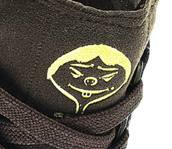
Adidas has a new limited-edition sneaker that features artwork by a half-Chinese graffiti artist. The problem is that the artwork on the shoe is a stereotypical caricature of an Asian with a bowl haircut, narrow slanted eyes, and buck teeth. This has led to a lot of debate over where the line between art and racism lies:
The character on the shoe is the creation of a San Francisco graffiti artist, Barry McGee, who is half Chinese. McGee, who calls the character Ray Fong after an uncle who died, said the image is based on how the artist looked as an 8-year-old. “You have to look at it as a piece of artwork,” said McGee, 40, who used Ray Fong as a graffiti tag in the late 1990s and later in art installations and catalogue covers. . . .
The controversy also addresses the issue of removing a potentially subversive image from the context of art and introducing it into the world of commerce, where there is no means to indicate that the image may be a wry commentary on stereotypes, rather than perpetuation of the stereotype itself.
“We live in such a cynical, postmodern society that if you are offended by something like this, people say, ‘Lighten up, it’s ironic, it’s a joke.’ And that’s really nice if you’re a student of art history,” [Frank] Wu said. “But how many 10-year-olds talk about irony? When you get teased, it doesn’t make it any better to know that they’re also calling it ironic. It sends the message that it’s hip to make fun of Asians.”
As always, Professor Wu has summed up the crux of this controversy quite nicely. In other words, it’s clear that the artist meant it as a piece of art. Nonetheless, for whatever reasons, he is apparently completely ignorant of the fact that this particular image has a painful historical legacy behind it that is associated with prejudice, intolerance, and racism against Asian Americans.
As this episode shows, there can be a very thin line between art and racism but in this case, the line was clearly crossed. With freedom of expression, there is also social responsibility. To use such a polarizing image that many people find offensive without any kind of historical or cultural context is irresponsible and therefore, racist.
In a land of over 1.3 billion people and hundreds of millions of Internet users, how does China manage to censor so much information being exchanged through websites, forums, and email? CNN has a special feature that illustrates the specific ways and mechanisms China’s communist government uses to accomplish all of that censorship:
E-mail is filtered by service providers. The method is based on the same technology that blocks spam. Body text and subject lines are scanned and blocked if anything objectionable is found. . . . Chinese search engines monitor content by keyword and remove offending Web sites.
When people request banned content through Chinese search engines like Baidu and Yisou, the filtering system disconnects them. Blogs, discussion forums, and bulletin boards are very popular in China. They’re heavily filtered by keyword blocks. Blogs’ service providers do not let posts with certain words be published, and blogs are also censored manually.
As the feature shows, censorship is serious business for the Chinese government, who are aided by foreign companies (most of the biggest ones like Yahoo, Microsoft, and Google, are American) in an elaborate method of controlling access to information. These companies have been under intense scrutiny by the federal government, but I seriously doubt that human rights will win over capitalism in this case.
This level of systematic repression and totalitarian control is almost breathtaking in its size and scope.
I wrote previously how, in the growing battle against methamphetamines, some law enforcement officials in Georgia have been accused of singling out South Asian-owned stores for sting operations. This week, the ACLU has made those allegations formal by filing suit against Georgian law enforcement, charging them with racial profiling and taking advantage of the South Asians’ lack of English fluency:
The A.C.L.U. said yesterday that prosecutors ignored extensive evidence that white-owned stores were selling the same items to methamphetamine makers and focused instead on South Asians to take advantage of language barriers. The sting sent informants to convenience stores in six counties in rural northwest Georgia beginning in 2003 to buy ingredients that can be used to make the drug — ordinary household items like Sudafed, matches, aluminum foil and charcoal.
Prosecutors said the clerks should have known that the ingredients would be used to make methamphetamine because the informants who bought them said they needed the items to “finish up a cook,” slang for making the drug. But several South Asians said they believed that the informants were talking about barbecue. Forty-four of the 49 people charged were Indian, and 23 out of 24 stores in the sting were owned or operated by Indians. . . .
Of the 629 convenience stores in the six-county area in the sting, 80 percent are owned or operated by whites, according to the A.C.L.U.’s court filing, but fewer than 1 percent of the stores in the sting are white-owned or operated. The filing said the clerk at the only white-operated store was known widely as a methamphetamine addict whose husband was in prison for making the drug.
If this isn’t a blatant case of racial profiling, I don’t know what is. This is the kind of prejudice and discrimination that still exists against Asian Americans that makes my blood boil. Clearly the law enforcement officials felt that the South Asian store owners and workers were an easier target because of their lack of English fluency.
I also suspect there was some racial prejudice involved as well, since law enforcement in the south does not have a good reputation when it comes to being sensitive to the issues of people of color through the years. Whatever the case may be, I can only hope that the ACLU and racial justice prevails in this case and the racial profiling is exposed for the blatant racism that it is.
People of color in this country (and all around the world for that matter) should be outraged at this example of racial profiling.