The views and opinions expressed on this site and blog posts (excluding comments on blog posts left by others) are entirely my own and do not represent those of any employer or organization with whom I am currently or previously have been associated.
Academic Version: Applying my personal experiences and academic research as a professor of Sociology and Asian American Studies to provide a more complete understanding of political, economic, and cultural issues and current events related to American race relations, and Asia/Asian America in particular.
Plain English: Trying to put my Ph.D. to good use.
In a recent post titled “The Degrees of Immigrant Bashing,” I described various ways in which the recession has led to increased anti-immigrant hostility, leading to blatantly offensive comments from public officials, acts of violence and hate crimes, and misguided federal regulations. As a follow up, blogger Michelle Waslin at Immigration Impact writes that, perhaps ironically, the recession seems to have resulted in fewer anti-immigrant proposals and legislation being passed this year at the local and state levels:
According to the Progressive States Network (PSN), budget deficits have meant that states are unwilling to pass legislation with a cost attached. Immigration is less of a wedge issue in 2009—that is, politicians seem less willing to push anti-immigrant platforms because candidates who did so in the 2008 elections lost.
PSN also reports that anti-immigrant legislators have been marginalized in 2009. Bills introduced by Texas State Rep. Leo Berman, a notorious anti-immigrant voice, got no traction, even from within his own party. No votes were taken on any of his 9 anti-immigrant bills. In Arizona, State Senator Russell Pearce has had little success with his anti-immigrant agenda this year. An Arizona Republic editorial criticized Pearce for devoting time and energy to immigrant-bashing instead of doing the real work that needs to be done on the state budget. Even Prince William County, Virginia Executive Corey Stewart—well known for his anti-immigrant rhetoric—has backed down, acknowledging that problems other than immigration deserve more attention. . . .
It is clear that vehement anti-immigrant legislation is not as fashionable as in past years. These measures have proven to be too expensive and ineffective, Americans care more about real solutions than scapegoating and rhetoric, and anti-immigrant politicians have not been successful on election day.
It’s encouraging to see that most politicians (apparently on both sides of the ideological divide) recognize that indeed, there are many more important issues these days than demonizing and dehumanizing immigrants, legal and undocumented. I also believe that many of them also understand that in this current recession, immigrants — again legal or undocumented — can make significant contributions to the American economy if given the chance.
That is, while many immigrants are disproportionately affected by these tough economic times, if they’re allowed to stay in the U.S., many are more than willing spend their income to help support local businesses, pay federal income and social security taxes, and state sales and gas taxes, to name just a few examples. This is especially true in immigrant-heavy states and cities such as California and Texas, that are being hit especially hard during the recession.
In other words, at a time when our country is struggling, we need everybody to pitch in and help out, regardless of their race, ethnicity, skin color, or immigrant status.
You might be interested to read the following posts from June of years past:
2008: Disneyland: A Metaphor for Fitting In A family outing to Disneyland highlights some of the issues that Asian Americans face when it comes to whether or not we’re part of the American mainstream.
2007: Eating Disorders Among Asian Americans Examining the pressures faced by Asian American women to look ‘western’ and how globalization might affect these trends in the 21st century.
2005: 49ers Video Promotes Anti-Asian Stereotypes Analyzing the controversy over a comedy skit produced by the San Francisco 49ers professional football team that many Asian Americans have criticized as racist.
It’s a well known and documented fact that in almost all Asian cultures, boys are systematically valued more than girls. Based on centuries of institutionalized patriarchy and traditional cultural practices, most Asian families would rather have children who are boys than girls. This gender bias is one of the reasons why an overwhelming majority of children given up for adoption in Asian countries are girls. This bias has also led to growing gender imbalances in many Asian countries, with some analysts predicting that such a gender imbalance may evolve into a threat to national security as this overpopulation of males become adults.
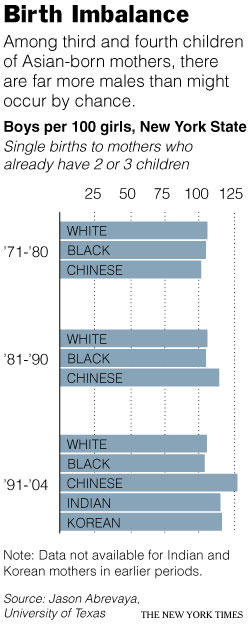
Here in the U.S., we might think that things are different among Asian Americans. That is, being a part of American society and within its social norms of gender equality, Asian Americans would have more “modern” views about the value of boys and girls so that there would not be any kind of systematic preference of one gender over another when it comes to our children. However, as the New York Times reports, recent Census data shows that at least among Indian Americans, Chinese Americans, and Korean Americans, there is a notable gender imbalance among their children in which boys are much more common than girls:
In general, more boys than girls are born in the United States, by a ratio of 1.05 to 1. But among American families of Chinese, Korean and Indian descent, the likelihood of having a boy increased to 1.17 to 1 if the first child was a girl, according to the Columbia economists. If the first two children were girls, the ratio for a third child was 1.51 to 1 — or about 50 percent greater — in favor of boys. . . .
Demographers say the statistical deviation among Asian-American families is significant, and they believe it reflects not only a preference for male children, but a growing tendency for these families to embrace sex-selection techniques, like in vitro fertilization and sperm sorting, or abortion. . . .
Dr. Norbert Gleicher, medical director of the Center for Human Reproduction, a fertility and sex-selection clinic in New York and Chicago, said that from his experience, people were more inclined to want female children, except for Asians and Middle Easterners. . . . The Fertility Institutes, which does not offer abortions, has unabashedly advertised its services in Indian- and Chinese-language newspapers in the United States. . . .
Efforts by clinics to appeal to Indian families in the United States provoked criticism and some community introspection in 2001. Some newspapers and magazines that ran advertisements promoting the clinics, which offered sex-selection procedures, expressed regret at the perpetuation of what critics regard as a misogynistic practice.
This emerging gender imbalance and “son-biased” sex ratio (illustrated in the accompanying New York Times graphic on the right) seems to reflect one fundamental point — that many Asian Americans still have very direct and strong family and cultural connections to their ancestral country. These traditional cultural ties can manifest themselves directly in the form of Asian immigrants still having the “son is superior” mentality that leads them to favor having boys more than girls.
Or, as the New York Times article also mentions, the other way that these traditional cultural ties become exemplified can be that even younger Asian American immigrant couples accept the U.S.’s norms of gender equality, various pressures from family, relatives, or friends in their ancestral Asian country lead them to favor boys over girls. As one example of this, perhaps couples in this situation have parents in the home country who will only give inheritance to male descendants and not female ones.
Ultimately, these demographic patterns (at least among Indian Americans, Chinese Americans, and Korean Americans) show us that the connections between Asia and America run deeper than just geographic distance.
That said, we should also recognize that this article and research studies that provide the basis of these demographic trends all note that these findings seem to be limited to Asian immigrant couples in which both spouses are foreign-born. In other words, there does not seem to be any data or evidence that this trend exists among Asian American couples in which both spouses are U.S.-born.
This last point goes to show just how powerful a force American assimilation is in the lives of most Asian Americans.
Racial hatred and the extremist ideas behind White supremacy are not new. As my friend and fellow sociologist Rory McVeigh writes in his new book The Rise of the Ku Klux Klan: Right-Wing Movements and National Politics, hate groups come in all forms, sizes, and levels of formal organization and have played a role in American race relations for over a century.
However, with the election of Barack Obama as our first non-White President, the current recession and economic insecurities confronting many Americans who had been comfortably middle-class up to this point, and the continuing uncertainty of institutional trends such as globalization and demographic population changes, many Whites understandably feel a little destabilized these days.
It is within this context that many Whites see an opportunity to rail against what they perceive to be the “invasion” or “taking over” of their country by those who are different from them — immigrants and non-Whites. Most recently, this has taken the form of post-election racial incidents and of subtle and non-so-subtle forms of immigrant bashing.
But as many sociologists such as my blogging colleague Jessie at Racism Review and other observers point out, this upsurge in racial intolerance is different because with the advent of internet technology and the proliferation of social networking websites, the message of White supremacy is being broadcast much more widely to a growing audience of White Americans feeling destabilized. The following video report from ABC News last year summarizes this emerging trend (about 3 minutes long):
A recent MSNBC article goes into more detail about this trend of racial/religious extremists using internet and social networking websites to spread their message of intolerance:
Militants and hate groups increasingly use social networking sites such as Facebook, MySpace and YouTube as propaganda tools to recruit new members, according to a report by the Simon Wiesenthal Center. The report released on Wednesday noted a 25 percent rise in the past year in the number of “problematic” social networking groups on the Internet. . . .
Rabbi Abraham Cooper, associate dean of the center, said Facebook recently removed several Holocaust denial sites, including one that featured a cartoon of Adolf Hitler in bed with Anne Frank, whose diary written in hiding from the Nazis in Amsterdam is among the best known stories of the Holocaust. . . . He pointed out a YouTube user whose racist content has caused his postings on the site to be taken down repeatedly, but he simply creates a new user profile, or channel, and posts the material again.
Extremist groups are also setting up their own social networking sites, the report said, picking out one called “New Saxon,” described as “a Social Networking site for people of European descent” produced by an American Neo-Nazi group called the National Socialist Movement. Other groups have created online games such as one created by an Iranian organization and called “Special Operation 85 — Hostage Rescue,” and one called “Border Patrol” in which the player has to shoot Mexicans, including women and children, as they try to come over the border into the United States.
I’m not here to say that we should ban or further restrict such websites or other forms of internet, communication, or media technology just because they allow people to spread messages of hate and intolerance more easily than would otherwise be possible (although I urge the administrators of such sites and internet services to take quick and decisive action to remove such blatantly offensive material, as per their stated policies). In other words, the technology itself is not to blame — it’s how technology is used.
With that in mind, I hope that those of us who oppose such racial and religious intolerance will make full use of such websites and technologies to counteract messages of hate with our own messages of understanding, tolerance, acceptance, and peace. This very site is my own attempt to do just that and thankfully, there are plenty of other sites and efforts toward promoting greater racial diversity and respect as well.
In fact, a homemade furniture commercial hosted on YouTube that has apparently become an internet sensation shows us that racial tolerance and capitalism can coexist together and that yes, it is possible for all of us to “just get along”:
Here are some more links out that have come my way relating to Asians or Asian Americans. As always, links to other sites are provided for informational purposes and do not necessarily imply an endorsement of their contents:
Photographic Exhibition: commUNITY
In celebration of Asian Pacific American Heritage Month, photographer William L. Snyder and the Art Museum of Greater Lafayette are collaborating to present “commUNITYâ€, a provocative photographic exhibition that documents the realities and experiences of Asian Americans who live, work, and go to school in Greater Lafayette.
Through black and white portraits accompanied by brief personal narratives, “commUNITY†investigates the notion of cultural and geographic communities and explores individual identity by deconstructing social, racial, and cultural constructs. What began as a conversation between Snyder and his producer Kate Van Oosten, became an artistic odyssey that materialized into an exhibition celebrating two subjects that the two are extremely passionate about: photography and Asian American identity.
Serving as an artistic platform to dispel disempowering stereotypes and expose the reality of the Asian American population who live in the community, the exhibition features the photographs and statements of 30 anonymous volunteers whose age ranges from 18 years old to 61 years old. They were also asked to respond to four questions addressing issues relevant to Asian American identity.
Curated by Snyder and Van Oosten, “commUNITY†aims to educate the public by exposing the fluidity of social identity and promoting awareness and recognition of the Asian American population in the community. The exhibit is supported in part by the Asian American Network of Indiana, the Council on Asian American Studies, and Color Tech.
Coinciding with the opening of the “The Artists of Ivy Tech: New Vistas†exhibition, the opening reception will take place May 22 from 7 to 9 p.m. in the Shook Gallery at the Art Museum of Greater Lafayette. The exhibit is on display from May 22 through June 20 at the Art Museum located at 102 South Tenth Street. A virtual exhibition of “commUNITY†will go live on Snyder’s web site williamLsnyder.com that will coincide with the museum opening. The online exhibition will feature additional volunteers whose profiles are not displayed in the museum exhibition.
Call for Submissions: APAture Festival
Kearny Street Workshop, the oldest Asian Pacific American multidisciplinary organization in the United States, is now accepting submissions for the 11th annual APAture festival of emerging Asian American artists. Each September, APAture showcases about 100 artists at venues throughout San Francisco, making it the Bay Area’s biggest platform for Asian American art.
We are accepting submissions in five disciplines: visual arts, film & video, music, literary arts and performing arts. The deadline to submit is July 11, 2009.
Go to kearnystreet.org/apature for more info and to apply online! Questions? Contact apature@kearnystreet.org.
As history records it, for two months leading up to this week, thousands of young Chinese college students and their supporters camped out in Tiananmen Square publicly advocating for greater political freedom and rights before the Chinese authorities, led by Deng Ziaping and Li Peng, ordered the army to crush the “rebellion” in the early hours of June 4, 1989. An estimated 2,000 Chinese died in the crackdown.
CBS New’s news-magazine show Sunday Morning recently did a segment on the 20th anniversary of Tiananmen Square and examined what led to the protests, how it ended, and the modern legacy of the events of 20 years ago (about 6 minutes long):
The take-home message is that 20 years after turning on their own citizens, China’s leaders have implemented many of the students’ original demands and have eased up on their control over the lives of ordinary citizens. Unfortunately, the changes that have taken place do not include greater political democracy nor many of the freedoms that we in the U.S. take for granted, such as freedom of the press.
Instead, the changes since the 1989 Tiananmen Square protests have steered Chinese toward a greater sense of nationalism (reaching a fever pitch at times) poised to rail against anything perceived to be anti-Chinese, an almost obsessive drive to make money and become rich (frequently at the expense of consumer safety), and perhaps most important, unquestioned acceptance of the communist regime’s authority and power.
In other words, the goals of the Tiananmen Square student protesters 20 years ago still remain largely unfulfilled and their efforts towards modernizing China toward a more democratic and humane society are still ongoing.
Ronald Takaki, a professor emeritus of ethnic studies at the University of California, Berkeley, and prolific scholar of U.S. race relations who taught UC’s first black history course, died at his home in Berkeley on Tuesday (May 26). He was 70.
During his more than four decades at UC Berkeley, Takaki joined the Free Speech Movement, established the nation’s first ethnic studies Ph.D. program as well as Berkeley’s American Cultures requirement for graduation, and advised President Clinton in 1997 on his major speech on race.
A descendent of Japanese plantation workers in Hawaii, Takaki left the islands in the late 1950s to study at Ohio’s College of Wooster, where he earned a bachelor’s degree. He went on to earn a Ph.D. in American history from UC Berkeley in 1967 and was hired at UCLA, where he taught the campus’s first black history course. He joined Berkeley’s Ethnic Studies department in 1971 and served as chair from 1975-77.
Among his numerous accolades for scholarship and activism, Takaki received a Pulitzer nomination for his book, A Different Mirror: A History of Multicultural America (Little Brown and Company, 1993); a Distinguished Teaching Award from UC Berkeley and the 2003 Fred Cody Award for lifetime achievement from the Bay Area Book Reviewers Association.
As the Berkeley blurb above points out, Professor Takaki had a long and very distinguished career — he was an active member of the free speech movement in the 1960s, taught the University of California’s first Black History course, and was one of the early pioneers and leaders of UC Berkeley’s Ethnic Studies Department. In short, he was a giant in the field of Ethnic Studies.
He was also one of the early icons and most influential scholars of Asian American Studies as well and it was within this context that I first learned about him, read his work, and eventually met him in person.
In my junior year of college at UC Irvine, I had just begun my minor in Sociology and one of my first courses was “Race & Ethnicity” in which his book Iron Cages: Race and Culture in 19th-Century America was one of the assigned readings. Through his book and the course, I rediscovered my identity as an Asian American and as a person of color, after consciously and unconsciously trying to repress that identity ever since I was a young boy growing up in a predominantly White society.
Through his book and his other seminal book in Asian American Studies Strangers from a Different Shore: A History of Asian Americans, I finally saw that being a person of color and an Asian American was not a source of shame or embarrassment but rather, a source of pride, strength, and inspiration — a lesson upon which I have built this website, along with my entire life and professional career.
I finally had the opportunity to meet Professor Takaki in person in 1993, my final year of college, when he came to to UC Irvine to give a talk and promote the release of his book A Different Mirror. Before the lecture, he sat outside at a table signing books for people. I brought along my copy of Iron Cages for him to sign and as he wrote, “Celebrating our different shores” inside the front cover, he asked me my name, what I was studying (Political Science and Sociology), and my plans for the future now that I was graduating.
I told him that after studying Sociology and reading texts like his, I had decided to pursue my Ph.D. in Sociology. A big smile came to his face and he replied, “That’s great, that means that one day we’ll be colleagues!” It took a while, but about ten years later, I finally completed my Ph.D. and he and I finally did become colleagues.
A couple of years ago, Professor Takaki visited this area and gave a talk at Amherst College, sponsored by a colleague in the area (herself one of dozens, if not hundreds, of young scholars that Professor directly mentored through the years) and she invited me to have dinner with her and Professor Takaki before his talk. He didn’t remember me from that day in 1993, but when I told him the story and what he said to me, he again smiled and said, “I’m glad to see that it came true.”
Professor Takaki, thank you for your life of service to American society, to the fields of Ethnic Studies, Sociology, and Asian American Studies, and for inspiring this humble person to be proud to be an Asian American.
Update: The Los Angeles Times has an article that discusses Professor Takaki’s life and career in more detail and also reveals that as a result of his 20-year battle with multiple sclerosis, Professor Takaki took his own life. While some will focus on the way Professor Takaki died, I nonetheless prefer to focus on the way he lived.
As the Census Bureau ramps up its efforts toward the 2010 census, they’ve just released a summary sheet from their recently published State and County report that highlights some interesting geographic characteristics of the racial/ethnic minority population in the U.S.:
Four states were majority-minority in 2008: Hawaii (75%), New Mexico (58%), California (58%) and Texas (53%). The District of Columbia was 67% minority. No other state had more than a 43% minority population. . . .
Hispanics
California had the largest Hispanic population of any state in July 2008 (13.5 million), as well as the largest numeric increase within the Hispanic population since July 2007 (313,000). New Mexico had the highest percentage of Hispanics at 45%.
Los Angeles County, Calif., had the largest Hispanic population of any county (4.7 million) in 2008 and the largest numeric increase since 2007 (67,000). Starr County — on the Mexican border in southern Texas — had the highest share of Hispanics (97%).
There were 48 majority-Hispanic counties nationally; the top 10 were all in Texas.
Blacks
New York had the largest Black population of any state as of July 1, 2008 (3.5 million); Georgia had the largest numeric increase since July 1, 2007 (67,000). The District of Columbia had the highest percentage of Blacks (56%), followed by Mississippi (38%).
Cook County, Ill. (Chicago) had the largest Black population of any county (1.4 million), and Orleans Parish, La. (New Orleans) had the largest numeric increase since July 1, 2007 (16,000). Claiborne County, Miss. — on the Louisiana border — had the highest percentage of Blacks in the nation (84%).
Seventy-seven counties were majority-Black or African-American; all were in the South.
Asians
California had both the largest Asian population of any state (5.1 million) in July 2008 and the largest numeric increase of Asians since July 2007 (105,000). Hawaii is our nation’s only majority-Asian state, with people of this group comprising 54% of the total population.
Los Angeles County, Calif., had the largest Asian population of any county (1.4 million) in July 2008. Santa Clara County, Calif. (San Jose) had the largest numeric increase (19,000) since July 2007. At 58%, Honolulu County, Hawaii, was the only majority-Asian county in the nation.
Overall, the Census Bureau also estimates that as of 2008, the Asian American population stood at 15,480,349 (13,549,064 of whom are monoracial Asian) and Asian Americans comprise 5.1% of the total U.S. population of 304,059,724.
As part of this blog’s mission of making academic research and data more easily accessible, understandable, and applicable to a wider audience and to practical, everyday social issues, I highlight new sociological books about Asians/Asian Americans and other racial/ethnic groups as I hear about them. As always, please remember that I highlight them for informational purposes only and do not necessarily endorse their entire content or arguments.
China has been in the news for several issues recently including the Summer Olympics, human rights abuses, faulty and dangerous consumer goods, etc. But for those who remember, 1989 was a monumental year for China. In the spring of that year, thousands of college students and their supporters camped out in Tiananmen Square, demonstrating for political reform and increased individual freedoms. After a tense two weeks, on June 4, 1989, the communist government finally sent in troops to crush what it perceived to be a “rebellion.”
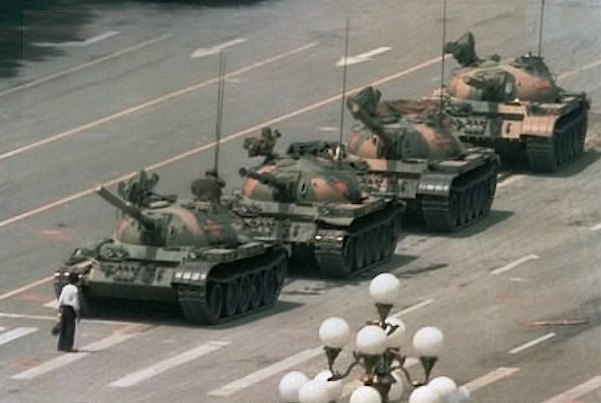
Most estimates are that in the crackdown, over a thousand Chinese protesters were killed by government troops. Several of the student leaders were ultimately imprisoned, executed, or just disappeared while a few were able to flee China and gain asylum in other countries. One of the most indelible images from the Tienanmen Square events was the picture of the “tank man” — a lone Chinese man who stood down a line of tanks and who came to symbolize the courage of individuals standing up to government corruption and tyranny.
One other prominent part of the Tienanmen Square events was Zhao Ziyang, China’s Communist Party General Secretary at the time. Initially seen as a reformer and rising star within the China’s government, he attempted to mediate the protesters’ demands with communist officials, notably Deng Xiaoping, China’s ultimate leader at the time. Ultimately, he was basically fired just before the crackdown and put under house arrest until his death in 2005.
As the New York Times reports, during his house arrest, Zhao secretly recorded his memoirs which is now being published as a book entitled, Prisoner of the State: The Secret Journal of Premier Zhao Ziyang:
One striking claim in the memoir, scholars who have seen it said, is that Mr. Zhao presses the case that he pioneered the opening of China’s economy to the world and the initial introduction of market forces in agriculture and industry — steps he says were fiercely opposed by hard-liners and not always fully supported by Mr. Deng, the paramount leader, who is often credited with championing market-oriented policies. . . .
Roderick MacFarquhar, a China expert at Harvard who wrote an introduction to the new book, said it had given him a new appreciation of Mr. Zhao’s central role in devising economic strategies, including some, like promoting foreign trade in coastal provinces, that he had urged on Mr. Deng, rather than the other way around. “Deng Xiaoping was the godfather, but on a day-to-day basis Zhao was the actual architect of the reforms,” Mr. MacFarquhar said. . . .
Although the tumult of 1989 is distant for many Chinese, it remains a forbidden subject, heavily censored on the Internet and rarely if ever mentioned in the state-run media. Beijing authorities are likely to be unhappy with Mr. Zhao’s airing of inside conflicts. . . In a sharp break with Chinese Communist tradition, even for dismissed officials, Mr. Zhao provides personal details of tense party sessions. . . .
Mr. Zhao said that in 1989 he argued that most of the demonstrating students “were only asking us to correct our flaws, not attempting to overthrow our political system.†. . . Perry Link, professor emeritus of Chinese Studies at Princeton said, “Laying bare the personal animosities from such a high position is something new here. It’s certainly the element that will send officials in Beijing through the roof.â€
Undoubtedly Zhao Ziyang remains a controversial figure for Chinese Americans and Chinese all around the world. Nonetheless, for those interested in China and the events of the Tiananmen Square protests of 1989, this book promises to give an unprecedented inside look into the political and personal issues within China’s communist regime.
As we continue celebrating May as Asian Pacific American Heritage Month, a common question I get from readers is, what are some common inventions that came from Asians? Basically, this question relates to the larger inquiry of what have been the contributions of Asians and Asian Americans to American society and the world through the years/centuries?
While I can’t give an exhaustive list, to help us answer one part of that question, HowStuffWorks recently featured the Top 10 Ancient Chinese Inventions. Their article includes an extended description and historical summary for each invention (certainly worth reading) but for those who want to cut to the chase, here is their list in reverse order:
10. Gunpowder
9. The Compass
8. Paper
7. Pasta
6. The Wheelbarrow
5. Seismograph
4. Alcohol
3. Kites
2. Hang Gliders
1. Silk
As probably the oldest and most well-known Asian culture, the Chinese and their inventions certainly deserve to be recognized since such inventions undoubtedly have had a significant impact on world civilizations and events throughout history. At the same time, we should remember that many other Asian cultures, along with Asian Americans, have made other contributions to benefit their society in many other ways.
Below is another announcement about an online survey in need of Asian American respondents:
Seeking Asian American and Biracial/Multiracial Asian American Participants for a Racial Experiences Study
Hello,
My name is Amanda Rivera and I am a doctoral student of clinical-community psychology at the University of La Verne. I am currently working on my doctoral dissertation, under the direct supervision of Christopher Liang, Ph.D.
Please consider participating in my study, which is focused on experiences of race. Participants will be entered in a raffle to win one of four $50 gift certificates to Target or Barnes and Noble. To participate in the study, individuals must be 18 years or older. The study should take approximately 30-40 minutes to complete and your responses will be kept confidential.
If you would like to participate in this study or would like more information please visit the following website:
In the event that you have any questions or concerns about this study, you may contact me at amanda.rivera@laverne.edu; my dissertation chair Dr. Christopher Liang at cliang@ulv.edu; or Al Clark, Ph.D., Associate Vice President for Academic Affairs at (909) 593-3511, extension 4240 (Institutional Review Board, 1950 Third Street, La Verne, CA 91750).
Issues related to immigration, particularly undocumented immigration, have always been and continue to be some of the most controversial in American history and society. As I’m sure you’ve seen yourself, such issues easily provoke strong emotions from all sides and can be very divisive between and even within racial/ethnic groups. On top of that, the current recession and fears on the part of many Americans about their financial security only add fuel to the fire.
It’s within this context that many Americans and American institutions look to blame all or part of their problems and difficulties on immigrants. But this immigrant bashing can take many forms — it can be very overt and direct in the form of racial slurs and violence, or it can be subtle and indirect, implicitly supported or set in motion by politicians who are otherwise seen as “liberal” or “progressive.” I would like to explore these different degrees of immigrant bashing as they’ve recently been manifested.
On the more blatant and overt side, we see time and time again that racial prejudice and economic instability often lead to violence. However, the second step in this kind of blatant immigrant bashing is when the criminal justice system fails to deliver justice for the immigrant victim. This was evident is the recent acquittal of two White teens on hate crime charges in the beating death of a Mexican immigrant in Pottsville, PA:
The [all White] jury found the teens innocent of all serious charges, a decision that elicited cheers and claps from the defendants’ families and friends – and cries of outrage from the victim’s. . . . Prosecutors cast Ramirez as the victim of a gang of drunken white teens motivated by a dislike of their small coal town’s burgeoning Hispanic population. But the jury evidently sided with defense attorneys, who called Ramirez the aggressor and characterized the brawl as a street fight that ended tragically. . . .
The case exposed ethnic tensions in Shenandoah, a blue-collar town of 5,000 that has lured Hispanic residents drawn by cheap housing and jobs in nearby factories and farm fields. Ramirez moved to the town about seven years ago from Iramuco, Mexico, working in a factory and picking strawberries and cherries.
The two men accused of fatally beating an Ecuadorean immigrant with a bat and a bottle after shouting epithets about Hispanics and gays face 78 years to life in prison if convicted on charges handed up by a Brooklyn grand jury and unsealed on Tuesday. The two suspects, Keith Phoenix, 28, and Hakim Scott, 25, are charged with second-degree murder, manslaughter and assault, all as hate crimes, for the Dec. 7 attack on the immigrant, Jose O. Sucuzhañay, and his brother Romel, who survived. . . .
The beating, coming soon after the killing of another Ecuadorean immigrant on Long Island, jangled nerves in immigrant and gay and lesbian communities. . . . Witnesses have described part of what happened next, beginning with slurs shouted from the car about Hispanics and gays. “Suddenly, Hakim Scott jumped out armed with a beer bottle,†Mr. Hynes said. “The two brothers tried to flee, but Scott caught up with Jose and slammed him across the head.â€
Mr. Phoenix “rushed from the S.U.V. armed with a baseball bat, ran over to Jose, and repeatedly beat him,†Mr. Hynes said, adding that as Mr. Phoenix walked back to the car he noticed that the victim was still moving. “Phoenix immediately went back to where Jose was laying and slammed him several more times on the head with the baseball bat until his victim was motionless,†Mr. Hynes said.
This kind of sentiment is also reflected in the recent swine flu outbreak. Since the swine flu originated in Mexico, inevitably this has led many to engage in blatant stereotyping and racial profiling against anything and anyone linked to Mexico:
“No contact anywhere with an illegal alien!†conservative talk show host Michael Savage advised his U.S. listeners this week on how to avoid the swine flu. “And that starts in the restaurants” where he said, you “don’t know if they wipe their behinds with their hands!†And Thursday, Boston talk radio host Jay Severin was suspended after calling Mexican immigrants “criminalians” during a discussion of swine flu and saying that emergency rooms had become “essentially condos for Mexicans.”
That’s tepid compared to some of the xenophobic reactions spreading like an emerging virus across the Internet. “This disgusting blight is because MEXICANS ARE PIGS!†an anonymous poster ranted on the “prison planet†forum, part of radio host and columnist Alex Jones’ Web site. . . . Savage speculated that terrorists are using Mexican immigrants as walking germ warfare weapons. “It would be easy,†he said, “to bring an altered virus into Mexico, put it in the general population, and have them march across the border.â€
[T]he growing public health concern has also exposed fear and hate. . . . Fearmongering and blame are almost a natural part of infectious disease epidemics, experts say. “This is a pattern we see again and again,†said Amy Fairchild, chair of sociomedical sciences at Columbia University’s Mailman School of Public Health in New York City. “It’s ‘the other,’ the group not seen as part of the nation, the one who threatens it in some way that gets blamed for the disease.â€
These acts of racial hatred, violence, and blatant stereotyping are undoubtedly tragic. Unfortunately, they are only one example within the range of immigrant bashing. Other examples do not involve physical violence committed onto the immigrant, but nonetheless show the same kind of callous indifference to their histories and experiences. This is exemplified by the case of a Korean Canadian student who stood up to racial taunts and slurs from a bully but was punished for defending himself (tip to AngryAsianMan for covering this story first):
The 15-year-old was suspended for four weeks from Keswick High School over a fight that he says began when another student racially abused him and punched him in the mouth. The boy, who has a black belt in tae kwon do, fought back with a single punch that broke his antagonist’s nose.
He was initially the only person investigated, and police charged him with assault causing bodily harm. But 400 of his fellow students walked out of class this week to denounce the racist bullying that preceded the punch, and the outcry reached newspaper front pages. In response, York police reopened the case, and assigned a special investigator to probe whether a hate crime was committed. . . .
The 15-year-old said he regrets throwing the punch, but felt he had no choice after the other boy called him a “fucking Chinese” and punched him in the face, cutting his mouth. His father said the school doesn’t seem to understand the impact of the racial comment. Afterward, a vice-principal asked his son why a Korean was upset about being called Chinese.
“Probably they don’t realize how much it hurts when someone makes a racist comment,” his father said. “My son said, ‘I felt all the way down, like I am nothing, on the floor. Like they’re the master and I’m the slave.’ “
As an update on this case, the school board has reversed the initial actions of the school’s administrators and have reinstated the student, removed the suspension from his record, and canceled the expulsion proceedings. The Korean Canadian student and the bullying student have met face-to-face and have apologized to each other.
This is a small but significant victory for victims of racial taunting and bullying but in the initial actions of the school’s principals and administrators, we once again see the evil twins of immigrant bashing — the first is the physical act itself, in this case the racial slurs, bullying, and first punch directed at the Korean Canadian student. But the second and equally appalling part are the lack of understanding, indifference, and outright hostility of our social institutions to respond to such immigrant bashing. In this case, the school officials initially blame the Korean Canadian student for the entire incident and wanted to expel him not just from the school but also from the entire school district.
Clearly, these officials just don’t get how racism works, most likely because as a White person, they’ve never experienced being called a racial slur, or had their group’s history or experiences denigrated, or had their distinct physical appearance mocked in public.
Unfortunately, examples of immigrant bashing do not end here. The entire range of such sentiments also includes official acts of government supported by politicians who we normally consider to be friends and allies of the immigrant population. One example is the federal “Troubled Asset Relief Program” (TARP) legislation that was passed in February to help bailout struggling financial institutions. One provision of the TARP act requires banks that receive federal bailout money to hire American workers over immigrants. As many community and business leaders argue, such a broad generalization against immigrant workers leads to some very troubling consequences:
In Sacramento, business leaders are worried about completing projects without the specialized expertise of consultants from foreign countries. . . . In California, foreign nationals helped create more than half of the startup companies in Silicon Valley, according to a Duke University study. In 2007, foreign nationals accounted for nearly two-thirds of all engineering doctorates awarded from the University of California and California State University systems, the study found. . . .
Wadhwa, an engineering professor at the Pratt School of Engineering at Duke and a researcher at the Harvard Law School, said some of his students are getting employment offers withdrawn, while others are frustrated and ready to move back home. He says it’s part of a troubling pattern in the United States: “Whenever there’s a downturn, you start blaming foreigners.”
In this example, I understand the need to make sure that federal money is used to help out Americans first. The problem with this is the assumption that immigrants are not Americans. Instead of seeing immigrants as productive Americans who pay American taxes, who buy American goods and services, and who contribute (many times disproportionately) in so many other ways to the economic health of the country — whether they are citizens, permanent residents, or even undocumented — immigrants are the first scapegoats when our country experienced difficulties.
Rather than looking deeper and more reflectively at the institutional issues that caused the current economic crises, such as high-risk loans and excessive greed on the part of financial institutions, we sadly and instinctively look to those living around us who seem to be different from us and based on this “Us versus Them” mentality, who we perceive to be not real, legitimate, or genuine Americans, and therefore, are somehow benefiting at our expense and therefore need to be vilified, dehumanized, and attacked — through our fists or our laws — as the cause of our problems.