The views and opinions expressed on this site and blog posts (excluding comments on blog posts left by others) are entirely my own and do not represent those of any employer or organization with whom I am currently or previously have been associated.
Academic Version: Applying my personal experiences and academic research as a professor of Sociology and Asian American Studies to provide a more complete understanding of political, economic, and cultural issues and current events related to American race relations, and Asia/Asian America in particular.
Plain English: Trying to put my Ph.D. to good use.
Here are some more announcements and links out that have come my way relating to Asians or Asian Americans. As always, links to other sites are provided for informational purposes and do not necessarily imply an endorsement of their contents. This time around, the announcements are about independent Asian, Asian American, and Asian Canadian films:
My name is Chris and I work for a small Asian American production company, Cherry Sky Films. We’ve produced Asian Am indies: Better Luck Tomorrow, Finishing the Game, Ping Pong Playa.
I wanted to get in touch with you because we’re trying something new for our next film, The Killing of a Chinese Cookie. We’re actually releasing it online through as site called Snag Films and it’s completely free!
It’s a lighthearted look at the origins and history of one of the most ubiquitous foods in American culture; the fortune cookie. We’re trying to get the word out. We hope you’ll like it enough to share it with your readers!
We’re a new fantasy thriller web series called Lumina, and our stars are Asian American (JuJu Chan, also TVB People’s Choice Award for Miss Chinatown USA 2009, Miss United Nation International Ambassador) and Asian Canadian (Michael Chan, star of the viral YouTube hit, Wall Street Fighter IV, and Vince Matthew Chung, winner of The Amazing Race Asia 3).
Although the series itself is not specifically about any Asian American / Asian Canadian identity issues, we’re trying to organically grow the audience for English language entertainment featuring Asian faces! The nine part series is free to view on our website: luminaseries.com and on our distribution partner KoldCast TV.
AsiaPacificFilms.com announces free unlimited access to its on-line library of 500 culturally significant and historically important feature films, shorts and documentaries from Asia and the Pacific. This free trial period lasts until November 1, 2009. After November 1, the monthly subscription rate for unlimited access is $8.99 a month. For more information, visit their site or read their pressreleases.
Governor Sonny Perdue of the US state of Georgia has proclaimed October 1, 2009 as “China’s National Day in Georgia,” calling on local citizens to celebrate with the Chinese people on the occasion.
“October 1, 2009 marks the 60th (founding) anniversary of the People’s Republic of China. With our strong bond of friendship and growing economic partnership, the state of Georgia is pleased to celebrate with the People’s Republic of China on the occasion of its National Day,” Perdue said in a sealed proclamation dated on September 16. . . .
According to the Atlanta Chapter of the US National Association of Chinese-Americans, approximately 50,000 Chinese live in Georgia.
“The contributions of these individuals, along with the companies, universities and organizations with direct ties to both lands, help bring together two nations half a world apart,” Perdue said, adding that the linkage between China and Georgia continues to strengthen and multiply.
There is clearly a motive to further economic development and investment between Georgia and China involved, but nonetheless I applaud Governor Perdue and the state of Georgia for recognizing the value and contributions of its Chinese and Chinese American citizens to the strength and vitality of their state.
As I’ve written about before, as the world and American society continue to become more globalized, Asian Americans are likely to have more opportunities to assert our “Asianness” (more specifically, our transnational cultural ties back to Asia) as an asset to American society and economy, in contrast to the past in which such associations were a liability in our efforts to integrate into mainstream American society.
I hope Georgia’s recognition of the value and contributions of Asian Americans is a positive sign for the future.
India and China fought a war in 1962 whose acrimonious legacy lingers even while economic ties flourish (China is now India’s biggest trade partner). Beijing refuses to acknowledge the de facto border — demarcated by the British empire — and claims almost the entirety of the northeastern Indian state of Arunachal Pradesh as part of its territory.
Indian strategic analysts believe Beijing’s stance has hardened in recent years, perhaps as a consequence of its increasing economic and military edge over India as well as growing Chinese influence in smaller South Asian countries like Nepal and Bangladesh. . . . “There’s a nervousness among some policymakers that the Chinese see India as weak and vulnerable to coercion,” says Harsh Pant, professor of defense studies at King’s College, London. . . . “Indians feel they can’t manage China’s rise and that they are far, far behind.” . . .
But the real arena for future confrontation, say most Indian strategists, lies not in standoffs on remote, rugged peaks but in the waters all around the Indian subcontinent. . . . Traditionally, India has imagined the ocean as part of its backyard without investing serious resources in its navy — much more goes to an army and air force that are perched by the land boundaries with the old enemy of Pakistan. . . .
To safeguard its vast appetite for oil and other natural resources, particularly those drawn from Africa, China has . . . [built] ports and listening posts around the Indian Ocean rim. . . . China will eventually possess key naval choke points around the subcontinent that could disrupt Indian lines of communication and shipping.
Reports of a tense standoff earlier this year between Indian and Chinese warships on anti-piracy patrol in the Gulf of Aden — though dismissed by both governments — did little to subdue the sense of distrust brewing between policymakers on both sides.
Something tells me that these renewed tensions between China and India are likely to get worse before they get better. If so, this is the last thing the world needs, but something that the U.S. may secretly like to see — two emerging superpowers and challengers to the U.S.’s global superiority sniping at each other and raising tensions in the region.
The other unknown is how will rising tensions between China and India affect relations between the Chinese American and Indian American communities in the U.S. Up to this point, these two Asian American communities seem to have good relations with each other, as they share many characteristics and experiences in common, particularly concerning immigration and entrepreneurship issues.
Nonetheless, with so many Chinese and Indian Americans maintaining connections with their ancestral countries, if tensions rise back there, they may eventually spill over into their lives in the U.S.
Here is an announcement from my colleagues at the Asian American Studies Center at UCLA:
UCLA’s “U.S./China Media Brief” Commemorates New Era of U.S.-China Relations
On the People’s Republic of China 60th anniversary year (1949-2009) and on the eve of President Obama’s historic November China visit, the UCLA Asian American Studies Center releases the new electronic, downloadable version of the “Presidents Edition” of the U.S.-China Media Brief to commemorate a new era of Sino-American relations. The “Presidents Edition” also serves as a handy electronic guide, together with the previous downloadable “Beijing Olympics Edition” to current issues in U.S.-China relations.
The U.S./China Media Brief website offers exclusive interviews with experts in U.S.-Chinese relations, commentary by former President Jimmy Carter, and essays exploring topics that range from labor unions to Obama’s potential impact on China.
Recent YouTube and podcast profiles feature: media expert Li Xiguang of Tsinghua University, Beijing; Janet Yang, Chinese American film producer; Gordon Chang, Stanford professor; Barbara Demick, Los Angeles Times Beijing Bureau chief; Cheng Siwei “the father of Chinese venture capitalism;” and Y.C. Chen, Hong Kong University of Science and Technology on U.S. corporate labor practices in Southern China.
The U.S./China Media Brief is accessible online for your viewing. Downloadable guides and materials include the following:
The entire 24-page, six-color 2009 U.S./China Media Brief “Presidents Edition,” which contains useful maps, charts, and commentary as well as summaries of key issues that will form the backdrop of President Obama’s November trip to China.
“China and the U.S. in the World,” a seven-page fold-out map that compares U.S. and Chinese energy, resources, and influence in Africa, Asia, Latin America and the Middle East developed by Harvard-trained researcher Sharon Owyang.
A compact Presidential Chart and Guide that traces the three decades of Sino-American normalization. This chart and guide summarizes past U.S. presidents’ relationship with Chinese leaders, ranging from Nixon to Obama.
An illustrated U.S.-China timeline that highlights key events/moments in the 200 year history between the U.S. and China.
Also, the 2008 “Beijing Olympics Edition,” reviewed by the New York Times on its Olympics blog (downloadable).
The U.S./China Media Brief was funded by the Walter and Shirley Wang U.S./China Relations and Communications Program at the UCLA Asian American Studies Center.
Earlier this week, musician, actor, and community activist Harry Connick Jr. was a guest judge on the Australian talent show Hey Hey It’s Saturday. One of the acts was a skit featuring a group of White men wearing blackface (using dark-colored makeup to appear racially Black), doing an impression of the Jackson Five. As ABC News reports and this video segment shows, Connick’s reaction to their performance was swift and sharp:
[Connick] was visibly shocked by the skit, in which [five] men with afro wigs and blackface sang and danced behind a Michael Jackson impersonator wearing white makeup. Connick, 42, gave the performance a zero score and told them that if it had been done in the United States it would have been pulled off the air.
Blackface was a traditional trope of minstrel shows in the U.S. that dates to the 19th century. Whites playing stock black characters — usually offensive stereotypes meant to demean — rubbed coal, grease or shoe polish on their faces. . . .
Public reaction to the “Hey Hey” performance in online forums was mixed. Some Australians said they were embarrassed such a racist sketch had been broadcast, while others said detractors were too politically correct and that the skit was funny. . . . Anand Deva, the frontman of the “Jackson Jive” act, said it was not meant to cause offense but added he would not have performed it in the United States.
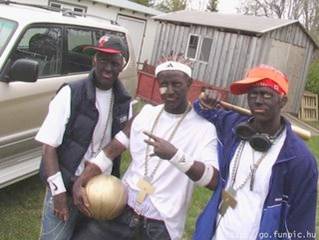
There are two interesting sociological points to note here. The first is the apparent differences in racial attitudes between the U.S. and Australia. That is, even though many Americans still are rather ignorant of the racial significance and racist legacy of blackface and still wear it from time to time (especially around this time of year, Halloween, as seen in the photo on the right), for the most part, I will presume that most Americans understand that blackface is offensive (or at least the reactions and criticisms to it are much more intense).
With that in mind, it is notable to see that in Australia, this sensitivity and recognition of blackface do not exist to the same level. In fact, despite the Australian government’s recent official apology to the aborigine population for centuries of racism, in general the racial attitudes of the Australian public seem to be a few decades behind that of the U.S. in terms of racial understanding.
This diminished level of cultural knowledge comes through in the responses by Anand Deva in defending his group’s skit with the usual refrain, “It wasn’t meant to be offensive, it was just a joke.” What he and other Australians do defend the skit don’t understand is that whatever the intent, the result was that it definitely came across as racist and offensive.
Secondly, the reason why they don’t understand why it was offensive is because as Whites in a White majority society, they have the position of being able to make fun of non-Whites while claiming that they did not intend it to be offensive. That, my friends, is the quintessential definition of White privilege.
As it relates back to Harry Connick Jr., as the video segment notes, he has been accused of being hypocritical because he participated in a previous comedy skit (apparently from MadTV) in which he played some kind of witch or voodoo doctor that some argue also makes fun of Blacks, although Connick counters that his character in the skit was actually White.
Despite this criticism of Connick, I give him credit for speaking up in the moment and denouncing the skit as racist and offensive. It takes courage to recognize such racial ignorance first of all, and second, to speak up and stand in opposition to it, rather than just keeping quiet, as many Americans from any racial background but particularly Whites, are more likely to do.
I know that as a native of New Orleans, Connick was affected by how his city and particularly the Black community were both devastated after Hurricane Katrina. In the aftermath of the disaster, he organized several benefits and other activities to begin rebuilding the city and its inhabitants.
At this point, I can only speculate, but I suspect that as a result of Hurricane Katrina and perhaps after understanding the cultural consequences of such media portrayals as his MadTV skit, he “got it” — that as an affluent entertainer and as a White person, he is very privileged person and has a lot of power and influence that can be used to make fun of people, or to help uplift them.
In other words, Connick’s actions — in the wake of Hurricane Katrina and in regard to this blackface skit — are a great illustration of what I tell me students all the time: for racism to continue, individual Whites like you (referring to my students) do not have to commit racist acts yourself. Instead, for it to continue year after year, generation after generation, all you have to do is to sit by and accept the consequences of discrimination committed against others.
Most people know the Hummer line of sport utility vehicles as embodying a very “in-your-face” image of conspicuous materialism and conservative, anti-environmentalist values. Hummers have been the bane of environmentalists for a while, with many being vandalized through the years by radical environmentalists. Nonetheless Hummer owners are very defiant and a recent survey of Hummer owners confirms that in buying their Hummers, most of them made a very conscious choice that their vehicles directly reflected their morals about American individualism, “patriotism,” and consumption.
This social image of Hummer and their owners is what makes this most recent development so ironic — as news organizations have begun reporting, Hummer’s current owner (General Motors) has just sold the brand to the Chinese heavy industry company Sichuan Tengzhong:
It marks the first time that Chinese investors have stepped in as buyers into the distressed U.S. auto industry. The sale also comes at a time when China has emerged as the world’s largest auto market and GM remains majority-owned by the U.S. government after being driven into bankruptcy. . . . A person familiar with the deal said earlier on Friday that the Hummer business would be sold for about $150 million, far less than GM’s early estimate that Hummer could fetch more than $500 million. . . .
Hummer’s sales peaked in 2006 but have been hit hard since by a slumping U.S. economy, higher gasoline prices and a shift in U.S. consumer tastes away from Hummer’s heavy-duty SUVs and its military-derived styling. Through September, Hummer’s U.S. sales were down 64 percent this year. Analysts said the new Hummer faces a difficult task of revamping a macho brand associated with the excess of the past economic boom in the United States.
From a sociological point of view, the question now becomes, what will these individualist, flag-waving, American-valuing fans of Hummer do, now that their beloved company is owned by [gasp] a Chinese company?!?
Will they still embrace the brand and its macho, John Wayne-worshiping image? Will they continue to buy Hummers in the future, even though it means that their money will go to a Chinese, rather than an American, company?
I don’t know the answers to these questions yet, but I will definitely enjoy sitting back and watching how these Hummer owners and fans grapple with this perplexing and ironic dilemma.
You might be interested to read the following posts from Octobers of years past:
2008: Racists Who Support Obama Analyzing why a large percentage of American voters who hold racist views of minorities nonetheless support Obama.
2007: Tila Tequila and Her Reality TV Show The latest high-profile Asian American media personality, Tila Tequila, gets her own reality TV show.
2006: Experiencing Race in the U.S. A new study looks at political opinions among communities of color and finds notable differences across social class lines for some, but not all groups.
2004: Affirmative Action: Beginning of the End? Recent political and educational trends suggest that the use of affirmative action programs is declining, although the need for such programs is still open to debate.
This post doesn’t focus on Asian Americans or racial/ethnic issues specifically but is certainly relevant to those kinds of discussion since it deals with what aggregate-level statistics can tell us about a person’s day-to-day life.
During this current economic recession, many of us are very aware of how it has affected our lives and perhaps the lives of those close to us. But beyond the grim stats about rising unemployment numbers that we hear on the news, what is the aggregate effect of the recession on Americans as a collective group? For many sociology students, this question might be rephrased as, “What can aggregate-level data tell us about individual lives?”
To try to answer that question, the Census Bureau has just released a report that describes how the recession has led Americans to make changes in many areas of their lives:
Preliminary data earlier this year found that many Americans were not moving, staying put in big cities rather than migrating to the Sunbelt because of frozen lines of credit. Mobility is at a 60-year low, upending population trends ahead of the 2010 census. . . . The percentage of people who drove alone to work dropped last year to 75.5 percent, the lowest in a decade, as commuters grew weary of paying close to $4 a gallon for gasoline and opted to carpool or take public transportation. . . .
Average commute times edged up to 25.5 minutes, erasing years of decreases to stand at the level of 2000, as people had to leave home earlier in the morning to pick up friends for their ride to work or to catch a bus or subway train. . . . Average commute times edged up to 25.5 minutes, erasing years of decreases to stand at the level of 2000, as people had to leave home earlier in the morning to pick up friends for their ride to work or to catch a bus or subway train. . . .
Nearly 1 in 3 Americans 15 and over, or 31.2 percent, reported they had never been married, the highest level in a decade. . . . Sociologists say younger people are taking longer to reach economic independence and consider marriage because they are struggling to find work or focusing on an advanced education. . . .
The homeownership rate fell to 66.6 percent last year, the lowest in six years, after hitting a peak of 67.3 percent in 2006. Residents in crowded housing jumped to 1.1 percent, the highest since 2004, a sign people were “doubling up” with relatives or friends to save money. . . .
More people are getting high school diplomas. Only two states, Texas and Mississippi, had at least 1 in 5 adults without high school diplomas. This is down from 17 states in 2000 and 37 in 1990. More older people are working. About 15.5 percent of Americans 65 and over, or 6.1 million, were in the labor force. That’s up from 15 percent in 2007.
It is probably no surprise that the recession has led many Americans to put off big life-changing events such as moving far away, getting married, or buying a house, along with smaller-scale changes such as driving alone less, more carpooling, sharing apartments, or working later in life. Many of us can relate to many of these changes ourselves.
What may be surprising is that aggregate-level data and statistics like this can capture such individual-level behavior and therefore give us a more fuller picture of how institutional events like an economic recession eventually affect the day-to-day lives of Americans on the aggregate level.
My point is that data like this are a nice example of how aggregate-level statistics help us understand individual-level actions. It’s with that in mind that I again urge everyone to complete and return the Census forms that will be sent out in a few months.
Those who are regular readers of this site and blog know that I spend a lot of time defending Asian Americans and criticizing acts of discrimination and violence committed against them. However, in the interest of fairness, I am also happy to point out and bash instances when Asian Americans themselves act like thugs and idiots.
With that in mind, here’s the perfect opportunity — as the Los Angeles Times reports, three UCLA Asian American students were recently arrested for their role in a fight at an Asian American-interest fraternity party:
Three UCLA students and four other people have been arrested in connection with a melee at an off-campus fraternity party that left three students injured last month, university officials said Friday. The fight broke the morning of Sept. 22 at a party hosted by Lambda Phi Epsilon, a fraternity that was on probation at the time after an incident last fall that involved an altercation with members of another fraternity. . . . None of the students is listed as being a member of the fraternity. . . .
One student was stabbed in the abdomen and required surgery. A second student was stabbed in the arm but did not require hospitalization. A third was hit over the head with a bottle. . . . [A] preliminary investigation indicates that all the suspects were “uninvited guests.” He said the party eventually became overcrowded and, after some disruptions, the suspects were asked to leave. . . .
The Asian fraternity has faced problems in the past. In 2005, 19-year-old Kenny Luong died from fatal head injuries during a tackle football game held at a city park in Irvine to initiate pledges into Lambda Phi Epsilon. During the game, pledges were gang-tackled repeatedly, police said. The fraternity was officially disbanded by UC Irvine in 2007.
In 2003, San Jose State Lambdas were involved in a melee that left one member fatally stabbed and others hospitalized. Police said about 60 fraternity brothers faced off against rivals from another Asian fraternity.
Since I did not witness the fight personally, I can only speculate about its circumstances based on articles such as this one from the LA Times. I also do not know to what extent members of the Lambda Phi Epsilon fraternity were involved in this incident. I also hope that the criminal charges brought against those who were arrested are fair and just, not overreactions on the part of the police and criminal justice system.
Nonetheless and as the article notes, this fraternity has a history of violence and legal problems, a few of which have involved the deaths of other Asian Americans.
Incidents like this that involve Asian Americans acting violently remind me of the movie Better Luck Tomorrow that portrays a group of high-achieving Asian American students turning to a life of crime and violence to relieve the stress and monotony of their “model minority” life.
On a more sociological level, incidents like this also bring up the question that I posed several years ago when I wrote about the brawl between Lambda Phi Epsilon and Pi Alpha Phi in San Jose that led to the stabbing death of a young Asian American male student — why are many Asian American males, particularly those associated with ethnic-interest fraternities, emulating the same kind of destructive machismo and violence that has plagued their community for so long?
To be sure, most members of these fraternities nationwide do not resort to violence and in fact, are good students and good community members. But even the casual reader can see that there is a pattern of problems involved with these two Asian American fraternities. As I speculated before:
Is there someone or something to blame here? The Greek system for making these Asian Americans feel like they have to defend the “honor” of their frat and of their “brothers” at all costs, including gang violence and murder, even if their antagonists are other Asian Americans?
A misplaced feeling that rather than the prejudice and discrimination out there in the larger society are their biggest threats, they scapegoat their most immediate rivals as the ones to blame for their problems?
An unconscious inferiority complex in which young Asian American men think they need to be hyper-violent to show that they’re just as masculine as Whites, Blacks, or Latinos?
Youthful bravado, reinforced by a mob mentality? Simple insanity on the part of each person who took part in this fiasco?
As part of this blog’s mission of making academic research and data more easily accessible, understandable, and applicable to a wider audience and to practical, everyday social issues, I highlight new sociological books about Asian Americans and other racial/ethnic groups as I hear about them.
As some of my readers have lamented, one of the drawbacks about looking at racial issues is that much of the research and writing focuses on the negatives — what’s wrong with the situation, who/which groups is/are hurt the most, how society is not just flawed but even responsible for the mess, etc. With that in mind, these new books look at the positives and successes — how we can and have moved forward toward more racial equality.
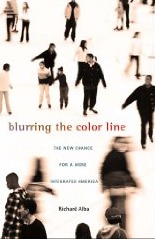
Richard Alba argues that the social cleavages that separate Americans into distinct, unequal ethno-racial groups could narrow dramatically in the coming decades. During the mid-twentieth century, the dominant position of the United States in the postwar world economy led to a rapid expansion of education and labor opportunities. As a result of their newfound access to training and jobs, many ethnic and religious outsiders, among them Jews and Italians, finally gained full acceptance as members of the mainstream.
Alba proposes that this large-scale assimilation of white ethnics was a result of “non-zero-sum mobility,†which he defines as the social ascent of members of disadvantaged groups that can take place without affecting the life chances of those who are already members of the established majority.
Alba shows that non-zero-sum mobility could play out positively in the future as the baby-boom generation retires, opening up the higher rungs of the labor market. Because of the changing demography of the country, many fewer whites will be coming of age than will be retiring. Hence, the opportunity exists for members of other groups to move up.
However, Alba cautions, this demographic shift will only benefit disadvantaged American minorities if they are provided with access to education and training. In Blurring the Color Line, Alba explores a future in which socially mobile minorities could blur stark boundaries and gain much more control over the social expression of racial differences.
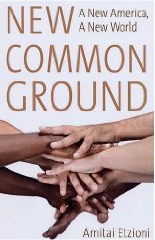
Race, age, political affiliation, country of origin, native language—too often Americans define themselves, and are defined, by the differences that separate them. But if the 2008 presidential campaign has taught us anything, it is that we as a people want to look beyond these divisions to the values and interests that unite us.
New Common Ground embodies this zeitgeist, showing the ways that traditional boundaries among ethnic groups, political ideologies, and generations are blurring, and how to hasten the process. New Common Ground demonstrates that even though the deepest divide in America is said to be racial, the differences in viewpoints and values among races are declining, even in an age of increased intermarriage.
On immigration and other controversial matters, Etzioni argues for diversity within unity and the means to achieve that necessary end. New Common Ground is a provocative and insightful look into how we as Americans can reach consensus not just in spite of our diversity but also in ways that strengthen our commitment to the good of one and all as we seek to overcome the divisiveness that sometimes results from identity politics. The book closes by looking beyond our shores to the bridges that bring America closer to the rest of the world.
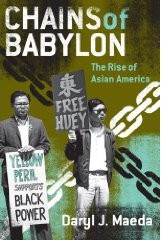
In Chains of Babylon, Daryl J. Maeda presents a cultural history of Asian American activism in the late 1960s and early 1970s, showing how the movement created the category of “Asian American” to join Asians of many ethnicities in racial solidarity. Drawing on the Black Power and antiwar movements, Asian American radicals argued that all Asians in the United States should resist assimilation and band together to oppose racism within the country and imperialism abroad.
As revealed in Maeda’s in-depth work, the Asian American movement contended that people of all Asian ethnicities in the United States shared a common relationship to oppression and exploitation with each other and with other nonwhite peoples. In the early stages of the civil rights era, the possibility of assimilation was held out to Asian Americans under a model minority myth.
Maeda insists that it was only in the disruption of that myth for both African Americans and Asian Americans in the 1960s and 1970s that the full Asian American culture and movement he describes could emerge. Maeda challenges accounts of the post-1968 era as hopelessly divisive by examining how racial and cultural identity enabled Asian Americans to see eye-to-eye with and support other groups of color in their campaigns for social justice.
Asian American opposition to the war in Vietnam, unlike that of the broader antiwar movement, was predicated on understanding it as a racial, specifically anti-Asian genocide. Throughout he argues that cultural critiques of racism and imperialism, the twin “chains of Babylon” of the title, informed the construction of a multiethnic Asian American identity committed to interracial and transnational solidarity.
In light of the recent emergencies due to natural disasters in the Philippines, Viet Nam, Samoa and American Samoa, Indonesia and other parts of Asia and the Pacific, if you would like to make a donation to help those in need, here are some links to respected organizations to make your donation:
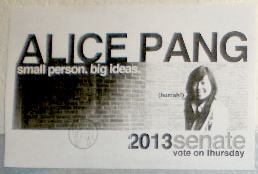
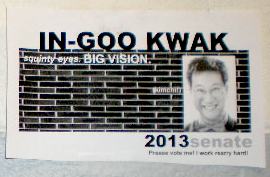
Two weeks ago, In-Goo Kwak, a freshman studying international relations and an immigrant from South Korea, put up a series of posters around his dormitory parodying the campaign poster of Alice Pang, another freshman of Asian descent who was running for the Tufts Community Union Senate. Kwak was not actually running for a student government position, but posted the parody next to Pang’s at the encouragement of his dorm mates. who thought he was right to poke fun at the air of political correctness he perceived on the campus.
Pang’s poster included the campaign slogan, “small person, big ideas,†with the exclamation “hurrah!†next to her portrait. Kwak’s parody poster looks strikingly similar in design to Pang’s and includes the slogan “squinty eyes, big vision.†Next to Kwak’s portrait is the word “kimchi!” — a traditional Korean dish. Additionally, where Pang’s poster read “vote on Thursday,” Kwak’s said, “Prease vote me! I work reary hard!†in deliberately broken English. . . .
Linell Yugawa [Director of Tufts’ Asian American Center] sent an e-mail to the entire Tufts community denouncing Kwak’s parody. . . .
“Many Asian/Asian Americans and individuals of other racial backgrounds have been angered, hurt, and offended by these posters,” Yugawa wrote . . . “The posters not only mocked an authorized campaign poster, but used negative and racist stereotypes that correlate with the discrimination and dehumanization of Asians. These posters go beyond affecting one individual or group, but offend all who have an understanding of how racist stereotypes impact our lives.
“Some may argue that we need to ‘lighten up’ and/or ‘reclaim’ the stereotypes and words that have harmed us and our communities. While it is one thing to mutually engage in this type of conversation, it is another to post stereotypical and racist language that is open to interpretation and hurtful to many.”
There seems to be a few different issues here. According to Kwak (the student who put up the parody poster), the main issue here is freedom of speech and his right to criticize what he perceives to be political correctness gone overboard. My response is, yes he has the freedom to criticize what he perceives to be political correctness. But along with that, other students have the same freedom to denounce him as ignorant and I agree with those criticisms against Kwak.
It is a tricky situation in that yes, to a certain degree, one strategy for us as Asian Americans to fight back against the prejudice and discrimination that we’ve experienced through the years is to appropriate the stereotypes and reclaim the derogatory slurs that have been used against us and to turn them around for our own purposes. Other cultural minorities groups have been successful in doing this, such as Mexican Americans reclaiming the term “Chicano” and gay Americans reclaiming the term “queer.”
However, this does not mean that Asian Americans should start going around spouting stereotypes left and right. Such an effort to reclaim derogatory slurs needs to be focused, coordinated, and consensual. Unfortunately, Kwak’s effort in the form of his parody poster were none of those.
Instead, as Director Yugawa noted, his effort made fun of another Asian American student and used offensive stereotypes that rekindled very painful memories for many Asian Americans. Instead of uniting other Asian Americans as allies in the fight against anti-Asian racism, he alienated them.
The lesson here is that Asian Americans have a right to criticize what they believe to be political correctness and even to try to reclaim offensive historical caricatures. But in the process of doing so, if they use demeaning stereotypes against other Asian Americans, they should be prepared to accept the criticisms and denouncements that will inevitably follow. Ultimately, freedom of speech goes both ways.