The views and opinions expressed on this site and blog posts (excluding comments on blog posts left by others) are entirely my own and do not represent those of any employer or organization with whom I am currently or previously have been associated.
Academic Version: Applying my personal experiences and academic research as a professor of Sociology and Asian American Studies to provide a more complete understanding of political, economic, and cultural issues and current events related to American race relations, and Asia/Asian America in particular.
Plain English: Trying to put my Ph.D. to good use.
Here are some more announcements, links, and job postings about academic-related jobs, fellowships, and other related opportunities for those interested in racial/ethnic/diversity issues. As always, the announcements and links are provided for informational purposes and do not necessarily imply an endorsement of the organization or college involved.
Today is the last day to help take the Queer Southeast Asian (QSEA) Census, March 1, 2011. As of now, we have collected 380 surveys nationally by Hmong, Thai, Laotian, Vietnamese and Cambodians who are LGBTQ living in the US. We need 20 more surveys to be taken to reach our goal of 400 and it would be fantastic if we surpass that goal!
I wanted to reach out to you all again in hopes that if you haven’t taken the survey yet, to please do so, as this is historical and ground breaking data that we have been needing to
help support our work and bring visibility to our communities that do exist for over 30 years in the US. And for those that have taken it or don’t fit the criteria, please help us outreach it to your family, friends and network until midnight via Facebook, social networks, website and email.
Our QSEA Census is directed towards Queer Southeast Asians that have been affected by the Vietnam War living in the countries of Laos, Thailand, Vietnam and Cambodia.
Leadership in Action (LIA) is an eight-week paid summer internship program designed to develop emerging young leaders by providing college students with practical leadership skills and the opportunity to work hands-on in the Asian and Pacific Islander (API) community in Southern California.
Approaching its 14th year, the program takes learning beyond the classroom, and places the student interns in a range of API community based organizations in order to gain real-life experience working at nonprofits. The intern will be paid $2,000 for the eight-week internship.
The intern’s weekly schedule is comprised of 4 days at their assigned community based organization (CBO) and 1 day at LEAP. At the CBO, the intern works with their assigned supervisor on a meaningful project. At LEAP, the intern’s day is devoted to leadership development training, issue discussions, CBO site visits and a community impact project. Nationally recognized trainers deliver workshops in critical skill areas. Issue discussions are on local or timely topics of interest and are facilitated by local community leaders/activists and LEAP trainers.
The community impact project will give the students interns an opportunity to flex their leadership skills in a safe setting, as well as allow them to contribute a service that has lasting impact on to the Asian American and Pacific Islander communities. The 2011 program will be held in Los Angeles from June 20 – August 12, 2011.
The application process for interns is now open. Applications are due Friday, March 11th, 2011. There are two rounds in the application process. The first round is where a committee reviews all the applications and decides who they want to come in for an interview. The second round is the actual interview either at LEAP or by teleconference. The results will be decided by the end of March and interns will be notified by the first week of April.
Junior Faculty Development Workshop, Penn State
On June 2-4, 2011, the East of California Caucus and the Pennsylvania State University will sponsor a junior faculty development workshop for early-career Asian Americanists. The workshop reflects EOC’s historical commitment to mentoring junior faculty and providing support to those working to increase the disciplinary and curricular visibility of Asian American Studies in higher education. Specifically, the workshop will help professionalize junior faculty by focusing on how to:
Create extra-institutional networks of support
Identify meaningful research projects and develop vocabularies for how to talk about such projects with a variety of audiences (department chairs, audiences outside of Asian American Studies, potential editors)
Confront pedagogical challenges
Establish effective collegial relationships
Navigate the tenure process successfully
To accomplish these goals, the workshop will feature panel discussions, breakout sessions, and work-in-progress workshops. Please note that space will be limited to ensure a high level of interaction among all participants. Interested scholars should submit a brief letter of application outlining what the applicant hopes to gain by attending the workshop, a draft or excerpt of approximately 7-15 pages of the article or book chapter being proposed for workshop development (only work that has not yet been published is eligible), and a c.v. Please send materials to Tina Chen tina.chen@psu.edu and Eric Hung msumeric@gmail.com; questions should be directed to Tina Chen.
This event is funded by the Penn State Asian Studies Program (ASP) with additional support from the Center for American Literary Studies (CALS). The workshop will begin on Thursday evening (6/2) and conclude at 12:30 on Saturday (6/4). PSU will cover lodging and all meals during the event (specifically, 2 nights of lodging; dinner on Thursday; all meals on Friday; and breakfast and lunch on Saturday).
Out of the Margins: Asian American Movement Building. A two-day conference on the past, present, and future of activism and social change. March 25-26, 2011 at the University of Michigan.
Highlights:
Conversation between Grace Lee Boggs and Michael Hardt on the Next American Revolution (3/25, 4pm, Michigan League Ballroom)
Asian American performers showcase with Geologic (from Blue Scholars), Kiwi and DJ Phatrick, comic Hari Kondabolu, and Nobuko Miyamoto (3/25, 7:30pm, Michigan League Ballroom)
Panel discussions on immigrant rights, youth organizing, cultural activism, building multiracial coalitions and campus/community connections (3/26, 9am to 6pm, Trotter Multicultural Center)
Join students, scholars, artists, and community organizers from the University of Michigan and across the nation in this historic event. See our website for updated information and free registration.
Sponsored by:
University of Michigan Asian/Pacific Islander American Studies Program
Committee on Institutional Cooperation
Asian American Association
Office of Academic Multicultural Initiatives
Rackham Graduate School
United Asian American Organizations
Asian American Studies Program (Ohio State University)
Multi-Ethnic Student Affairs, Asian/Pacific Islander American Heritage Month
Examining the Resettlement & Integration Experiences of Lesbian, Gay, Bisexual, Transgender and Intersex Refugees
Intensive Internship Yielding Thesis-Level Stand-Alone Report and Publication
[10-week Program from June 13th to August 19th]
ORAM (Organization for Refuge, Asylum and Migration) is a California-based non-profit organization with a mission to advocate for refugees fleeing sexual or gender based persecution. ORAM conducts international education and advocacy on behalf of these highly vulnerable individuals. It also provides legal counseling and representation as these persons struggle to find security and safe haven. We work with the United Nations High Commissioner for Refugees (UNHCR), with other non-governmental organizations (NGOs) and with community-based groups in the U.S. and abroad to achieve our mission. More information is available at www.oraminternational.org.
Project: Conducting a Survey on the Resettlement Experiences of LGBTI Refugees
ORAM is looking for exceptionally committed and highly qualified interns to conduct and report upon a survey documenting the experiences of LGBTI refugees in the United States. Each intern will be assigned a geographic area corresponding to his/her location. After contacting local resettlement organizations and locating LGBTI refugees, the intern will conduct in-person interviews with the persons identified. ORAM will provide translation services on an as-needed basis. Basing their work on a survey designed by ORAM, interns will inquire into areas including the refugees’ access to medical and mental health care, ability to find employment, and access to safe housing.
Participants’ stand-alone papers based on these interviews will be appropriate for use as graduation theses, upon school approval. ORAM will utilize the information gathered to compile a high quality analytical advocacy report, along with extensive recommendations for organizations and government agencies resettling LGBTI refugees. As in all ORAM projects, student contributors will be fully credited in the final published work.
Requirements
Anthropology, sociology, gender studies, social work and journalism students are encouraged to apply. Applicants must have excellent interviewing, listening and writing skills. High-level fluency in a second language, including (but not limited to) Spanish, Arabic, French or Farsi is highly desirable. Applicants receiving academic credit for this internship are strongly preferred. Interns are unpaid. They will work a minimum of 20 hours of work per week during a 10-week period in the summer of 2011. Interns will report to an ORAM supervisor and will be required to attend a weekly meeting via Skype.
Application Procedures
Interested applicants should send (1) a resume, (2) a cover letter, and (3) an original, non-fiction writing sample to ORAM Internship Coordinator at internship@oraminternational.org. Please write “Resettlement Experiences Internship Application” in the subject line of the email. Applications will be evaluated on an ongoing basis until May 1, 2011.
To highlight the continuing growth and vitality of Asian American Studies, the following is a list of recent doctoral dissertation from scholars in the social sciences and humanities that focus on Asian Americans. As you can see, the diversity of research topics is a direct reflection of the dynamic and multidimensional nature of the Asian American population. Last but not least, congratulations to my new academic colleagues on being “Ph.inally D.one.”
The records are compiled by Dissertation Abstracts International. Copies of the dissertations can be obtained through your college’s library or by addressing your request to ProQuest, 789 E. Eisenhower Parkway, P.O. Box 1346, Ann Arbor, MI 48106-1346. Telephone 800-521-3042, email: disspub@umi.com. As always, works included in this list are for informational purposes only and do not imply an endorsement of their contents.
We Will Not Be Moved: The Mobilization Against Southeast Asian American Detention and Deportation
Dao, Loan Thi (University of California, Berkeley)
Abstract: This project will discuss how deportation policies affecting Southeast Asians has catapulted a new generation of community leaders into positions of power in Southeast Asian American communities. The mobilization efforts of three community organizations in particular — CAAAV/YLP, KGA, and PrYSM — have challenged the dominant discourse of Southeast Asian American youth through their organizing and have traced a map for the Asian American movement in the 21st Century. This dissertation examines the organizing efforts of these core organizations in the Southeast Asian Freedom Network from its inception in August 2002 until December 2004.
How does the shift in leadership and orientation to a Southeast Asian American emphasis affect change and continuity in Asian American social movements in this new historical period? The analysis of the collective identities, tactics, strategies, and cultural productions of these organizations illuminates a nascent era in Asian American movement that continues to challenge dominant narratives about racialized immigrant and refugee urban youth. I argue that the anti-detention and anti-deportation work of the Southeast Asian Freedom Network demonstrates the trajectory of Asian American social movement for several reasons. The impact of a new demographic of Asian American leaders to the movement in general is in itself significant.
Between 2002-2004, working-class, urban refugee 1.5 to 2nd generation youth took leadership on a national scale in the political framing, strategizing and actions of deportation practice and policymaking. The deportation issue galvanized the Asian American community and Southeast Asian American organizations into the realization that a critical mass of new leaders had equipped themselves to meet the challenges of their peers in light of a power vacuum during a time of collective crisis. This research points to three main shifts in Asian American movements: (1) The conceptualization of an Asian American Left political position that re-aligns “anti-communist” and radical left ideologies; (2) The redistribution of power in effecting social change from legal and service professionals to working-class community members directly affected and with it, grassroots organizing tactics and strategies; (3) New cross-sectional alliances beyond ethnicity speak to the complicated identity formation of this new generation.
Politics Out of Trauma: Asian American Literature and the Subject Formation of Asian America
Kase, Yasuko (State University of New York, Buffalo)
Abstract: This dissertation unravels the complex relationships between trauma, politics, and the subject formation of Asian America in order to challenge the assumption that the subject’s experiences define the political grounds of representation. The category of Asian American, which was contrived during the civil rights movement, has never produced the homogeneous identity of Asian America as the cultural nationalists imagined. Asian America has repeatedly negotiated both its discrepancy from and interpellation into hegemonic (White) America.
Traumatic events such as the Philippine-American War, World War II, the Vietnam War, the Los Angeles civil unrest in 1992, and 9/11 have altered the formations of nationhood that redefine the relations among Asia, the U.S., and Asian America. Writers such as Japanese Americans John Okada, Perry Miyake, and Karen Tei Yamashita, Filipino American Jessica Hagedorn, Korean American Nora Okja Keller, and Vietnamese Americans Lan Cao and le thi dien thuy directly or indirectly deal with these historical traumas. These writers’ texts challenge the homogeneous U.S. official memory of the traumatic events through their rewritings.
This dissertation argues that trauma does not bring a crisis for minority politics by simply destroying the subject. Rather, it offers a dynamic chance to problematize the foundations of politics itself, which has naturalized a uniform subject as the enunciating site for political representation
With and Without the White Coat: The Racialization of Southern California’s Indian Physicians
Murti, Lata (University of Southern California)
Abstract: This study examines the role of occupational status in the racialization of Indian physicians in Southern California. Since the liberalization of U.S. immigration policy in 1965, the number of first and second-generation Indian doctors in the U.S. has grown to nearly seven percent of the nation’s physician workforce; however, Indians constitute less than one percent of the total U.S. population.
Overrepresented in one of America’s most prestigious professions, Indians are more visible in U.S. medicine than in the U.S. at large. Previous scholarship in immigration research, Asian American Studies, and the sociology of occupations has paid little attention to these professional non-white immigrants and their racial experience in the U.S. Asian American Studies in particular has focused primarily on the racial-ethnic identity formation of economically disadvantaged non-white groups, under the assumption that professional Asian Americans’ class status and occupations in the sciences effectively shield them from racist harm and preclude their engagement in racial politics. This research shows that Indian doctors’ high occupational status and class privilege provide them only partial, situational protection from racism. They have what I call occupational citizenship — access to most of the same rights and privileges as whites only when perceived as being both professionally successful and economically beneficial to the U.S.
They are clearly marked as occupational citizens during clinical interactions with patients, when they are in the white coat. But outside of this context, they are subject to racist treatment from colleagues, staff, health care institutions, and the general public. The particular forms of racism these doctors face, as well as how they interpret this racism, have as much to do with their gender, immigrant generation, and perception of others’ race and class, as with their own professional class status. These findings are based on fifty-two interviews with first and second generation Indian doctors in Southern California as well as participant observation at the monthly meetings of two regional Indian medical associations. I also observed seven Indian doctors at work, noting their interactions with patients, staff, and colleagues. Southern California represents an ideal case for understanding the racial formation of Indian physicians in the U.S. because of its large but dispersed population of established Indian physicians, and its overall diversity of race, ethnicity, and class.
Implicit and Explicit Racial Attitudes: Moderation of Racial Typicality Evaluations
Stepanova, Elena V. (Washington University in St. Louis)
Abstract: Previous research has shown that racial images representing more typical Afrocentric phenotypic characteristics result in more negative evaluations, whether assessed by explicit or implicit attitudes measures. However, the factors that define and moderate the perception of racial typicality have not been sufficiently explored. The current research investigated additive and interactive influences of skin tone and facial physiognomy on racial typicality evaluations, as well as the degree to which those effects were moderated by explicit and implicit racial attitudes, ethnicity of participants, and availability of cognitive resources.
Using a 6-point scale ranging from very African American to very Caucasian, participants ( N = 250) judged faces varying on 10 levels of facial physiognomy (from very Afrocentric to very Eurocentric) and 10 levels of skin color (from very dark to very light). Additionally, time constraints were manipulated by having participants complete the racial typicality judgments three times–without a response deadline, with a deadline equal to their median response during the no-deadline condition, and with a deadline equal to their 25th percentile response during the no-deadline condition. Skin color and facial physiognomy interacted to influence racial typicality ratings, and this interaction was further qualified by the time constraint manipulation.
Under time constraints, participants primarily relied on skin color when rating faces of extreme levels of facial physiognomy, whereas they relied on both skin color and facial physiognomy when rating faces of intermediate levels of facial physiognomy. Other results indicated that the relationship between skin color and participants’ ratings of racial typicality was stronger for those with higher implicit racial attitudes. European American and Asian American participants relied upon skin color more than African American participants, and African American participants relied upon facial physiognomy more than European American and Asian American participants. Conceptual, methodological and practical implications for race-relevant decisions are discussed.
As I previously promoted on this blog, this past weekend, the annual conference of the East Coast Asian American Student Union (ECAASU) was held on my home campus, the University of Massachusetts, Amherst. ECAASU bills itself as the largest Asian American student conference in the nation and from most accounts, it was a big success with almost 1,500 attendees from schools all around the country. Kudos are in order for the organizers, attendees, presenters, and entertainers who all contributed to a dynamic and enriching event.
Inevitably, the conference was not without some controversy. Specifically, many attendees and presenters this year questioned the appropriateness of U.S. military branches such as the Navy and Coast Guard and government agencies such as the Central Intelligence Agency (CIA) and the Transportation Security Administration (TSA) as sponsors of the event. In fact, there were several contentious instances in which speakers vocally criticized various historical and contemporary aspects of the U.S. military and security agencies along with their presence at the conference, with about 30 or so representatives of such military and security agencies sitting directly in front of them in the audience.
Apparently, these and other military branches and government agencies have prominently sponsored ECAASU conferences in the past, so their presence was not new. Since I have not attended many ECAASU conferences recently, I do not know whether there were similar objections raised in a very public way before. Nonetheless, this year the tensions were clearly out in the open.
In trying to not minimize the positive aspects of the conference, I would also like to reflect a little bit on this particular issue and source of tension. Also at the risk of contradicting one my favorite quotes — “I don’t know what’s the key to success, but the key to failure is trying to please everybody” (Bill Cosby) — my personal and sociological thoughts on this matter includes praise and criticism for both sides.
Speaking the Truth
On the one hand, the speakers who criticized the military and government agencies clearly had a right to do so and also had plenty of “ammunition” to back up their criticisms. There can be little denial that through the years, the U.S. military and security agencies and a number of individuals working for them have perpetrated or been directly complicit in innumerable instances of injustice and outright crimes against innocent civilians domestically and abroad and in the process, destroyed lives and livelihoods left and right.
To make a long story short, it is because of these actions that many people around the world have a very intense hatred of the U.S. and in extreme cases, feel compelled to resort to desperate actions to fight back against such historical and contemporary oppression. As such, the opposition to the presence of these U.S. military branches and government agencies at a conference focused on, among other things, counteracting institutional domination and cultural colonialism is perfectly understandable and justified.
Taking a Step Back
On the other hand, we cannot dismiss the fact that many members of the military put their very lives at risk to protect our right to criticize their employers — our government. More specifically, in criticizing the presence of the U.S. military and government agencies, I feel that the speakers missed an important distinction — the actions of individuals versus institutional policies. In other words, as a sociologist, one of the first things that I teach my students is that in order to properly understand a social issue or problem, we first need to recognize its dynamics and dimensions across different levels of analysis — the individual level, the group/community level, and the institutional level.
The issue of racism is an excellent example of the need to recognize how sociological understanding takes place at each of these levels of analysis. For instance, when a person of color points out how racism still exists in U.S. society these days, a White person may interpret that as a personal attack and direct implication against them and that they are being accused of being a racist when in fact, the person of color is referring to racism on the institutional level.
Similarly, many Whites may feel that racism will be eliminated once individuals are taught to be colorblind or that it’s wrong to have racial prejudices, when in fact the most enduring mechanisms that reinforce and perpetuate racism exist not among individuals, but within institutional policies and practices that privilege one racial group over another. Ultimately, it is when people discuss an issue like racism from different levels of analysis that misunderstandings, tensions, and hostility inevitably result.
As applied to the ECAASU conference and the speakers’ criticisms against the U.S. military and government agencies, I feel that they missed the opportunity to engage the military and agency personnel in a constructive sociological discussion because they largely conflated these levels of analysis. This happened in instances in which speakers implied that the military and government personnel in attendance at the conference, by virtue of their employment and position within such agencies, were directly complicit in committing crimes or acts of injustice.
More subtly, the conflating of these levels of analysis prevented speakers from conceptualizing the possibility that the military and government personnel in attendance might actually be agents of social change. In other words, on the one hand, there is the strong possibility that people of color, Asian Americans, or anyone else who has a commitment to racial equality and justice may end up just becoming another cog in the machine or another brick in the wall if they enter these military and government institutions and get swallowed into the perpetual system of bureaucracy.
But on the other hand, it is also possible that such individuals can bring their sense of racial equality and justice into an organization, build a coalition, consensus, or critical mass with like-minded others within the organization through time, and after achieving positions of power and authority, begin to apply their beliefs and little by little, change the culture and policies of that organization toward greater social/racial equality and justice. Organizations, institutions, and as we’re seeing in the Middle East, entire nations do change through individual actions — either toward more oppression, or toward more equality and democracy.
The Times They Are A’ Changing
Here in the U.S., we have three recent examples, including one involving the U.S. military — Gary Locke (Secretary of Commerce), Professor Steven Chu (Secretary of Energy), and General Eric Shinseki (Secretary of Veterans Affairs). Within each of their respective careers, all three of these Asian Americans have personified a sense of working toward greater social equality and while there is still plenty of work to be done, I feel are positive examples and role models of how social change can occur within institutions.
I also recall a conversation I had with a student in which she mentioned that, as an advertising major, she also has a strong commitment to use her experiences and training to work toward greater racial equality and justice for Asian Americans and people of color. But she also expressed reservations about entering the advertising industry with its history of portraying people of color in very narrow and even stereotypical ways. One of the things that I told her was that if students like her self-select out of these kinds of industries, everything will just be perpetual status quo and nothing will change. Instead, I encouraged her to bring her determination with her into the advertising industry and as I described earlier, build a critical mass with others who share similar goals and fight for the change that she wants to see happen.
I cannot guarantee that the 30 or so military or government personnel in attendance at the ECAASU conference have the same kind of drive toward achieving racial equality and justice, but based on the brief speeches that a few of them gave, I am confident that many of them do. As such, while we can and should continue to criticize their institutions for the injustices that they’ve perpetrated through the years, that should not preclude us from encouraging individual members of such institutions from doing what they can to change their institutions from within.
Following up on my earlier post about a few interesting interactive infographics showing population-related data from the Census and other sources, the Census Bureau has begun to release results from the 2010 Census for each state and has created an interactive application (below) that summarizes changes in the state’s population by counties and racial/ethnic group (to change states, click on the “Select Another State” link at the top of the graphic):
Data for more states will be released in the next few months, so if the state you’re interested in is not yet listed, check back a little later and eventually it will be up.
The Census has another interactive graphic below that shows state-level changes in population from 2000 to 2010, along with historical changes in population for each state since 1910. This is basically the data upon which state governments will use to reapportion their Congressional districts in time for the next Congressional elections in 2012. You might recall that a few states will lose one or more seats in the House of Representatives (most of whom are in the midwest and northeast) because their population either declined or was stagnant while other states (mainly in the south and west) will gain seats because their populations increased.
This is the third of my three-part list of the best documentaries that focus on immigration and are great choices for showing in high school and college immigration classes. This third and final part will focus specifically on issues related to socioeconomic attainment, mobility, and assimilation — the individual-, community-, and institutional-level processes involved as immigrants (regardless of their legal status) become integrated into the rest of U.S. society.
Part 1 focused on the historical and global context of immigration and Part 2 looked at unauthorized immigration. The following list is organized by topic and corresponds to the chronological order in which I discuss each topic in my “Sociology of Immigration” course. For each topic, I highlight the documentary that I tend to show the most often, followed by other videos that are good choices for that topic as well.
Socioeconomic Mobility and Settlement Patterns
What are the historical and contemporary patterns of educational, occupational, and income attainment on the part of immigrants and how do such patterns compare across waves of immigration, nationality/ethnic group, and in relation to U.S.-born racial/ethnic groups? Also, what are some recent developments regarding where immigrants settle, how they create their own communities and enclaves, and role of these ethnic communities in their overall assimilation process?
Saigon USA: Summarizes the exodus of refugees out of Viet Nam, how many of them eventually settled in Orange County CA, the formation of the Little Saigon enclave, and the ways in which Vietnamese Americans reflect both old and new ways, and the ways in which they’re socially divided yet united as well.
In this section, I focus on the assimilation and integration process on the individual level. Specifically, I look at the different forms of forms of assimilation that immigrants undergo, the factors that affect their own personal racial/ethnic/cultural identity, and how community- and institutional factors influence whether immigrants experience upward or downward assimilation through time.
The Neo-African Americans: Using interviews and case studies, this documentary explores the experiences of African and Black Caribbean immigrants to highlight the inter-ethnic issues involved as African immigrants navigate the transition to U.S. society and where they fit into the larger “Black” community in the U.S.
This section explores assimilation and integration specifically related to native language retention vs. English acquisition among immigrants, their religious patterns and the roles that religious organizations play in their lives, and their patterns of participating in the political process at various levels and in particular, the prospects of immigrants leveraging their growing population size into greater political power.
Latinos ’08: This question of Latino immigrants parlaying their growing numbers into more political power is at the heart of this excellent PBS documentary. It explores the demographic changes taking place within the Latino population and the communities in which they’re increasingly prominent, their history of activism, and some challenges they face internally and from more established racial/ethnic groups in the volatile world of politics.
In this final section of my “Sociology of Immigration” course, I reflect back on where immigrants to the U.S. have been — politically, economically, and culturally — and just as important, take a look at where immigration and immigration policy are headed as we move forward into the 21st century and in particular, as we become more culturally diverse, globalized, and transnational.
California and the American Dream: The New Los Angeles: This documentary examines how Los Angeles transformed from a conservative, virtually all-White city into a vibrant and multicultural metropolis. Through historical and contemporary examples, it illustrates both the challenges and rewards involved in creating and managing such a diverse social, political, and economic space.
As I and my colleagues in New England continue to dig ourselves out of another snowstorm, here are some posts in this blog from February of years past:
2010: Connecting Toyota and Asian Americans Looking at the larger sociological context surrounding Toyota’s recent troubles and its cultural connections to Asian Americans.
2008: Another Example of East-West Convergence McDonalds restaurants incorporating feng shui — capitalism and natural harmony coexisting or just lipstick on a pig?
2007: Controversy Over Childrens Book Cross-ethnic and nationalist tensions get reignited over the award-winning book So Far From the Bamboo Grove.
2006: Toyota Joins NASCAR Toyota’s announcement that it will participate in NASCAR, the most popular form of motor racing in the U.S., poses a challenge to the sport’s all-White, American south-based culture.
2005: Multiracial Commercial Images Images of racially-diverse and multiracial Americans are becoming more common, but how representative are they of the realities of the U.S. racial landscape?
2003: in Defense of Ignorance Asian Americans react to Rep. Coble’s ignorant and misinformed defense of the imprisonment of Japanese Americans during WWII.
Here are some more announcements, links, and job postings about academic-related jobs, fellowships, and other related opportunities for those interested in racial/ethnic/diversity issues. As always, the announcements and links are provided for informational purposes and do not necessarily imply an endorsement of the organization or college involved.
Part-Time Lecturers: Claremont Colleges
The Intercollegiate Department of Asian American Studies at the Claremont Colleges invites applications for part-time, visiting lecturer positions to teach one or two courses in Asian American Studies during the Fall 2011 semester. We welcome applicants who can offer “Contemporary Issues” and/or special topics courses which complement our curriculum, especially courses on Muslim, Pacific Islander, Southeast Asian, mixed race, or mixed ethnicity Asian Americans. Applicants should have a Ph.D. or be ABD, and have some teaching experience.
The Claremont Colleges (Claremont McKenna, Harvey Mudd, Pitzer, Pomona, and Scripps) are liberal arts colleges located 35 miles east of downtown Los Angeles. We value diversity, and actively encourage applications from women and members of historically underrepresented groups. Please submit a letter of interest, curriculum vitae, proposed course syllabi, and contact information for three references via email to madeline.gosiaco@pomona.edu, followed by a hard copy of your application materials to:
Professor Kathy Yep
c/o Madeline Gosiaco
Intercollegiate Department of Asian American Studies
Claremont Colleges
Lincoln Building 1118
647 N College Way
Claremont, CA 91711
Review of applications will begin February 1, 2011. Applications will be accepted until the position is filled.
We invite you to join us for the 6th Biannual Northeast Conference on Indonesian Studies. NCIS is a one-day conference for the presentation of new research relating to religion, politics, economy, language, culture, and the environment in Indonesia.
February 19th, 2011
Luce Hall
Yale University
34 Hillhouse Avenue
New Haven, CT
Keynote Speaker:
Dr. J. Joseph Errington
Professor of Anthropology, Yale University
“Other Indonesians: The National Language in Some Out-of-the Way Places”
Please visit the conference website or contact the organizers at YIFconference@gmail.com with any questions.
The Visiting Associate Director provides primary leadership for AARCC programs (University of Illinois, Chicago) that address Asian American students academic, personal, and vocational needs, including the Asian American Mentor Program; coordinates center and campus programs and activities with a focus on Asian American awareness such as Asian American Awareness Month; advises individual students as well as student groups; acts as AARCC liaison to campus units, especially student affairs units; provides consultative services to students, faculty and staff engaged in diversity initiatives in relation to relevant Asian American issues; supervises center staff; assists the Director with administrative oversight of center operations and staff. This position is partially funded by the Asian American Native American-Serving Institutions (AANAPISI) grant administered by the U.S. Department of Education.
Duties:
Oversee and coordinate Asian American Mentor Program, including supervision of graduate assistants and undergraduate mentors.
Coordinate campus educational programming such as Asian American Awareness Month and year-round guest speakers, events, workshops that focus on Asian American issues.
Provide and/or supervise academic, organizational, social, and personal advising to Asian American students, including assistance with resource allocations for student-initiated programs.
Serve as primary liaison between AARCC and student services, acting as primary representative of AARCC to these offices.
Develop and present workshops and trainings for faculty, staff, and students on Asian American student needs and services.
Serve as an AARCC liaison to the university on policy and practices in order to ensure that the campus serves Asian American students and addresses Asian American needs effectively.
Assist with administrative oversight of AARCC, which may include human resources support, budget oversight, as well as facility management; responsible for following all University procedures and protocols in these and all other administrative areas. Authorizes expenditures (to assigned limits) in the Director’s absence.
Serve as center liaison to external and internal associates in the absence of, or as designated by the Director. May represent the Director and AARCC on committees and at meetings.
Qualifications:
Master’s degree in Student Affairs field, Psychology, Social Work or Education; Experience in higher education and student affairs with expertise on Asian American students, student development theory, and knowledge of Asian American Studies required. At least five years of demonstrated experience in areas related to student academic advising, student organizational advising, campus programming, facilitation of workshops, development of resource materials, coordinating and presenting educational trainings and workshops. Counseling background highly desired; strong interpersonal skills, excellent oral and written communication skills: ability to work effectively with diverse populations.
To apply, please submit an online application with your resume, cover letter, and names of three references. Review of applications starts Feb. 10th, but the search will remain open until the position is filled. This is a visiting position partially funded by a grant, renewable depending on funding.
Part-Time Lecturers: Cal State Fullerton
The Asian American Studies Program at California State University, Fullerton (CSUF) is recruiting qualified candidates to teach courses on a part-time basis (Job Control Number 23582H-11-050). Proud of its diversity, Cal State Fullerton is currently ranked 5th nationally in the number of bachelor’s degrees it grants to members of underrepresented groups.
Asian American Studies Program Goals: CSUF’s Asian American Studies Program aims: 1) to inform students about the history, challenges and triumphs of Asians and Pacific Islanders in America, including their contributions to this country; 2) to build interracial and interethnic understanding and cooperation; 3) to promote study and research in the area; 4) to contribute to Asian American communities in southern California to develop critical thinking and communications skills; and 5) to prepare students in selected career paths where knowledge and understanding of the Asian American and Pacific Islander experience is important.
Among the courses to be staffed are:
Asian American Studies 101—Introduction to Ethnic Studies
Asian American Studies 300—Introduction to Asian Pacific American Studies
Asian American Studies 308—Asian American Women (face-to-face or online)Asian American Studies 320—Asian American Creative Expression (face-to-face or online)
Asian American Studies 325—Asian American Film and Video (face-to-face or online)
Courses focusing on specific Asian American ethnic groups
Faculty members will teach undergraduate courses and are expected to be available to their students for consultation one hour per week for each three units of classroom instruction. Most courses are three-units per semester, typically offered in a lecture-discussion or online mode (as indicated).
Qualifications:
ABD Doctoral Candidate or M.A. with substantial graduate course work in relevant field is required
Evidence of ability to work effectively with a wide and culturally diverse range of students and faculty
Evidence of prior teaching, mentoring, or tutoring experience
Academic Calendar: The fall term begins in mid-August and ends in mid-December; the spring term runs from mid-January through the end of May.
Rank & Salary: These are non-tenure-track, temporary appointments to the classification of Lecturer. Salaries vary depending upon qualifications and experience. Typical starting salaries for part-time faculty range from $4147 to approximately $4533 for a three-unit class. Eligibility for health benefits is governed by the collective bargaining agreement and based on a number of factors including unit load (wtu’s/timebase, etc).
Application Procedures: Please submit a letter of interest, a current curriculum vita, CSU-1 form, documentation of teaching effectiveness, sample course syllabi, and three current letters of recommendation. In your letter of interest, please indicate your availability for teaching throughout the week. Send all materials directly to:
Dr. Eliza Noh, Coordinator
Asian American Studies Program
Recruitment Control Number
California State University, Fullerton
800 North State College Blvd.
P.O. Box 6868
Fullerton, CA 92834
In addition, please complete an Applicant Data Flow Form and enter the Job Control Number listed above. Application materials are reviewed on an on-going basis.
The 5-year Korean Family in Comparative Perspective (KFCP) Laboratory for the Globalization of Korean Studies at the University of Illinois, funded by the Academy of Korean Studies, and housed in the Department of East Asian Languages and Cultures, is pleased to announce a KFCP Postdoctoral Fellowship starting August 16, 2011. This one-year position, with the possibility of a one-year extension, is open to: (1) recent PhD recipients (within the last 3 years) and (2) those who will deposit their dissertation by August 15, 2011.
The KFCP Laboratory aims to bring the Korean family to the center of comparative East Asian and general family studies, highlighting Korea as a productive comparative case of interest to non-Koreanists across a range of disciplines and scholarly locations. KFCP Fellows must be scholars interested in comparative work on the Korean family. Scholars with primary expertise in the family of other East Asian countries (e.g., China, Hong Kong, Japan, Taiwan) are particularly welcomed to apply. Scholars with primary research emphasis on the Koreas must have a concrete plan to conduct comparative research (i.e., with another country/region). The postdoctoral fellowship is open to scholars in any humanities or social science discipline.
The KFCP Laboratory is directed by anthropologist Nancy Abelmann and includes 3 KFCP Laboratory Fellows: Jungwon Kim (EALC and History, University of Illinois), Seung-Kyung Kim (Women’s Studies, University of Maryland), and Hyunjoon Park (Sociology, University of Pennsylvania). The Postdoctoral Fellow will be welcomed to an active Koreanist community at the University of Illinois that includes a biweekly Korea Workshop (that will actively engage the themes of the Laboratory). The KFCP Fellow will be provided the opportunity to participate in organizing a Korean Family Colloquium Series which graduate students will be able to attend for partial credit.
KFCP Laboratory Director, Fellows, and National Board Members will take an active role in nurturing the comparative scholarship of the Postdoctoral Fellow. The Postdoctoral fellow will also have the opportunity to “workshop” his or her manuscript/s with experts from both on and off campus. The KFCP Fellow will be paid $40,000 including benefits and some funds for domestic research-related travel. Application deadline: February 25, 2011.
A cover letter reviewing your research history, including your dissertation and other publications.
A statement of interest in the Korean family in comparative perspective, including a publication plan that includes the submission of one article for each postdoctoral year (OR a single- or co-authored book manuscript) (this can be integrated into the cover letter).
A statement of commitment to active participation in KFCP Laboratory events, including the Korean Family Colloquium Series (this can be a simple statement in the cover letter).
One writing sample, 25-40 pages.
Contact information for three referees who can speak to your scholarly work and abilities and to the feasibility of your research and publications plans for comparative work on the Korean family. Referees will be contacted electronically and asked to submit their letters.
Please address inquires to slcl-hr@illinois.edu.
Position: Sociology, Georgia State University
The Department of Sociology at Georgia State University invites applications for an anticipated tenure-track assistant professor position, beginning in August 2011, pending budgetary approval. We are looking for a scholar with substantive research interests in one of the three following specialty areas that complement our existing strengths: 1) family, health, and life course; 2) race and urban; or 3) gender and sexuality.
A successful candidate must have a demonstrated research agenda that can lead to external funding. Located in the heart of Atlanta, we are a Ph.D. granting department with a research-active faculty and a diverse graduate and undergraduate student body. We enthusiastically encourage applications from minority candidates. Applicants should submit: 1) a letter outlining their qualifications; 2) a curriculum vitae; 3) two samples of their scholarly work; 4) evidence of teaching effectiveness (e.g., course syllabi, student evaluations, and statement of teaching philosophy); and 5) three letters of recommendation. A Ph.D. is required at the time of appointment. An offer of employment will be
conditional on background verification. Send materials to: Recruitment Committee, Georgia State University, Department of Sociology, P.O. Box 5020, Atlanta, GA 30302-502. Deadline for application is February 28, 2011.
Applications are invited to “Rethinking International Migration,†a 2011 National Endowment for the Humanities Summer Seminar for College and University Teachers. To be directed by Roger Waldinger, Distinguished Professor of Sociology, University of California, Los Angeles, this five week summer seminar will be held at the UCLA campus from June 13 through July 15, 2011.
The seminar is open to 16 NEH summer scholars, from a broad range of disciplinary backgrounds. Principally oriented to teachers of American undergraduate students, the seminar is open to qualified independent scholars, and will include two full-time graduate students. The seminar will be informed by a view that the study of migration resembles the process of migration itself: an activity that cuts across boundaries, in this case intellectual, not political, one best pursued by drawing insights and methods from a variety of disciplines.
Hence, this seminar will seek to expose NEH summer scholars to an interdisciplinary approach to migration studies, via focused discussions of three key areas at the core of migration debates: rights, citizenship, migration policy; the second generation; diasporas and transnationalism. Visit the program website for more information and the application form. The deadline is March 1, 2011.
To commemorate and celebrate the contributions to our nation made by people of African descent, American historian Carter G. Woodson established Black History Week. The first celebration occurred on Feb. 12, 1926. For many years, the second week of February was set aside for this celebration to coincide with the birthdays of abolitionist/editor Frederick Douglass and Abraham Lincoln. In 1976, as part of the nation’s bicentennial, the week was expanded into Black History Month. Each year, U.S. presidents proclaim February as National African-American History Month.
41.8 million
As of July 1, 2009, the estimated population of black residents in the United States, including those of more than one race. They made up 13.6 percent of the total U.S. population. This figure represents an increase of more than a half-million residents from one year earlier.
38%
Percentage of Mississippi’s population that was black in 2009. Although New York had the largest number of blacks of any state, Mississippi had the largest share of blacks in its total population. Blacks also made up more than a quarter of the population in Louisiana (33%), Georgia (31%), Maryland (31%), South Carolina (29%) and Alabama (27%). They comprised 55% of the population in the District of Columbia.
19%
Percentage of blacks 25 and older who had a bachelor’s degree or higher in 2009.
11.5 million
Among blacks 25 and older, the number who had an advanced degree in 2009 (e.g., master’s, doctorate, medical or law). A decade earlier, in 1999, about 900,000 blacks had this level of education.
2.5 million
Number of black college students in fall 2008. This was roughly double the corresponding number from 25 years earlier.
55%
Turnout rate in the 2008 presidential election for the 18- to 24-year-old citizen black population, an 8 percent increase from 2004. Blacks had the highest turnout rate in this age group.
65%
Turnout rate among black citizens in the 2008 presidential election, up about 5 percentage points from 2004. Looking at voter turnout by race and Hispanic origin, non-Hispanic whites and blacks had the highest turnout levels.
$32,584
The annual median income of single-race black households in 2009, a decline of 4.4 percent (in 2009 constant dollars) from 2008.
28%
The percentage of single-race blacks 16 and older who worked in management, professional and related occupations.
$137.4 billion
Receipts for black-owned businesses in 2007, up 55.1 percent from 2002. The number of black-owned businesses totaled 1.9 million in 2007, up 60.5 percent.
In my travels around the internet, I recently came across three interesting infographics related to race/ethnicity and immigration.
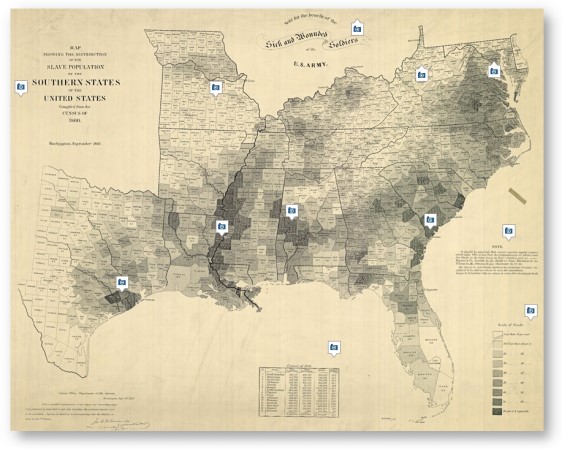
The first one is a “Map of American Slavery,” published in the New York Times (small thumbnail below, you can click on it to go to the larger version at the NY Times site). For casual historians like me, it is interesting to see that the counties that had the highest concentration of slaves were generally located along the Mississippi River and whose labor was in demand the most to facilitate trade, further reinforcing the notion that so much of the American south’s economy was fundamentally tied to slavery.
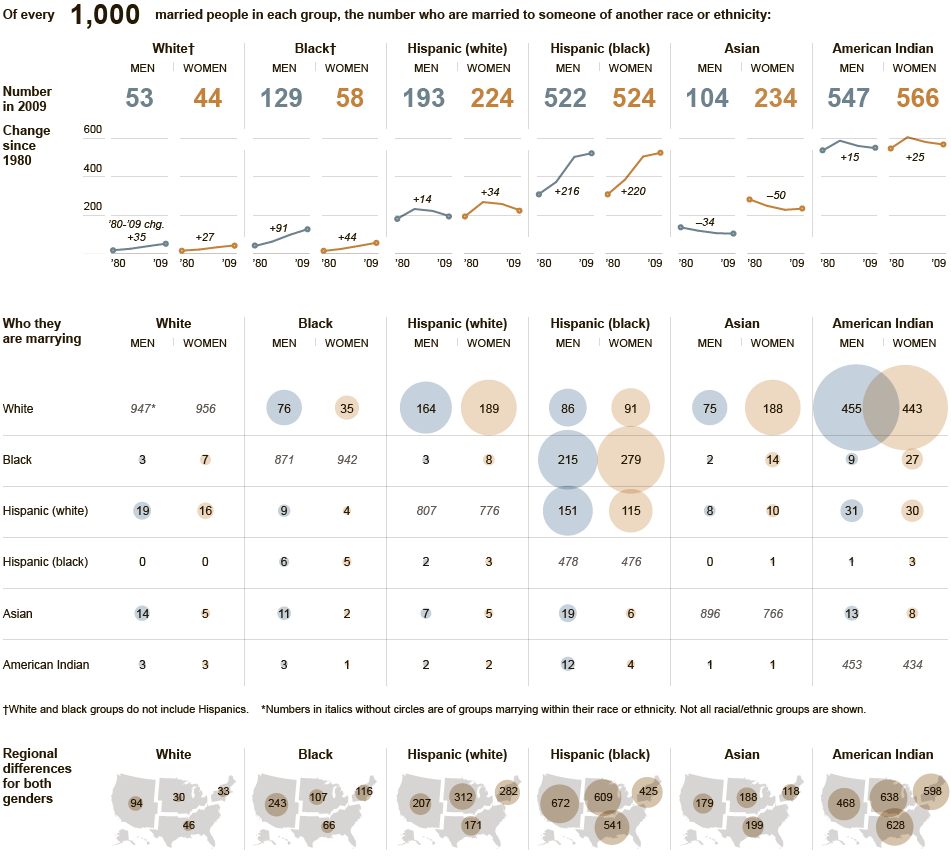
The second interesting infographic is entitled “Who is Marrying Whom,” also was published by the New York Times, and shows a visual breakdown of interracial marriage across the major racial/ethnic groups in the U.S. (again, you can click on the thumbnail below to see the full-size version). In looking it over, some of the most interesting results are:
The groups that seem to have the highest rates of being interracially married are American Indians and Black Hispanics.
The largest gender disparities are among Blacks and Asian Americans, although the gender pattern is the opposite for each: Black men are 124% more likely to be interracially married than Black women, while Asian American women are 125% more likely to be married interracially than Asian American men.
Since around 1990 or so, interracial marriage rates have actually been declining for White Hispanics and American Indians. Moreover, for Asian Americans, they’ve been generally declining since 1980. For White Hispanics and Asian Americans, I believe much of this decline is due to the large influx of immigrants since the ’80s and ’90s, many of whom are already married as they arrive in the U.S. or are less likely to intermarry in general. As such, it would be interesting to see these same numbers for just U.S.-raised members of these racial groups (those who were born in the U.S. or arrived at at 13 or younger and therefore, and therefore were socialized within the U.S. racial landscape).
The interracial marriage graphic is linked to an interesting article also on the NY Times site that discusses the growing multiracial/mixed-race population in the U.S. and how they are increasingly forging their own identity that combines elements of both sides of their ancestry, rather than trying to fit themselves into preexisting and frequently narrowly-defined racial/ethnic categories, as this video clip shows:
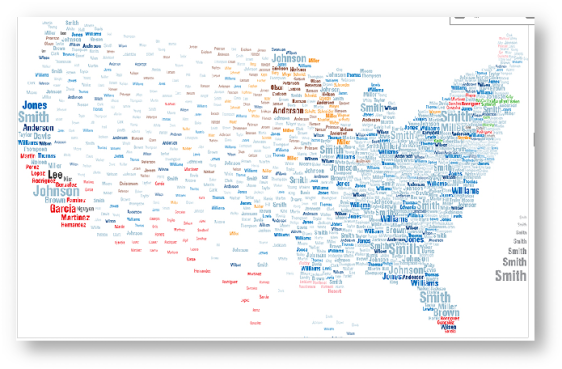
A third interesting infographic was published by the National Geographic Society, titled “What’s in a Surname?” and shows some of the most common surnames in different geographic parts of the U.S. The map confirms what demographers have noted for some time now — racial/ethnic minorities (represented here by their surnames) are increasingly becoming the majority population in many parts of the U.S. (again, click on the thumbnail below to view the larger interactive graphic at the National Geographic Society site).
As one example, in the southern California part of the map, some of the most common surnames are Garcia, Martinez, Hernandez and even Nguyen (a nod to the huge Vietnamese American “Little Saigon” community in Orange County). There are further large concentrations of Latino surnames (represented in red) in the southwestern U.S., southern Florida, and upstate New York as well. And unbeknown to me, there is apparently a large contingent of Koreans named “Kim” in central California.
This is the second of my three-part list of the best documentaries that focus on immigration and are great choices for showing in high school and college immigration classes. This second part will focus specifically on the issue of unauthorized immigration. We all know that unauthorized immigration has become one of the most controversial, hotly-debated, and emotionally-charged issues in American society today. In that context, these documentaries highlight various sides of the debate and taken together, will hopefully provide a more comprehensive picture of this complicate and often contradictory issue.
Part 1 focused on the historical and global context of immigration and Part 3 will look at socioeconomic attainment, mobility, and assimilation. The following list is organized by topic and corresponds to the chronological order in which I discuss each topic in my “Sociology of Immigration” course. For each topic, I highlight the documentary that I tend to show the most often, followed by other videos that are good choices for that topic as well.
Unauthorized Immigration: The Basics
As the name implies, this section lays out the basic historical, political, and economic foundation and concepts that frame the contemporary nature of unauthorized immigration. I focus much of the discussion on such immigration from Mexico but also stress that much of the unauthorized immigrant population are people who had official permission to enter the U.S., and with that in mind, why we as a society focus such a disproportionate amount of attention on those from Mexico.
Farmingville: This video chronicles the events surrounding the influx of Mexican day laborers in the town of Farmingville, NY on Long Island. While the video is about 10 years old now, it still provides an excellent overview of the institutional factors that precipitated the arrival of so many day laborers, along with the individual-level tensions and hostilities that eventually resulted in the community.
In this section, I describe historical and contemporary examples of how immigrants from various backgrounds and countries have encountered nativism, xenophobia, and racism upon their arrival. At the same time, I also focus on how such hostility and tensions have been magnified in recent years against unauthorized immigrants and the racial/ethnic connotations behind them.
9500 Liberty: Produced by acclaimed filmmakers Eric Byler and Annabel Park, this documentary describes how Prince William County, Virginia became ground zero in the national debate over unauthorized immigration several years ago. Specifically and as a preview of Arizona’s SB1070, it describes how newly-elected officials passed a law requiring police officers to question anyone they have “probable cause” to suspect is an undocumented immigrant.
This section explores the various proposals, programs, and laws that attempt to address the unauthorized immigration issue. I cover the pros and cons of both the “enforcement only” and “comprehensive reform” approaches, as well as examining the variety of costs and benefits that unauthorized immigration have on American society and its economy.
“Immigration” episode of the reality TV show 30 Days (Season 2): Created by Morgan Spulock (the guy who made Supersize Me in which he only ate McDonalds fast food for 30 days), this particular episode follows the experiences of a conservative Cuban American who participates in the Minuteman vigilante border patrols. He then agrees to live with an unauthorized immigrant family for 30 days and in the process, learns more about the institutional and individual aspects of their lives. An extremely powerful portrayal that should be required viewing in all immigration courses.
This section highlights the immigration process and experiences of women, children, and families specifically. I examine the multi-level issues involved in transnational families where parents are separated from their children and the effects that workplace raids by Immigration Control and Enforcement agents have on unauthorized immigrant families.
Maid in America: This documentary follows the lives of three Latina domestic workers in the Los Angeles area. Through looking at their daily lives, we see how they balance the satisfaction of earning money for them and their families, versus the emotional toil of being separated from much of their family, including their young children.
This spring semester, I am again teaching my “The Sociology of Immigration” course, whose description reads, “This course examines who, why, and how different groups immigrate to the U.S. and what happens once they arrive — how they are received by mainstream society and how they adjust to their new country. Specific issues include settlement, education, identity, assimilation, discrimination, employment, language, marriage, legal status, and political participation.”
With that in mind, I would like to share my list of films, videos, and documentaries that I think are good choices for showing in introductory classes focused on immigration (the videos are most suited for college and advanced high school courses). As we all know, the political, economic, and cultural issues related to immigration are some of the most emotional, controversial, and hotly-debated topics in American society today. While the documentaries listed here tend to emphasize a comprehensive approach to immigration reform, they all do an excellent job in portraying and highlighting just how complex and even contradictory this issue is.
The following list is organized by topic and corresponds to the chronological order in which I discuss each topic in my “Sociology of Immigration” course. For each topic, I highlight the documentary that I tend to show the most often, followed by other videos that I consider to be good choices for that topic as well. This post focuses the the first few topics of my immigration course — the history and global context of immigration. Part 2 will focus on issues specific to unauthorized immigration and Part 3 will emphasize socioeconomic attainment, mobility, and assimilation.
Basic Concepts: The Racialized Landscape
In this first section of the course, I lay out the sociological framework and institutional nature of the U.S.’s racial/ethnic landscape, within which the issues of immigration are framed and structured. I focus on how, contrary to historical and contemporary ideals of being “colorblind,” American society has been and continues to be highly racialized and these mechanisms of racialization impact immigration.
Race: Power of an Illusion (Episode 2): This excellent PBS series explores the social and political construction of race and perceived racial differences. As it relates to immigration, this episode takes an in-depth look at how the identity of “American” has been closely linked with Whiteness and the inherent barriers that people of color and immigrants have to overcome in order to formally and informally be considered “real” Americans.
The Color of Fear
Race, the World’s Most Dangerous Myth
Understanding Race
Historical Patterns of Entry and Restriction
In this section, I summarize the major waves of immigration into the U.S. through the years, along with the evolution of immigration laws and regulation in U.S. history.
Between Two Worlds: Produced by PBS and part of the Becoming American series, this episode examines the events leading up to the Chinese Exclusion Act of 1882 and its effects on Chinese Americans and their families who were kept apart by both ancient custom and U.S. law. It also describes way in which a few laws also provided relief as Chinese Americans turned to the courts for justice.
This section explores the multidimensional and multi-level process of how immigrants have been received by mainstream American society and how they have adapted to the challenges and opportunities in the first generation of life in the U.S. I also discuss the major theories of why and how immigration happens, particularly as they relate to global political, economic, and cultural forces.
Mountain’s Mist and Mexico: Part of the After the Immigrant documentary series, this episode follows the stories of individual Mexican immigrants to illustrate the interconnected push and pull factors that have contributed to the long history of Mexicans in the U.S.
From a Different Shore: The Japanese-American Experience
The Global Context
Drawing on the global issues inherent in the immigration process, this section explores some examples of the variety of experiences and issues of immigration in other countries around the world. Students in my class find it useful to compare and contrast the experiences of immigrants in other countries to those of immigrants to the U.S.
Dying to Leave: The Dark Business of Human Trafficking: This video illustrates how globalized forces can lead to desperation on the part of people, who then become unwittingly entangled in the illicit human trafficking business in many countries around the world.
I presume that by now, all of you have heard about the debate and controversy over Amy Chua’s book Battle Hymn of the Tiger Mother, her accompanying article in the Wall Street Journal provocatively titled, “Why Chinese Mothers Are Superior,” and the resultant backlash throughout American society and on the internet from Asian Americans and non-Asians alike.
Although I have not yet read her book, from her various public appearances lately and based on other people’s summaries of her points, I understand that her main arguments are that American parents tend to be too lax in their parenting styles, particularly when it comes to not emphasizing hard work, persistence, and total commitment to education and other tasks necessary for your child to be a high achiever in contemporary American and global societies. In her own words on the Wall Street Journal article, she writes:
A lot of people wonder how Chinese parents raise such stereotypically successful kids. They wonder what these parents do to produce so many math whizzes and music prodigies, what it’s like inside the family, and whether they could do it too. Well, I can tell them, because I’ve done it. Here are some things my daughters, Sophia and Louisa, were never allowed to do:
attend a sleepover
have a playdate
be in a school play
complain about not being in a school play
watch TV or play computer games
choose their own extracurricular activities
get any grade less than an A
not be the No. 1 student in every subject except gym and drama
play any instrument other than the piano or violin
not play the piano or violin . . .
To get good at anything you have to work, and children on their own never want to work, which is why it is crucial to override their preferences. This often requires fortitude on the part of the parents because the child will resist; things are always hardest at the beginning, which is where Western parents tend to give up. But if done properly, the Chinese strategy produces a virtuous circle. Tenacious practice, practice, practice is crucial for excellence; rote repetition is underrated in America.
I’ve been meaning to comment on her points for a while and I also know that there are plenty of other writers and bloggers who have already weighed in on this subject. However, I’ve been occupied with preparing for the start of the new semester and have not been able to read many of their responses yet. Therefore, I apologize if I am restating points that others have already brought up.
As I describe in more detail below about the specific arguments Chua makes that I agree and disagree with, the main point that I want to emphasize is that parenting does not have to be an “either-or” proposition — there does not have to be a rigid line drawn between “rigorous” and “permissive” styles, nor does there have to be a complete separation of “Chinese” and “American” styles. As I have consistently emphasized throughout this blog, frequently there is an artificial division between these two identities that inevitably creates unnecessary barriers, misunderstandings, and tensions between all those involved.
Instead, I want to emphasize that it is possible to achieve a balance between these two identities. This is what Asian Americans have been doing for a while now — taking different elements of each culture to meld and synthesize them into their own style that includes the best of each. As I discuss below, I believe this applies to parenting styles and the drive for achievement and success as well.
In Defense of Chua
One of her points with which I agree is that for whatever reasons, it is very common and indeed beneficial for many (as in a large number, but certainly not all) Asian, Asian American, and immigrant parents to place a very strong and heavy emphasis on educational achievement and success. Many native-born American parents do so as well, but I am reminded of an article that I used for a previous course on racial/ethnic demography, “Test-Score Trends Along Racial Lines, 1971 to 1996: Popular Culture and Community Academic Standards,” written by Ronald F. Ferguson (a chapter in America Becoming: Racial Trends and Their Consequences, 2001). The article described data to show that when it comes to parental expectations of their children’s academic performance, Asian parents who were high school dropouts still had higher expectations of their children than White, Black, and Latino parents who had a college degree.
My point is, it is not necessarily a bad thing to expect your children to not just perform well, but to excel, academically or otherwise. Particularly in this age of globalization, the need for advanced educational and professional skills in order to stay competitive in the global marketplace is readily apparent and increasingly stressed by almost everyone from all backgrounds. We also know that, as it currently stands, the American educational system needs much improvement in terms of preparing our young people to meet the challenges of the 21st century. In other words, as a society, we as Americans should not and cannot settle for mediocrity if we expect to retain our standard of living.
As other sociological research as also shown, many Asian and Asian American parents also understand that as a racial minority in American society, almost by necessity, they need to push their children a little further to make sure that they are able to overcome some of the hurdles and barriers that stand in our way when it comes to socioeconomic success and full institutional integration into American society, especially in tough economic times when competition for jobs and other resources is even more intense and potentially filled with racial tension and hostility.
With this in mind, I also find it quite unfortunate that some of the criticism directed at Chua includes elements of racism that link her to China’s recent emergence to become the new “yellow peril” threat to the U.S. and even death threats against her personally. Time magazine’s recent article on this debate summed up the global context of this debate nicely:
The tiger mother’s cubs are being raised to rule the world, the book clearly implies, while the offspring of “weak-willed,” “indulgent” Westerners are growing up ill equipped to compete in a fierce global marketplace. . . .
These national identity crises are nothing new. . . . In the 1980s, we fretted that Japan was besting us with its technological wizardry and clever product design — the iPod of the ’80s was the Sony Walkman — and its investors’ acquisitions of American name-brand companies and prime parcels of real estate. . . . [Now] our rivalry with the Japanese has faded as another one has taken its place: last year, China surpassed Japan as the world’s second largest economy.
The U.S. is still No. 1 — but for how long? We’re rapidly reaching the limit on how much money the federal government can borrow — and our single biggest creditor is China. How long, for that matter, can the beleaguered U.S. education system keep pace with a rapidly evolving and increasingly demanding global marketplace?
Such fears about the U.S. losing its position as the unquestioned political, economic, and cultural superpower are real and valid. At the same time, it is one thing to criticize Chua for her parenting style, but it’s a different matter altogether to reinforce and perpetuate anti-Asian stereotypes and advocate committing violence towards her and others who are perceived to be threats to the “American” way of life. In fact, for many Asians and Asian Americans, such racism only confirms the ongoing challenges we face and the need to overachieve as a reaction to such racial hostility.
Criticisms for Chua
On the other hand, Chua’s style of parenting is certainly not for everybody and in many respects, has the danger of creating some very negative consequences. When it comes to Asian Americans and the model minority image, I’ve written many times before in this blog about the need to balance the drive for success with caution against excessive parental and societal pressure. As a community, unfortunately Asian Americans have experienced too many incidents in which too much parental pressure on their children has led to incidents of suicide and violence. In fact, it is well worth repeating that Asian American women between 15-24 years old have the highest suicide rates of any racial, ethnic, age, and gender group in the U.S.
More generally, I also feel that Chua unnecessarily and unfortunately reinforces this artificial distinction between “Chinese/Asian” and “American.” Beyond the inherent overgeneralizing that Chinese mothers do this while American mothers do that, Chua does not seem to give much credence to the possibility that many Chinese Americans and Asian American parents do both — that we combined the best elements of the different cultures with which we’re familiar. In fact, this is just another example of the kind of “transcultural” assimilation that Asian Americans have done ever since we first arrived in the U.S.
As this CBS News video shows, even parents in China are increasingly rethinking their “success at any cost” approach to parenting that Chua insists is “superior”:
As it relates to parenting, I also do not believe it is not a contradiction to instill a drive for achievement and excellence while also nurturing a sense of independence and an understanding that there is more to life than just material success. Toward that end, I personally do not feel that, in order to stress the importance of personal achievement, parents need to berate, criticize, or shame their child. Chua’s “tough as nails” methods may eventually instill a sense of confidence and achievement in her daughters but I am pretty sure there are less harsh and extreme ways to accomplish the same thing. They might include letting our children work out herself many of the interpersonal difficulties that they encounter everyday and explaining to the child the various individual and institutional challenges that lie ahead of her them and that if they expect to have a comfortable standard of living, they will need to accomplish and at times, master certain tasks toward that goal.
Perhaps I am being too idealistic to think that my daughter has the ability to truly understand these multi-level and long-term issues about what she needs to do now in order to have certain things later. But then again, isn’t that what Chua is basically telling her daughters as well?