The views and opinions expressed on this site and blog posts (excluding comments on blog posts left by others) are entirely my own and do not represent those of any employer or organization with whom I am currently or previously have been associated.
Academic Version: Applying my personal experiences and academic research as a professor of Sociology and Asian American Studies to provide a more complete understanding of political, economic, and cultural issues and current events related to American race relations, and Asia/Asian America in particular.
Plain English: Trying to put my Ph.D. to good use.
Wired News reports that Microsoft has been working directly with the Chinese government in censoring material on its Chinese language web portal:
The policy affects blogs created through the MSN Spaces service, said Adam Sohn, a global sales and marketing director at MSN. Microsoft and its government-funded Chinese business partner work with authorities to omit certain forbidden language, Sohn said. . . [B]loggers were not allowed to post terms to MSN Spaces such as “democracy,” “human rights” and “Taiwan independence.” Attempts to enter those words were said to generate a message saying the language was prohibited. . . .
China’s government encourages internet use for business and education but tries to ban access to material deemed subversive. Chinese censors scour internet bulletin boards and blogs for sensitive material, and block access to violators. Sites that let the public post comments are told to censor themselves or face penalties.
Sohn said heavy-handed government censorship is accepted as part of the regulatory landscape in China, and the world’s largest software firm believes its services still can foster expression in the country. “Even with the filters, we’re helping millions of people communicate, share stories, share photographs and build relationships. For us, that is the key point here,” he said.
I suppose it is inevitable that when you work with the Chinese government, you’ll have to agree to many of their terms, which includes censorship. To be fair, other articles note that many U.S. Internet companies, such as Yahoo and Google, do the same thing. But it is still a little sad to see a company like Microsoft, who supposedly prides itself on providing people the means to maximize communication and creative expression, acede to demands that they censor such communication and expression.
Oh well, anything to promote capitalism I guess . . .
CBS News and other media outlets are covering Vietnamese Prime Minister Phan Van Khai’s visit to the U.S. this week and his attempts to win the U.S.’s support for Viet Nam to join the World Trade Organization.
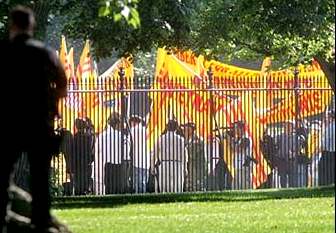
Not surprisingly, two other issues are at the forefront — Americans still want Viet Nam to provide a fuller accounting of U.S. military personnel who are still listed as “missing in action” and as shown by the picture above, Vietnamese Americans are following Phan’s visits to protest the communist government and its record on human rights and civil liberties in Viet Nam:
[Khai] said although there were cultural and historic differences between the United States and Vietnam he and Mr. Bush agreed the two nations could work together to reduce differences and improve bilateral relations. Khai’s talk with Mr. Bush is part of a weeklong visit to the United States where he is meeting with business leaders on both coasts. Khai is ringing the opening bell at the New York Stock Exchange later this week — evidence of Vietnam’s economic gains over the years. . . .
After his discussions with Mr. Bush, Khai planned to meet with Defense Secretary Donald H. Rumsfeld. Military ties between the two countries have included periodic docking of U.S. warships in Vietnam and plans for U.S. military training of Vietnamese officers. Intelligence sharing and cooperation on counterterrorism activities also are part of the mix. Also Tuesday, officials from the two countries will sign an agreement at the State Department to cooperate on adoptions.
While Khai will want to talk about business, Mr. Bush is being pressured by human rights groups and some members of Congress to link any trade concessions with improvements in Vietnam’s human rights record. The U.S.-based Human Rights Watch says it has documented cases of abuses by the communist government, including the arrests of dissidents for promoting democracy or human rights. In Seattle, Khai was greeted by demonstrators who shouted “Down with communists!” and called for an end to political and religious persecution.
CNN reports that a museum about Chinese Americans in the Midwest recently opened in Chicago, and was all due to the efforts of a small group of dedicated individuals:
With $1,000 and a stubborn desire to build a museum for Chinese-Americans, Chuimei Ho and five others took their message to the streets, speaking at small gatherings about the rich history of Chicago’s Chinatown. . . . Their monthly lectures led to donations of money, a building and antiques from local families. Three years and $1 million later, the Chinese-American Museum of Chicago opened its doors inside a former wholesale warehouse in mid May.
The article also notes that the museum even has plans to expand and hire full-time employees. Congratulations and best of luck to Chuimei Ho and everyone involved with the Chinese American Museum of Chicago. It’s a great example of determination and personal initiative to educate American society about the history, experiences, and contributions of Chinese (and Asians in general) in the U.S.
As one further example of outsourcing in the U.S., the Christian Science Monitor reports that more schoolchildren in the U.S. are turning to tutors in India to help them with their schoolwork:
Americans have slowly grown accustomed to the idea that the people who answer their customer-service and computer-help calls may be on the other side of the globe. Now, some students may find their tutor works there, too. . . . But critics worry about a lack of tutoring standards and question how well anyone can teach over a physical and cultural gulf. The fact that some of the outsourced tutors may be used to fulfill the No Child Left Behind (NCLB) supplemental education requirements – and get federal funds to do so – has been even more controversial. . . .
“We don’t know who’s tutoring the students, we don’t know what their qualifications are, and we’re concerned about their familiarity with the curriculum in the districts of the students they’re tutoring,” says Nancy Van Meter at the American Federation of Teachers (AFT). . . . Still, while the AFT and others, including US Rep. George Miller (D) of California, have been quick to pounce on the practice, its proponents wonder why qualified teachers should be kept from helping kids, just because they’re in a foreign country.
It’s a different form of outsourcing, but the same old arguments are being used here — critics ask whether the Indian workers are qualified to do their job and whether Americans will accept outsourced services from foreign workers, while supporters argue that despite cultural differences, the Indian workers are just as qualified and that the whole process will ultimately benefit Americans and strengthen the whole economy.
I still can’t say for sure whether I am pro- or anti-outsourcing — there are just too many variables and different circumstances to take into consideration. But there’s one thing that needs to be kept in mind by all sides — outsourcing is a natural consequence of living within a capitalist economy. If outsourcing critics want someone to blame, they need to blame the capitalist system in which they live and support in many different ways — not workers halfway around the world who are just trying to make a living.
The Christian Science Monitor has an article which chronicles recent signs that hate crimes are on the rise in the U.S. The article postulates that some of the rise may be due to anti-immigrant sentiment in the wake of the 9/11 attacks and the Iraqi War, some is a backlash against gay marriage, while others are influenced by increasing religious fundamentalism. As some observers note,
Such trends can be difficult to gauge. States and localities use different definitions and reporting requirements. As the subject grows in public consciousness, incidents that may have gone unreported in the past now become known, giving the sense of an increasing problem. But, says Chip Berlet, an analyst at Political Research Associates in Somerville, Mass., who specializes in hate groups and far-right activity, “I have seen what appears to be an increase in anger toward gay people and immigrants, as well as anti-Semitic conspiracy theories.” . . .
The underlying conflict over such “values” issues in politics and society has sharpened the tone of public discourse, with opponents characterized as “evil” or “immoral” on talk radio or the Internet. What’s missing today, says Brian Levin of the Center for the Study of Hate and Extremism, “is the idea of democracy as compromise, as opposed to all-out victory at any cost.” The result, he says, is a divided country and a lack of goodwill exemplified by personal attacks in politics and the media. In turn, that can lead to individual threats and assaults.
I think there is something to the argument that American society is becoming increasingly polarized between Republicans and Democrats, liberals and conservatives, blue states and red states, Christians vs. non-Christians, and perhaps many other axes of differences. A more difficult question to answer is, how will this affect Asian Americans?
Since many Asian Americans are immigrants and are non-White, it would seem that many of us would be targets for these kinds of hate crimes. Further, if we as a community continue to achieve socioeconomic success, we may feel more resentment from Latinos and Blacks. Conceiveably, we may even begin to encroach upon White-controlled institutions and be seen as a threat to their power.
In other words, unless we unite as a community and form alliances with other groups of color, we may end up being left high and dry, disparaged and despised by both Whites and other groups of color.
Fresh on the heels of stories proclaiming that college-educated Asian American women make more than White women, as reported by The Arizona Republic, the Center for Women’s Business Research notes that the number of Asian women-owned small businesses have surged in recent years:
Nationally, the number of Asian women-owned businesses surged 69 percent between 1997 and 2004. That’s about twice as fast as other minority groups. Sales and employment also have soared. Meanwhile, overall business numbers grew 9 percent.
Asian women become entrepreneurs for the reasons others do: to boost their earnings potential, to balance work and home life or to pursue an idea, experts say. But the top reason is that they desire independence.
The article notes, and as I’ve found out in my own research on Asian American self-employment, there are a variety of reasons why Asian American men and women go into business for themselves. Some of it is opportunism, while others are of a last resort. Whatever the motivation, it’s encouraging to see Asian American women taking the initiative to work toward their success.
CNN has a story about former King of Cambodia Norodom Sihanouk and his penchant for blogging:
“My country, Cambodia, has chosen to be a liberal democracy since 1993. Every Cambodian … including the King has the right to express freely their view.” It was one of thousands of commentaries that fill the Web site of the world’s most colorful and pugnacious royal blogger, offering Sihanouk’s views on anything from environmental rape through Hollywood stars and killer spouses to the rough-and-tumble of Cambodian politics.
Today at 82 . . . he’s as sharp-tongued and loquacious as ever. The man who grew up on cowboy movies has taken to the Internet with equal gusto. . . Sihanouk’s Web site, which incorporates his blog in French, Khmer or English, attracts about 1,000 visitors daily from around the world. . . [S]ays David L. Sifry, whose company Technorati tracks blogs, Sihanouk is making “incredibly innovative use of the Internet to be able to communicate directly with the people of Cambodia and the people of the world.”
I think it’s pretty cool — many Asian cultures and politicians aren’t exactly known for being cutting edge and socially innovative, so it’s nice to see one example where Asians are embracing modern tools of communication, especially when he’s a former king and 82 years old. Pretty impressive.
CBS News has a story that describes the growing popularity of Chinese language classes in elementary and secondary schools around the country. Apparently, more and more parents feel that as China emerges as the next superpower, it would give their children an edge later in life to be able to communicate directly in Chinese.
I suppose it’s a positive trend — not only in terms of kids actually learning Chinese (which has the largest number of native speakers in the world), but also in that it indirectly promotes better respect and understanding of the Chinese culture, and by implication, Asian and Asian American culture as well.
The San Francisco Chronicle reports that they have obtained a copy of an training tape, produced in-house by the San Francisco 49ers’ public relations director Kirk Reynolds, which includes several off-color depictions of life in the San Francisco area. As the article notes, they include spoofs about lesbians, gay marriage, topless dancers, and unfortunately, about Asian Americans:
The 15-minute video . . . was intended as a primer on how players should handle the media in diverse San Francisco. Instead, it’s turned into a team embarrassment — with PR man Reynolds looking for another job. . .
[The video] opens with Reynolds impersonating the mayor and speaking directly into the camera about this “beautiful, diverse and tremendous city.” “I’m going to take you through the city,” Reynolds says — and what a trip it is.
First stop, Chinatown. Reynolds says the team reads everything written about the players and the organization. Then, to illustrate the point, a bespectacled, buck-toothed Chinese man in an aloha shirt (played by then-49ers trainer and martial arts expert George Chung) is asked to translate an Asian newspaper story.
Sure — the man says in theatrical Asian accent. “Tim Latte (Rattay, a Niners quarterback). He feel good now. He feeling good. No plactice with the team, so most of the time he play with himself.” Another show stopper: “49ers love being in community. Very patriotic . . . support president and his George Bush erection.”
“Erection?” Reynolds asks. “Yes,” the Chinese man responds. “It say, ‘You like Bush –then you like his erection.’ “My name is Suck Hung,” the Chinese man says as he’s leaving. “My brother’s name is Suck Young –my whole family suck.”
Needless to say, Gavin Newsom (SF’ss mayor) and the 49er ownership are not amused and Reynolds is now apparently looking for a new job. Although I can appreciate the “locker room” humor tone of the video, the fact that it uses the stereotype of nerdy Asian foreigners with exaggerated accents is very offensive. What’s even more offensive to me is that an Asian American (49er trainer) George Chung willingly participated in it and indeed played up his buffoon role.
Although the 49ers organization has apologized to the Chinese American community in San Francisco, it all goes to show that ignorance comes from both sides — Asian Americans are not immune to reinforcing and perpetuating stereotypes against themselves.
Danny Graves is an Amerasian (mother is Vietnamese, father is White) reilef pitcher for the Cincinnati Reds and has been one of their best players for the past eight years. However, last week, he was abruptly released (fired) by the Reds. Their explanation was of his recent slump and ineffective performances. However, most observers argue that it was because he cursed and flipped off a fan who was heckling him after a recent performance.
To make matters worse, the San Jose Mercury News reports that the fan’s heckling also contained a racial epitath: “”Go back to Vietnam, you slant-eyed (vile epithet)!” As noted in the article, Danny’s teammates were generally shocked to hear that their teammate’s employment with the club was terminated so abruptly: “As first baseman Sean Casey put it: ‘Put him on the (disabled list). Pitch him in mopup to let him try to get it right. Don’t throw him out like garbage.'” Another article at CNNSI.com notes,
Stunned teammates sat in folding chairs in the clubhouse after learning of the move, which leaves the team without a proven closer. Several players said Graves should have been given a chance to work out his problems. “This is not his fault,” first baseman Sean Casey said. “We stink. For us to be 15-28 has nothing to do with Danny Graves. That’s the frustrating part for me.
“I know I’m a little emotional right now, but I think the Cincinnati Reds as an organization owe a lot more to Danny Graves for the eight years he stepped up every year. They owe him more than to just release him like this. I just disagree with it.”
Outfielder Ken Griffey Jr. said he’s never seen anything quite like the move. “It’s tough,” Griffey said. “He’s not a troublemaker. He’s not a guy that complained. He wants the ball. It’s just upsetting. It’s a tough way to lose a guy that’s been here and dedicated himself to the organization.”
As one of the few Asian American (as opposed to Asian) professional baseball players in the sport, it is indeed sad to see his career take such an unpleasant turn. But considering that he played for the Cincinnati Reds, it’s probably not that huge of a shock that he would be treated is such an insensitive, callous, and indeed hostile way.
For those who don’t know, the Cincinnati Reds organization was onced owned and controlled by Marge Schott, whose racial insensitivites were legendary. For example, she routinely called her Black ballplayers her “high-priced niggers” and once said that Adolf Hitler was misunderstood — that he had “good ideas but went too far.” After a few of these embarassing incidents became public, Major League Baseball officials suspended her and ultimately forced her to sell her interest in the team.
But that’s not all — many community activists and scholars know Cincinnati to have one of the worst race relations problems in the entire country. It’s a city in which several young Black men have been shot by White police officers in recent years. It was also where Vincent Chin’s murderers were acquitted by an all-White jury of violating Vincent’s civil rights when they bludgeoned him to death with a baseball bat.
In short and in retrospect, I suppose it was only a matter of time until the city of Cincinnati and its residents showed their true racist colors. I hope Danny Graves signs with a better team that has a few less racist redneck fans.
The Washington Post has an article that describe several recent efforts to develop TV programming aimed at the emerging Asian American population. As the article points out,
Over the past year, at least a half-dozen English-language, 24-hour cable and satellite networks targeting Asians have started or announced plans, such as Comcast-owned AZN and MTV’s three channels for Indian, Chinese and Korean immigrants. They are all clamoring to reach markets with large Asian populations. . . .
As competition intensifies, the networks have discovered that the programming of yesteryear (think amateurs croaking songs on Saturday mornings) no longer cuts it. Unlike the mammoth Latino market, Asians cannot be unified by language, so programmers are trying to lure an audience that straddles several niches. And they compete mightily to create content that will resonate across Asian subgroups and eventually into the mainstream, bringing in the viewers and advertising revenue they need to survive. . . .
In an industry with entire channels devoted to foodies and fashionistas alike, niche programming still needs to reach out and touch everyone. So shows are developed for Asians, as broad as such an audience already is, and sometimes taken even broader. With enough luck and buzz, they could be the next “Iron Chef” (Food Network) or “Queer Eye for the Straight Guy” (Bravo).
I find it interesting that on the one hand, several “mainstream” media powerhouses apparently have an interest in developing programming aimed primarily at Asian American audiences, but on the other hand, many of these same media companies are so resistant and utterly clueless about incorporating Asian Americans into their own “mainstream” TV shows, as evidenced by the continuing criticism that they receive from APA organizations about the lack of Asian American characters in primetime TV.
In other words, they want our eyeballs and our money, but don’t want to spotlight us to a general audience — kinda like they’re ashamed of us or something. Hmmm . . .
The Pacific News Service has an interesting story about the recent emergence of Washington D.C.’s Chinatown. It describes that in the past, this very small Chinatown was just another area of a neglected urban landscape, rife with crime and stagnation. However, in recent years, due to a pro-business mayoral administration and development, trendy and fashionable stores are now located right next to established Chinatown businesses:
As a popular tourist attraction, however, Chinatown still functions well. Every Chinese New Year, thousands of affluent Chinese American families from nearby Maryland and Virginia come to watch the annual parade. And on weekdays, the district’s dozen remaining Chinese restaurants are packed full with hungry office workers. . .
Affluent national retail chains like Starbucks, Ruby Tuesday, TGIF, Anne Taylor and Hooters have elbowed their way into the six square block ward, giving a flashy, plate-glass gloss to the neighborhood.
For China-born Heung Me Ie, 75, who has lived in Chinatown for 15 years and works as a caretaker in the small Kwun Yum Temple, the changes are welcome. “I think the new shops and restaurants are all good,” she says in Cantonese. “Even if they are not Chinese, they make the streets more lively.”
Time will tell if these new corporate-backed non-Asian businesses eventually squeeze the older, smaller, more established Chinese businesses out (as they have apparently already begun doing), but for now at least, it sounds like it’s a “successful” blending of new and old, Asian and non-Asian — just like America itself.