The views and opinions expressed on this site and blog posts (excluding comments on blog posts left by others) are entirely my own and do not represent those of any employer or organization with whom I am currently or previously have been associated.
Academic Version: Applying my personal experiences and academic research as a professor of Sociology and Asian American Studies to provide a more complete understanding of political, economic, and cultural issues and current events related to American race relations, and Asia/Asian America in particular.
Plain English: Trying to put my Ph.D. to good use.
Have you ever wondered how people type in Chinese? In other words, while English (and other letter-based languages) speakers like us have only around 26 Roman letters to use, the Chinese use thousands of characters to represent their language. Do they have a giant keyboard with thousands of keys on it? Of course not — it’s actually quite simple and users have different options:
In the Peoples’ Republic of China, most computer users type out their Chinese in transliteration, using the standard Roman alphabet keys on a QWERTY keyboard. To generate a character, you type out its sound according to the same spelling system — called Pinyin — The computer automatically converts the Pinyin spelling to the correct Chinese characters on the screen. . . . If the computer still doesn’t have enough information to pick a character, you’ll have to choose from a pop-up list of possibilities. . . .
Speed-typists in mainland China use another input method called Wubi. To type a character in Wubi, you punch in a sequence of keys that corresponds to what it looks like and how it’s drawn. A Wubi-configured keyboard looks just like the Western version but is divided into five regions for different types of pen strokes: left-falling, right-falling, horizontal, vertical, and hook.
You “spell” a character by typing out up to four strokes, in the order in which you’d draw them on paper. If he knows what he’s doing, a Wubi typist can produce up to 160 characters per minute. . . . Older people who aren’t comfortable with typing might be more inclined to use an electronic writing tablet instead. The precise strokes of Chinese characters make them relatively easy for a computer to distinguish.
Pretty interesting, I think, to now know how more than a billion people do the same things we do but using a different method. To paraphrase the old saying, “different (key)strokes for different folks” — diversity in action.
Catholicism is apparently becoming more popular and institutionalized in Viet Nam. After decades of repression at the hands of the communist government, there are tangible signs of official tolerance towards Catholics in Viet Nam, along with optimism for establishing official ties with the Vatican:
Religion is still a sensitive subject in Vietnam. The US accuses it of violating the rights of believers, particularly ethnic minority Christians in rural highlands. Vietnamese officials say they respect religious freedoms and point to recent legislation that bans forced conversions and gives equal protection to all faiths. . . .
Of the six official religions recognized by Vietnam, Catholicism ranks second behind Buddhism. It has between 5 million and 7 million followers, concentrated mostly in the south, and is reportedly becoming more popular among young urban Vietnamese who are enjoying the fruits of the country’s rapid economic growth.
As I’ve said before, as Viet Nam becomes increasingly integrated into the international community, it’s likely that some freedoms will improve, and it looks like that’s the case here. Although the article notes that there is still a long way to go before true freedom of religious exists in Viet Nam, this improvement in religious activity is indeed encouraging?
Now if only we can say the same thing about other freedoms of expression and a true democracy . . .
More than thirty years after it ended, Americans are still acutely aware of the legacy of the Viet Nam War. But in these ongoing discussions about the meaning and consequences of the war, apparently nobody bothers to ask us Vietnamese how we feel about it, as illustrated most recently by several high-profile conferences in which not one Vietnamese speaker was invited to participate:
For two days (March 10-11), the John F. Kennedy Presidential Library in Boston will host a conference on “Vietnam and the Presidency,” under the auspices of the National Archives and all 12 presidential libraries. Conference organizers have invited an impressive list of political big-shots. . . . The organizers claim to address a wide range of issues and new information, yet curiously, not a single Vietnamese was among the invitees.
In politics, the media and academia, the voice of Vietnamese and Vietnamese-Americans is rarely heard. From the “Vietnam as History” conference at the Woodrow Wilson Center for Scholars in Washington, D.C., to the (USC) University of Southern California’s “Vietnam Reconsidered” event in early 1983 to the recent Oakland Museum conference and exhibit, “What’s Going On: California and the Vietnam Era” to the upcoming JFK library conference, the Vietnamese voice has always been circumscribed and gagged. . . .
By purposely framing the conference around Vietnam and the presidency, the organizers have effectively shut the Vietnamese voice out of the historical debate and sidestepped the issue of why America went to Vietnam in the first place. In case the pundits have forgotten, the American promise and premise was to secure the blessing of liberty and self-determination for the (South) Vietnamese people.
Unfortunately, while that last premise may have been used as the humanitarian ideal at one time in the past, we should know by now that the real why the U.S. got involved in Viet Nam — and as a result, the reason why Vietnamese are consistently excluded from contemporary discussions about the war — was to further their own geo-political interests, not to “liberate” us Vietnamese.
Similar to how President Lincoln’s ultimate goal in going to war was to keep the country intact, rather than often-cited magnanimous ideal of freeing the slaves, the U.S. went to war for itself, plain and simple. That’s the reason why the war is called “The American War” inside Viet Nam.
Hmmm, that kind of selfish approach couldn’t possibly happen these days, can it? An American regime using some idealistic and ultimately flawed rationale for going to war, and then struggling mightily to conduct it properly while fending off increasing opposition to it at home? The conference speakers would do well to talk about that past-present connection as the war’s biggest legacy.
Tuesday was International Women’s Day and thousands of women in many Asian countries rallied in support of themselves and their sisters worldwide:
Among leaders of the [Multan, Pakistan] rally was Mukhtar Mai, a woman who was gang-raped in 2002 on orders by a council of villagers near Multan as punishment for her brother’s alleged affair with a woman from a higher caste family. Mai drew international attention after she spoke publicly about her ordeal. . . .
In mostly Muslim Bangladesh, where women lead the ruling and main opposition political parties, thousands joined calls for an end to attacks with flesh-burning acid that leaves hundreds of women disfigured each year. . . . In the Indonesian capital Jakarta, hundreds more women marched against a proposed anti-pornography bill that would also make the baring of legs or shoulders in public a crime.
As you can see, women all around Asia still face numerous barriers in their quest for gender equality. Lets hope that as Asian countries continue their gradual march toward modernization and democracy that the women in those countries share equally in such political, economic, and social gains and measures of progress.
Americans trends have usually been popular in Japan as well. But one of the newest Americans trends that is increasingly becoming common in Japan is being fat and overweight. In fact, the rise of this trend is threatening to tarnish Japan’s status as one of the healthiest countries in the world:
“I don’t know for how long Japan can maintain the world’s highest longevity,” says Yukio Yamori, director of the International Center for Research on Primary Prevention of Cardiovascular Diseases. “If eating habits change, life expectancy will shorten and this has already been made clear.”
Still, Japan’s fat problem pales besides that of the U.S., reports Craft: While about one-third of Americans are obese, the rate for Japan is just 3 percent. Only 24 percent of Japanese aged 15 and older are believed to be overweight, compared to about 65 percent of adults in the United States.
But concern is growing over eating patterns like Sayaka’s. Instead of the fish, rice and miso soup of their grandparents’ generation, younger Japanese are increasingly wolfing down fast food like burgers, fried chicken and instant noodles. Bad diets and less exercise create what psychologists say is a vicious cycle: Fat kids are increasingly picked on at school, get depressed and find solace in eating even more.
Ahh, the march of American capitalism and consumer culture never ends. It pervades almost every corner of the world and is apparently powerful enough to change a national culture previous built on centuries, even millenia, of tradition. Japan, wake up and look at your waistlines before it’s too late.
Ang Lee became the first Asian to win the Academy Award for Best Director for his movie Brokeback Mountain, although Brokeback Mountain was upset for Best Picture by Crash.
With the exception of his movies produced in Asia such as Crouching Tiger, Hidden Dragon, up to this point, Ang Lee really hasn’t featured Asian Americans in his movies. Nonetheless, many Asian Americans see him as an inspiration and role model for Asians in the filmmaking business. I happen to agree and therefore congratulate him on finally being recognized as one of the top directors in Hollywood.
I also happen to agree that Crash deserved to win Best Picture of Brokeback Mountain. Having seen both movies, I was more impressed with Crash’s character development and intertwining of plot elements. Although I applaud the movie industry for recognizing gay-themed movies for excellence this year, I am more thankful that they also recognize the issues of racism and race relations just as prominently as well.
Can sports transcend war and politics? At the least, it could be a place to start trying — Christian Science Monitor in the continuing efforts to normalize relations between the U.S. and Viet Nam, a group of Americans that includes Cleveland Indians pitcher and Vietnamese Amerasian Danny Graves just inaugurated Viet Nam’s first baseball field:
Jan Scruggs, a decorated American veteran and founder of the Vietnam Veterans Memorial Fund (VVMF), smiled as he walked onto the field. Last year, he persuaded Major League Baseball and its suppliers to sponsor a goodwill tour of Vietnam and to inaugurate the country’s first-ever baseball field.
“Here is an opportunity for us to really turn a battlefield into a field of dreams,” he says. Baseball is a wonderful way “to reach out to people.”
The article also mentions that before they could build the baseball field, they had to clear away several pieces of unexploded mines and other military ordinances left over from the Viet Nam/American War. These pieces are among an estimated 300,000 tons of unexploded ordinances still left on Vietnamese soil.
Reconciliation takes time but it’s nice to see that progress is being made. As I’ve said before, normalization can be very positive for both sides. For Americans, it’s a chance to see Viet Nam as something other than a bitter war they lost and to see the Vietnamese (and by implication, Vietnamese Americans) as allies, rather than enemies.
And for the Vietnamese, normalization is likely to increase their level of interconnectedness with the global community, and may even produce a little bit of liberalization and democracy. Every little bit helps . . .
The Washington Post describes a recent study conducted by the Gallup Organization that measured self-reported incidences of workplace discrimination. Among other things, the report notes that the Asian Americans report the highest rates of discrimination in the workplace:
For example, 31 percent of Asians surveyed reported incidents of discrimination, the largest percentage of any racial or ethnic group, with African Americans the second-largest group at 26 percent. But Asians generally file fewer discrimination complaints than other groups, according to the EEOC. . . .
The Gallup poll found that the most frequent type of discrimination cited by respondents reporting bias (26 percent) was sex bias, followed by race (23 percent) and age (17 percent). Women were more than twice as likely as men to say they had encountered bias. Some types of discrimination reported in the poll are not clearly covered by federal law, including favoritism, sexual orientation and language. . . .
The most frequent reports of discrimination were in promotion decisions (33 percent of those claiming bias) and pay (29 percent). But workers interviewed during the poll also reported bias manifested in harassment, work conditions and assignments.
The article goes on to document several recent lawsuits alleging systematic workplace discrimination, brought against notable companies such as Best Buy, AutoNation, Morgan Stanley, Boeing, Eastman Kodak, BellSouth, and Wal-Mart.
I find it quite interesting that although Asian Americans report the highest levels of workplace discrimination, they tend to be the least likely to actually file a discrimination complaint against their employer. Sadly, it looks like the cultural image of Asian Americans as quiet, docile, and therefore, easy to pick on and discriminate against is apparently true.
It is certainly unacceptable that Asian Americans are apparently encountering so much workplace discrimination. No group deserves to be treated with contempt or hostility in that manner. At the same time, perhaps one of the reasons why Asian Americans experience the most discrimination is because not enough of us actually fight back, which can then encourage even more discrimination against us.
In other words, at some point we as Asian Americans have to stand up, speak out, and demand our rights to equal treatment. No one else is going to do it for us. Until we collectively demonstrate that discriminating against Asian Americans will lead to the same kind of consequences as that committed against Blacks, we will continue to be seen as an easy target, plain and simple.
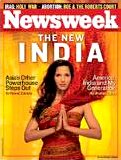
Newsweek Magazine’s feature article this week is entitled “India Rising” and similar to their article about China last year, describes the political, economic, and cultural emergence of India on the international global stage:
Fascinated by the new growth story, perhaps wary of Asia’s Chinese superpower, searching to hedge some bets, the world has woken up to India’s potential. But does it really know this complex, diverse country? Just as important, does India know what it wants of the world?
The marketing slogans wouldn’t work if there were no substance behind them. Over the past 15 years, India has been the second fastest-growing country in the world—after China—averaging above 6 percent growth per year. Growth accelerated to 7.5 percent last year and will probably hold at the same pace this year. Many observers believe that India could well expand at this higher rate for the next decade. . . .
A much-cited 2003 study by Goldman Sachs projects that over the next 50 years, India will be the fastest-growing of the world’s major economies (largely because its work force will not age as fast as the others). The report calculates that in 10 years India’s economy will be larger than Italy’s and in 15 years will have overtaken Britain’s.
By 2040 it will boast the world’s third largest economy. By 2050 it will be five times the size of Japan’s and its per capita income will have risen to 35 times its current level. Predictions like these are a treacherous business, though it’s worth noting that India’s current growth rate is actually higher than the study assumed.
At the same time, the article also notes that India is not without its problems, specifically poverty, slums, crumbling roads, underdeveloped infrastructure, huge HIV-positive population, etc. The article also notes that India’s growth is qualitatively different from that of China’s, where the central government controls virtually all aspects of economic activity, whereas in India, it’s largely a free market-driven system and the advantages and disadvantages involved therein.
Interestingly, the article also notes that in a recent international survey, Indians had the highest favorable impression of the U.S. of any country (except for the U.S. itself of course). I find this remarkable because if you asked the typical American if s/he has a favorable impression of India, I’m willing to bet that most Americans would answer no.
Why not? Mainly because of the outsourcing phenomenon and sensationalized reports of American workers losing their jobs to lower-paid workers in India. In many American industries, India is portrayed as some kind of depraved scavenger, sneaking up on unsuspecting Americans and waiting to grab whatever it can and run.
How ironic indeed, that Indians apparently admire Americans so much, but not the other way around.
Newsweek Magazine has an article describing Jet Li’s latest movie “Fearless,” a bio-pic of Huo Yuanjia, one of China’s most revered kung fu masters. The article notes that this is likely to be Jet Li’s last kung fu movie:
In an age when talented mainstream actors like Chow Yun Fat and Ziyi Zhang can dance their way through spectacular action scenes with the aid of wire work and computer animation, action stars like Li and Jackie Chan — who made their names through sheer physical prowess — are being crowded out.
Long interested in Buddhism, he was baptized as a monk in 1998 and says his faith compelled him to end his kung fu career. The desire to retire intensified after the 2004 tsunami. With his wife, the actress Li Chi, and their two daughters, he was vacationing in the Maldives when the giant wave struck. As they rushed from the beach, a piece of furniture injured his foot.
They headed inland to another hotel but had no way to contact anyone for several days. “When we came out from hiding, everywhere we went we saw death,” he says. “I realized that life is unpredictable. I want to spend the time I have on things more meaningful.”
I have to admit that I am a fan of these new “wire-fu” movies, but I think it would be a shame if Jet Li quits making kung fu movies because of them. At the same time, I admire his self-determination and sense of personal priorities. It is certainly true that we should always enjoy life in its current moment, since there is never any guarantee of what the future will bring.
Nonetheless, Jet Li has meant a lot to many Asian Americans. Many of us see him as the only genuine heir to Bruce Lee’s legacy. It would be unfortunate if we were to lose out on his talents and inspiration.
On February 2, I attended Asian Pacific American Legislation Day at the State Capitol in Olympia, Washington. An annual event, it drew a large, organized crowd of Asian Americans from all over Washington. People heard Governor Gregoire give an upbeat speech, and afterwards disbursed in the drizzle to seek out their district representatives. The idea was to put the concerns and interests of a diverse Washington Asian American community into the hands of citizens, and send them to meet face to face with their representatives.
Before attending the event, I studied the APA Legislative Agenda, which outlined issues important to immigrants and minorities across the state. I came across and item called SB 6499, which was sponsored by Pam Roach, the Republican State Senator from the 31st district. It called for new voter identification laws, including birth certificates and proof of citizenship in order to vote.
Then I saw something really interesting. According to the APA schedule, there was no meeting set with Senator Roach to discuss this issue, which is of paramount importance to Asians and other immigrant and minority groups.
On February 1, I called the Senator’s office. A staffer didn’t know what APA Legislation Day was. I asked for clarification. Potentially two thousand Asians from all over Washington, the Governor speaking, Senator Roach sponsored SB 6499, you don’t know what it is?
I was told that no one had asked for a meeting with Senator Roach. I checked with APA. I was told they had requested a meeting, but had not heard back yet. I left my name and number with the staffer. No return call.
The morning of February 2, as I drove down Interstate 5 in the early morning downpour, I called the Senator’s office again. I re-introduced myself. I was told no one had told them about APA Day until someone called yesterday. I explained that someone was I. I was assured no one else had asked for a meeting.
I was told Senator Roach had a very busy schedule. I asked if that meant no meeting would be scheduled. I re-iterated the concerns about the Senator’s bill, and how it would affect thousands of her constituents. I was told to stop by around 1:30PM. It was suggested by the staffer we might catch her between meetings.
Indeed, Senator Roach was gracious enough to meet with members of APA, including Maxine Chan and Kelli Nakayama of International Community Health Services, and Franklin Yi of the Korean American Voters Alliance. After explaining to us that SB 6499 was essentially going nowhere, she assured the group that her concern in such legislation was making sure it was valid citizens who voted in elections. After the 2004 Washington Governor’s race, there was a lot of activity in Olympia involving voter verification.
Maxine Chan explained that there already existed specific social and logistical barriers to immigrant and minority voters, and additional bureaucracy could disproportionately affect that group. She also mentioned the language barrier, which often resulted in discrimination and difficulty at polling places. That was when the whole thing turned into a bad horror film.
Senator Roach responded by saying she was sympathetic with the whole language barrier, and that no one should be discriminated against at the polls. She went on to explain that she was an advocate of early English proficiency education, particularly for immigrant children so that they might grow up accent free. She spoke of a future of no accents, which would alleviate a host of problems.
By shedding foreign sounding accents, she thought people would face less discrimination. It was in their best interest. She then turned to Franklin Yi, a Korean immigrant whom she knew as a constituent, and pointed out his foreign accent. However, she jokingly vouched for Franklin, because she knew him.
I, Maxine and Kelli sat stunned. We thanked her for meeting with us, and she thanked us for coming, saying her door was always open. We went out and stood in the rain, dumbfounded. Had she really said that? Did I just hear what I thought I heard?
Clearly, Maxine, Kelli and I were “okay†with Senator Roach because we had shed our foreign accents. Is that what had earned us the right not to be discriminated against? I began to think back on some of the well meaning, institutionalized racism I had encountered in my life as an “accent free†Chinese American.
“You didn’t sound Asian on the phone.â€
“You don’t act like a foreigner.â€
“I’m not talking about you, though. You’re different.â€
“You’re so Americanized.â€
And so on, and so on.
What perhaps is most frightening about this story is that I believe Pam Roach loves her country and loves democracy. What does that say about how far we have come, how far we have to go?
About the author: Andrew Tsao works as a television and theater company director, and a lecturer on film directing and acting. He currently lives in Bellevue, WA. You can also visit his personal website and read his blog.
Toyota wants to be just another good ‘ol boy — they’ve recently announced that they will join Ford, Chevrolet, and Dodge as automobile manufacturers competing in the NASCAR Nextel Cup racing series. You may remember that this is the most popular racing series in the western hemisphere, anchored by the world famous Daytona 500 that took place yesterday.
You may also remember that NASCAR has strong roots in the American South and is generally considered to be a virtually all-White sports environment. As such, as a recent post on AutoBlog notes, the reaction to Toyota’s announcement has been mixed:
“I’m not going to root for the cars,†said fan Al High when asked about Toyota’s entry. “I’m going to root for the drivers.” Another fan, Glen Barber, said “it doesn’t bother me they’re in racing. … It’s just another nose piece (front of car) and a brand name.â€
But fan Glen Wilkinson was definitely not accommodating. “It won’t be NASCAR,†he stated. “It will be ‘Japanese car’.†And while he’s aware that Toyota has plants in the U.S. building vehicles (called ‘transplants’) he added, “I know we got a plant up there (in Georgetown), but it’s not American. I think they ought to just ship it out of here, anything that’s not American-made.”
Toyota is apparently aware of the situation and sees participation in NASCAR as a further extension to its American factories, employment, and reputation. Said said Jim Farley, vice president of marketing for Toyota Motor Sales, U.S.A., “we (Toyota) hope, if we do it right, it’s a way to be seen as a part of America, not just a company with a big check.
In that same AutoBlog post, some of the comments from readers point out that while Toyota’s plants are hiring more American workers and paying out larger bonuses, “American” automakers like Ford, GM, and Chrysler are laying off workers and giving out smaller bonuses. In other words, it all comes back to the question, “What constitutes ‘American’?”
That is, Toyota has several factories in the U.S. that employ thousands of American workers, are profitable, and contribute to the U.S.’s economy. Not to mention that the Toyota Camry has been the best-selling passenger car in the U.S. for the past several years. The only hangup that some people apparently have is that it is not an “American-owned” company, although it doesn’t seem to bother Americans that Chrysler is owned by Mercedes-Benz from Germany.
This episode is still to be played out of course, once Toyota actually starts racing in NASCAR, but alas, it is just another example of the ethnocentric and xenophobic mentality that still prevails too often in the U.S.: only Whites — and culture predominantly associated with Whites — deserve to be considered as “real” Americans.