The views and opinions expressed on this site and blog posts (excluding comments on blog posts left by others) are entirely my own and do not represent those of any employer or organization with whom I am currently or previously have been associated.
Academic Version: Applying my personal experiences and academic research as a professor of Sociology and Asian American Studies to provide a more complete understanding of political, economic, and cultural issues and current events related to American race relations, and Asia/Asian America in particular.
Plain English: Trying to put my Ph.D. to good use.
Here are some miscellaneous links that have come my way. As always, I mention them to disseminate information and perspectives, not to necessarily endorse every single aspect of their content:
For those who haven’t noticed, in recent months, there has been a notable increase in the number and size of raids against illegal immigrants and the businesses where they work. The Homeland Security department (home of the Immigration and Customs Enforcement agency, formerly known as the Immigration and Naturalization Service) have now shifted their emphasis from stopping illegal immigrants as they cross the border to rounding them up and arresting them at their workplaces.
I can understand the need to enforce existing laws against hiring illegal immigrants, although I think there are better ways to address the larger issue of reducing illegal immigration. However, what I cannot support is how families are literally being torn apart and lives at risk as a result of such raids and mass arrests against illegal immigrants. Case in point — as the New York Times reports — babies being ripped from their mothers arms and separated indefinitely:
Ms. Umanzor had been at home with two of her three children, both American citizens, when the immigration agents arrived, along with a county police officer. . . As the agents searched, Ms. Umanzor breast-fed her jittery baby, she recalled in an interview after her release. . . .
She was forced to leave both Brittney and the other American daughter, Alexandra, who is 3, since the agents could not detain them. “Just thinking that I was going to leave my little girl, I began to feel sick,†Ms. Umanzor said of the baby. “I had a pain in my heart.†. . .
In jail and with her nursing abruptly halted, Ms. Umanzor’s breasts become painfully engorged. With the help of Veronica Dahlberg, director of a Hispanic women’s group in Ashtabula County, a breast pump was delivered on her third day in jail. Brittney, meanwhile, did not eat for three days, refusing to take formula from a bottle, Ms. Dahlberg said. After four days, the county released all six children to Ms. Umanzor’s sister, who managed to wean Brittney to a bottle.
On Nov. 7, after two dozen women’s health advocates and researchers sent a letter protesting Ms. Umanzor’s detention, Ms. Myers issued a memorandum instructing field officers “to exercise discretion†during arrests by releasing nursing mothers from detention unless they presented a national security or public safety risk. . . .
In their study, released this month, La Raza, a national Hispanic organization, and the Urban Institute, a nonpartisan research organization in Washington, examined three factory raids in the past year, in Greeley, Colo.; Grand Island, Neb.; and New Bedford. . . .
The study found that . . . many families hid for days or longer in their homes, sometimes retreating to basements, the study reported. Although many children showed symptoms of emotional distress, family members were reluctant to seek public assistance for them, even if the children were citizens, fearing new arrests of relatives who were illegal immigrants.
As the article also notes, federal immigration officials and opponents of illegal immigration argue that while their goal is not to victimize children, ultimately it is the fault of the parents for putting their children in these situations, based on their status as illegal immigrants.
Unfortunately, this kind of reasoning is a textbook example of what sociologists call “blaming the victim.”
Yes it is true that by virtue of the fact that they came into the U.S. without authorization that they are here illegally. But as scholars and other halfway informed observers will tell you, the reasons the vast majority of border-crossers come here is not to get rich off of welfare, but to try to earn a living by working in jobs that most Americans will not accept.
In other words, illegal immigrants come here to work. Once they are inside the U.S., data also show that the vast majority of them obey the laws and pay taxes — sales taxes, property taxes, and even federal and state income taxes that are estimated to contribute $60 billion a year to Social Security funds. It’s also worth noting that because illegal immigrants often use fake social security numbers, income taxes get taken out but they will most likely never see any of those funds themselves.
The point is, the choices that illegal immigrants make, more often than not, actually results in net benefits to American society. And how do we as a society treat them as a result? By vilifying, demonizing, and dehumanizing them. And by literally tearing families apart and putting innocent lives at risk.
As the article notes, even the Homeland Security department has apparently come to its senses, recognized the inherent brutality and inhumanity in their actions, and reevaluated its draconian tactic of separating mothers from their young children. As a result of incidents like that described in the article, they now instruct their agents to release mothers who have young children unless they pose a direct threat to national security.
I’m not a legal scholar, but I might actually describe what happened to families like the Umanzors in the article might be classified as cruel and unusual punishment, perhaps even torture.
There must be a better way to address the problems associated with illegal immigration than to treat them like animals.
That better way is to enact comprehensive immigration reform that addresses the issue on all levels — stricter enforcement of laws against knowingly hiring illegal workers, creating some legal arrangement to allow temporary workers to come and work in the U.S., giving law-abiding illegal immigrants the opportunity to become citizens and continue their contributions to American society, and efforts to strengthen foreign economies to reduce the push factors that drive many to leave for the U.S., to name just a few.
But to focus the brunt of our country’s resources on forcibly separating families and exacting incalculable human costs and suffering is nothing short of barbarism.
A colleague of mine asked me to post the following announcement about an online survey that some of her students are conducting about body image among Asian American women. The survey should take about 15-20 minutes to complete. Please consider helping them out and contributing your opinion by taking the survey.
———————————–
We are conducting a preliminary survey on body image among Asian American women. The study is for Professor Miliann Kang’s Women Studies course, “Asian American Women” at the University of Massachusetts, Amherst.
As a participant, you should be a college student who identifies as female. If you decide to be part of the survey, participation should take 15-20 minutes. You will be asked personal questions about your body image. If a question makes you uncomfortable, you do not have to answer it. You are also able to stop filling out the survey at any time. Conversely, if you have a story to tell or a comment to say, we welcome and appreciate any additional elaboration.
Your survey responses will be strictly confidential and data from this research will be reported only in the aggregate. The information you provide will be used for the class project and will be presented in class (Dec 3 and Dec 5, 2007). If you have questions at any time about the survey or the procedures, you can contact me at 626-588-8949 or via email at syu@email.smith.edu
Thank you for your assistance.
Sandy Yu, Mike Kauffman, Sarah Colen, Judea Beatrice, and Jessica Brooks
These intellectual challenges to mainstream and other viewpoints are some of the opinions Latino, Asian/Pacific Islander-American, and black bloggers are exposing on a growing number of sites focused on social, political, and cultural issues. The sometimes facetiously named blogs range from Angry Asian Man to The Angry Black Woman.
Readers can find Latino viewpoints at Guanabee, The Unapologetic Mexican, or Latino Pundit. Those interested in information from an Asian angle head to Ultrabrown, Zuky, or Sepia Mutiny. Sites created by blacks include The Field Negro, Too Sense, and Resist Racism. But often these bloggers discard the handcuffs of their ethnic origins to tackle subjects affecting a range of racial or ethnic groups.
These sites – many of which launched in the past year, although a few are older – have become places where people of color gather to refine ideas or form thoughts about race relations, racial inequities, and the role pop culture has in exacerbating stereotypes. The writers often bring attention to subjects not yet covered by mainstream media.
Overall, the Boston Globe article portrays bloggers of color very positively. At the same time, I could not help but notice the quote (cited above), “these bloggers discard the handcuffs of their ethnic origins to tackle subjects affecting a range of racial or ethnic groups” (emphasis added).
I’m not really sure what the article’s author means by that statement. Is she implying that covering an issue that predominantly or most immediately affects one particular racial or ethnic group in a particular story is counterproductive and ultimately divisive? Does she mean that it’s not useful to point out specific issues, experiences, or characteristics of a particular racial/ethnic group?
I certainly hope that these are not the implications she intended because that only plays into the whole “colorblind” myth of American society — that everyone is all the same and should be treated according to a “standard” manner or set of rules.
In fact, I would guess that most if not all of these bloggers portrayed in the article would probably agree that while there are certainly many commonalities that different racial/ethnic groups share, there are many things that make each group unique.
Further, pointing out these unique characteristics ultimately benefits us by educating us and expanding our knowledge of others, rather than dividing or separating us. Let’s not fall into that colorblind (some would even say White supremacist) way of thinking.
As we all know, race, race relations, and racial discrimination are all very complicated and controversial issues. Up until about 50 years ago, the overall consensus (particularly among “average” Americans) was that different racial groups were biologically and genetically very different from each other. Further, most people believed that these genetic differences also included intelligence — i.e., some racial groups were genetically more intelligent than other groups.
Since that time however, as we began to learn more about the actual science of genetics, we as a society gradually came to a new consensus — that from a biological or physiological point of view, the idea that there are genetically distinct racial groups actually has no scientific validity at all.
That is, we now know that over 99% of any given person’s genes are identical to that of any other person on earth and that there are no distinct “racial” groups as we know them — there are just too many variations and exceptions to each “rule” about which person belongs in which racial group. In other words, the idea of “racial groups” is socially constructed, not scientifically-based.
However, new, emerging research is starting to challenge some of these consensus beliefs. As the New York Times reports, recent studies based on the latest advances in human genome mapping suggest that there might be something to the idea that genetic differences may exist between different racial groups after all:
Scientists, for instance, have recently identified small changes in DNA that account for the pale skin of Europeans, the tendency of Asians to sweat less and West Africans’ resistance to certain diseases. . . .Ancestry tests tell customers what percentage of their genes are from Asia, Europe, Africa and the Americas. The heart-disease drug BiDil is marketed exclusively to African-Americans, who seem genetically predisposed to respond to it. Jews are offered prenatal tests for genetic disorders rarely found in other ethnic groups.
Such developments are providing some of the first tangible benefits of the genetic revolution. Yet some social critics fear they may also be giving long-discredited racial prejudices a new potency. The notion that race is more than skin deep, they fear, could undermine principles of equal treatment and opportunity that have relied on the presumption that we are all fundamentally equal. . . .
Though few of the bits of human genetic code that vary between individuals have yet to be tied to physical or behavioral traits, scientists have found that roughly 10 percent of them are more common in certain continental groups and can be used to distinguish people of different races. They say that studying the differences, which arose during the tens of thousands of years that human populations evolved on separate continents after their ancestors dispersed from humanity’s birthplace in East Africa, is crucial to mapping the genetic basis for disease.
But many geneticists, wary of fueling discrimination and worried that speaking openly about race could endanger support for their research, are loath to discuss the social implications of their findings. Still, some acknowledge that as their data and methods are extended to nonmedical traits, the field is at what one leading researcher recently called “a very delicate time, and a dangerous time.â€
New American Media has another article that summarizes many of the latest research findings on race and genetics. This NY Times article goes on to describe that, according to many scientists who are at the leading edge of this kind of genetic research, it is pretty much inevitable that many people (particularly nonscientists) will try to extend these emerging genetic differences into the conclusion that different racial groups are genetic more or less intelligent than others.
At the same time, these scientists are quick to point out that even if genetic differences in intelligence exist, the influence of institutional and socioeconomic factors are still much more important in explaining social inequalities between racial groups. As Dr. David Altshuler puts it, “[L]iving in America, it is so clear that the economic and social and educational differences have so much more influence than genes. People just somehow fixate on genetics, even if the influence is very small.â€
In other words, at this point, the overriding message from scientists is that genetics still does not validate or legitimate prejudice or discrimination against different races.
But where does that leave liberals like me? As also noted in the NY Times article, many liberals largely dismiss these genetic findings and instead argue that, as noted above, even if such genetic differences exist, social and economic factors have a much more significant effect on achievement in society.
On the other hand, other liberals argue that we should use such genetic findings to tailor programs specifically to the needs of particular racial group involved in an effort to compensate for any inherent disadvantages.
To be honest, I’m not sure which side of the argument I agree with more at this point. For now, I will take a “wait and see” approach and see what other findings come up. A the same time, there is one thing that I do know for sure — regardless of the scientific details, extremist ideologues and racial supremacists will use and spin such findings however they want to suit their own agenda.
That point is for certain — we should expect the debate and controversy to get worse before it gets better.
I came across this 1999 article from Time magazine that caught my eye: The Most Influential Asians of the 20th Century. I had not seen this particular list before, and found it to be an interesting read. I’ve broken down the names on their list into my own categories below but you should definitely read the individual descriptions and biographies for yourself on the Time site:
Communist Leaders
Ho Chi Minh
Pol Pot
Mao Zedong
Deng Xiaoping
National Leaders Seen as Benevolent
Sun Yat-Sen (‘Father’ of modern China)
Mohandas Gandhi
Corazon Aquino
Chulalongkorn (‘Father’ of modern Thailand)
National Leaders Seen as Tragic
Hirohito
Park Chung Hee (President of South Korea during its economic rise)
Sukarno (Former President of Indonesia)
Economic Leaders and Artists
Eiji Toyoda (leader during Toyota Corp.’s international rise)
Akio Morita (founder of Sony Corp.)
Akira Kurosawa (famed filmmaker)
Embarrassed to Say I’ve Never Heard Of
M.S. Swaminathan (considered ‘Father’ of modern green revolution)
Issey Miyake (fashion designer)
Daisuke Inoue (inventor of the karaoke machine)
Rabindranath Tagore (Asia’s first Nobel Laureate, for literature in 1913)
Like I said, it’s an interesting list and each of their biographies is well worth the read.
Today, November 9, marks the start of the Diwali (also known as Deepavali) Festival, celebrated by Indians and South Asians around the world as the “Festival of Lights” that symbolizes the triumph of light (good) over darkness (evil).
Wikipedia has a rather comprehensive description of the holiday, while the Gay & Lesbian Alliance Against Defamation has a summary of the how the festival and its cultural significance relates to gay and lesbian members of the Indian community. In GLAAD’s words, “The holiday and its themes of love, compassion and understanding also reflect the unique hopes and dreams that resonate within the South Asian LGBT community.”
The following YouTube video, made by the India Association at the University of Missouri — Rolla, depicts the ancient legend of how Diwali first began:
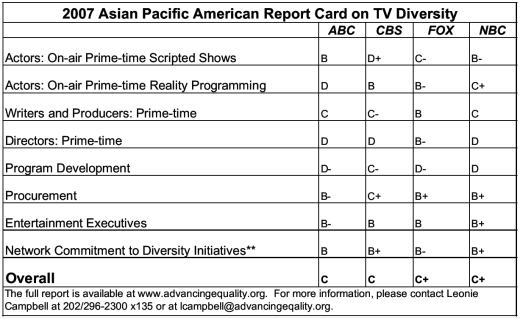
For years now, the Asian Pacific American Media Coalition (APAMC) has given out an annual “report card” to each of the major television networks on how racially inclusive its shows are regarding the representation of Asian Americans as actors, producers, writers, etc. The summary of grades for each of the four major national networks is below, followed by an excerpt of APAMC’s statement and summary of the grades:
The Asian Pacific American Media Coalition (APAMC) is disappointed in the degree of progress that has been made by the four major networks — ABC, CBS, FOX and NBC — none of which improved their overall grades from last year.
Overall, only 29 Asian Americans were cast in regular roles in prime-time, only two more than last year. And many of the regular roles are not quality roles with significant air time. When compared to other racial groups, APAs are still far less likely to be in starring roles in prime-time programming, although a number of shows are set in cities with high APA populations. Furthermore, APAs are the only ethnic group that does not boast someone as the star of his/her own show.
The Coalition is pleased to see that the number of APA writers and producers have rebounded from the severe drop last year. However, there are still too few APA and other minority writers and producers on prime-time shows; and too few in charge of creative decisions.
As a result, there are only a small number of fully developed, quality roles for APA actors. This continuing deficiency of APAs and other minorities in key decision making positions also results in incidents such as the recent slur against Filipino American physicians made on Desperate Housewives.
Standout shows that have excellent roles for APA actors are ABC’s Grey’s Anatomy and NBC’s Heroes. Grey’s Anatomy, which has Shonda Rhimes, an African American woman as show runner, illustrates the importance of providing opportunities for talented minority writers which helps to foster the creation of roles depicting minorities, including APAs, as quality, non-stereotypical characters. Both shows are good examples of how addressing the nation’s growing diversity can lead to both commercial and critical success.
Of great concern to us this year, is the declining number of opportunities for APA directors, which fell from 27 the previous year to 23 this year. Growing the number of APA directors working on prime-time shows is also crucial to increasing the presence of well-rounded APA characters with quality stories.
Of even greater concern is the serious lack of development deals in the pipeline at any of the networks that would lead to shows starring an Asian American as the central character or featuring Asian Americans as a couple or a family.
I don’t actually watch much television, so I can’t really add much more to what the APAMC already describes. Instead, I want to reiterate one point in particular with which I strongly agree: increasing the number of “decisionmakers” at each network is absolutely critical.
In other words, it is nice to have more Asian American actors and roles, but the place where it all starts is at the executive level where senior executives, producers, and senior writers decide which shows are made, which characters are included, what are the plots, and who should be cast in them. That is where the “real action” takes place and that is where it is essential for Asian Americans to be present when such basic and high-level decisions are made.
That is true whether we’re talking about the corporate/business world in general or the network television business — Asian Americans need to become the decisionmakers for any real change to eventually take place.
Many people inside and outside the Asian American community disagree about whether Pakistan and Pakistani Americans should be included under the “Asian American” category. There are valid arguments on both sides and it’s not my intention to try settle that question here.
Instead, based on the general agreement that Pakistan increasingly occupies a prominent position in international politics and this administration’s war on terrorism, it is certainly appropriate to discuss its current political situation. Specifically, as New American Media reports, many Pakistani Americans are not taking kindly to Pervez Musharraf’s latest actions:
General Musharraf said he had to declare a state of emergency because he could not “allow this country to commit suicide.†But he’s not fooling anyone, not even his own diasporan community many of whom had tentatively supported him when he seized power in a 1999 coup.
Then, says Agha Saeed, founder of American Muslim Alliance, Pakistani-Americans were so fed up with the “corrupt and inefficient†civilian administrations of Nawaz Sharif and Benazir Bhutto, they’d given Musharraf the benefit of the doubt.
“At first Musharraf did introduce some amount of efficiency and stability, even increasing the number of women’s seats and minority seats,†says Dr. Saeed. “But now he’s shown it’s just business as usual.†. . .
The Pakistani American National Alliance (PANA), a coalition of Pakistani-American organizations has accused Gen. Musharraf of “high treason†and organized protests in front of the consulates in Chicago, Dallas and New York and is planning another one in Los Angeles.
The article goes on to note that in addition to the general anger directed at Musharraf, many Pakistani Americans also criticize the Bush administration for implicitly supporting Musharraf’s recent actions, despite the administration’s declarations to the contrary.
In fact, regardless of its public and official criticisms of these most recent events, the U.S.’s ongoing support of Musharraf’s increasingly totalitarian policies sounds a lot like another example of the U.S. supporting oppressive totalitarian regimes around the world merely because such governments are seen as useful allies against some “more dangerous” enemy.
In the past, that would have been communists or other “leftists.” In today’s case, it’s the Taliban and al Qaeda.
History also shows us that the U.S.’s support for such totalitarian regimes in the past frequently did more harm than good in terms of turning whole populations of citizens against the U.S. for decades and generations to come and sewing the seeds of anti-Americanism that are now flourishing around the world.
So the question becomes, is the U.S. going to learn any lessons from history here and persuade Musharraf to allow the democratic process to unfold, or will the U.S. stand by and do nothing and in the process, be complicit in the death of democracy?
In fact, as I’ve heard before, that is exactly the definition of insanity — doing the same thing but hoping for a different result.
Did you know that November is American Indian & Alaskan Native Heritage Month? Asian Americans share much in common with our Native American Indian and Alaskan brothers and sisters, not just in terms of social and cultural solidarity, but because we share common Asian ancestors as well. To celebrate their heritage, the U.S. Census Bureau has a brief summary of the heritage month and a fact sheet with some interesting statistics:
The first American Indian Day was celebrated in May 1916 in New York. Red Fox James, a Blackfeet Indian, rode horseback from state to state, getting endorsements from 24 state governments, to have a day to honor American Indians. In 1990, President George H.W. Bush signed a joint congressional resolution designating November 1990 as “National American Indian Heritage Month.â€
4.5 million
As of July 1, 2006, the estimated population of American Indians and Alaska Natives, including those of more than one race. They made up 1.5 percent of the total population.
688,500
The American Indian and Alaska Native population in California as of July 1, 2006, the highest total of any state in the nation. California was followed by Oklahoma (397,000) and Arizona (331,200).
9
Number of states where American Indians and Alaska Natives were the largest race or ethnic minority group in 2006. These states are Alaska, Arizona, Idaho, Montana, New Mexico, North Dakota, Oklahoma, South Dakota and Wyoming.
301,800
The nation’s Cherokee alone population. Cherokee is one of the nation’s largest tribal groups, along with Navajo (alone), which has a population of 296,100.
$26.9 billion
Receipts for American Indian- and Alaska Native-owned businesses in 2002. These businesses numbered 201,387.
$33,762
The median income of households where the householder reported being American Indian and Alaska Native and no other race.
27%
The poverty rate of people who reported they were American Indian and Alaska Native and no other race. There is a wide variation in the demographic characteristics of American Indians and Alaska Natives. For instance, members of the Chippewa (alone) tribal group had a median household income of $36,481, while for Navajos (alone), median household income totaled $27,815.
If you want to compare the general socioeconomic characteristics, such as those listed above, with those from the other major racial groups, you can visit my article on Socioeconomic Statistics and Demographics. Unfortunately, the numbers indicate that in many ways, Native American Indians are the worst-off of all the major racial groups.
As most historians and sociologists will tell you, while there are still many individual cases of destructive behavior among some Native American Indians, much of that can be traced directly back the systematic exclusion and institutional inequality that they have experienced ever since Christopher Columbus first set foot in North America.
Because of their relatively small size, it’s common for the overwhelming majority of Americans of all races and backgrounds to overlook their experiences and issues these days. However, I hope we as Asian Americans recognize that while we may have historical and socioeconomic differences with Native American Indians, as numerically small minority groups, it is in our best interests to stick up for each other so that our collective voices can be louder.
As you may have noticed, Japanese comics have gripped the global imagination. Manga sales in the US have tripled in the past four years. Titles like Fruits Basket, Naruto, and Death Note have become fixtures on American best-seller lists. Walk into your local bookstore this afternoon and chances are the manga section is bigger than the science fiction collection.
Europe has caught the bug, too. In the United Kingdom, the Catholic Church is using manga to recruit new priests. One British publisher, in an effort to hippify a national franchise, has begun issuing manga versions of Shakespeare’s plays, including a Romeo and Juliet that reimagines the Montagues and Capulets as rival yakuza families in Tokyo.
Yet in Japan, its birthplace and epicenter, manga’s fortunes are sagging. Circulation of the country’s weekly comic magazines, the essential entry point for any manga series, has fallen by about half over the last decade. Young people are turning their attention away from the printed page and toward the tiny screens on their mobile phones.
Fans and critics complain that manga — which emerged in the years after World War II as an edgy, uniquely Japanese art form — has become as homogenized and risk-averse as the limpest Hollywood blockbuster.
The article describes one potential savior of the Japanese manga industry — copyright piracy. That is, because the existing manga series in Japan are apparently getting stale, amateur manga writers and artists openly “borrow” existing manga characters but add new storylines and plots to them. These limited-run amateur editions serve to revitalize interest and popularity into the entire manga industry.
Technically, this “borrowing” of manga characters by amateurs is illegal. But as the article notes, “Amateur manga remixers aren’t merely replicating someone else’s work. They’re creating something original. And in doing so, they may well be helping, not hindering, the commercial interests of the copyright holders.”
So far, everyone wins. Is this implicit agreement between the copyright holders and amateurs likely to stay in place for long? As long as both sides are making money, it probably will.
As the Asian American population continues to grow, many are increasingly entering fields other than medicine, computers, and engineering. One of these emerging fields for Asian American professionals is law. But how welcoming are the top law firms toward the growing number of Asian American lawyers? To help answer that question, as the New York Times reports, a new study by the grassroots organization “Building a Better Legal Profession” has graded the nation’s largest law firms on how culturally diverse they are:
The students are handing out “diversity report cards†to the big law firms, ranking them by how many female, minority and gay lawyers they have. . . . The numbers were provided to a central clearinghouse by the firms themselves. “Our process is simple,†the student group said in explaining its methodology. “Cut, paste and rank.â€
Firms in the top fifth received A’s, in the second fifth B’s, and so on. Overall grades were arrived at by averaging grades for partners and associates in five categories: women, blacks, Hispanics, Asians and gay people. . . .
I [NY Times reporter] asked the firms with particularly poor rankings for comments, and most of them responded, generally with quite similar statements. The issues are serious and difficult ones, they said, but they are working hard to make progress. . . .
The report cards seem to be having an impact. Mr. Bruck said a second-year student at Stanford had recently turned down an offer from one firm “as soon as he saw that it got an F on our diversity report card.â€
The study’s data on the representation of Asian Americans as partners and associates is quite interesting. The numbers show that, nationally, the law firms that scored the best for Asian Americans are located in northern California’s Bay Area. This makes sense because Asian Americans generally represent about 15% of all residents of that area.
But it might also reflect the idea that being located in such a “liberal” and technology-heavy area, these firms understand that it is in their best interests to have lots of Asian American attorneys because these lawyers are not only intelligent, well-qualified, and hard-working, but as American society becomes increasingly globalized, these Asian Americans have the unique opportunity to leverage their cross-national ties, networks, and knowledge to lead their firms into the 21st century.
In the process, these Asian American attorneys are gradually expanding the definition of what it means to be an “American” to make it more diverse, especially in the context of our ever-evolving society and world.
Congratulations to those firms that scored well and I hope they keep up the good work.