The views and opinions expressed on this site and blog posts (excluding comments on blog posts left by others) are entirely my own and do not represent those of any employer or organization with whom I am currently or previously have been associated.
Academic Version: Applying my personal experiences and academic research as a professor of Sociology and Asian American Studies to provide a more complete understanding of political, economic, and cultural issues and current events related to American race relations, and Asia/Asian America in particular.
Plain English: Trying to put my Ph.D. to good use.
Among academics like me, this month is very significant not just because of the presidential election, but also because it marks the 40th anniversary of the multiracial mass student strikes at San Francisco State University (SFSU) which lasted for several months and eventually resulted in the creation of the country’s first Ethnic Studies (including Asian American Studies) program in the U.S. To commemorate this anniversary and to provide a detailed chronology of the strike’s significant moments, the San Francisco Chronicle has a story that reflects on the strike’s legacy 40 years later:
Critics of the strike said some of its goals did not justify the violence. But ethnic studies experts and historians say it brought positive change to the university, particularly the creation of its College of Ethnic Studies, which includes Asian American Studies, Black Studies, La Raza Studies and Native American Studies. . . .
“Did their 15 demands justify the bombings? Hell no,” he said. “They placed a bomb in the administrative offices while school was in session. They were setting fires in the library. They were putting people’s lives in serious danger.”
But Laureen Chew, now associate dean of the College of Ethnic Studies and one of nearly 700 students jailed during the strike, said the battle was necessary. As an Asian American, she had faced racism in high school and from customers of her parents’ laundry shop who called her father a “stupid Chinaman.”
As a scholar whose work and life centers largely on Ethnic Studies and Asian American Studies, I feel a lot of complicated and perhaps even contradictory feelings over these events that took place 40 years ago, long before I was even born.
On the one hand, I generally do not subscribe to a “the ends justify the means” approach when it comes to protests or demonstrations. While I was not there 40 years ago and can’t confirm the tactics that the student protesters may have used that put people’s lives in danger, I will say that committing violence to make a point and purposely putting innocent people’s lives in harm’s way is not the answer.
At the same time, I am pretty sure that the violence that the student protesters endured at the hands of the police was far worse than the violence that the students perpetrated against innocent bystanders. With that in mind and paraphrasing Malcolm X, protecting yourself against brutality is not being extremist — it’s basic common sense.
And ultimately, I do agree with Professor Chew’s sentiments that there comes a time when enough is enough — when you or your community endure so much systematic discrimination, inequality, and injustice that everything reaches a boiling point, at which time you must stand up and assert your basic human rights as an American.
Suffice it to say that I probably would not have the job I have now if it weren’t for this strike at SFSU 40 years ago and other student-led movements that paved the way for the creation of Ethnic Studies and Asian American Studies programs around the country.
But even beyond that, the SFSU strike stands as an inspiring example and reminder to all who are marginalized that learning about justice and equality is just the first step — the point is to turn that knowledge into action.
The first American Indian Day was celebrated in May 1916 in New York. Red Fox James, a Blackfeet Indian, rode horseback from state to state, getting endorsements from 24 state governments, to have a day to honor American Indians. In 1990, President George H.W. Bush signed a joint congressional resolution designating November 1990 as “National American Indian Heritage Month.”
4.5 million
As of July 1, 2007, the estimated population of American Indians and Alaska Natives, including those of more than one race. They made up 1.5% of the total population.
30.3
Median age of the single-race American Indian and Alaska Native population in 2007, younger than the median of 36.6 for the population as a whole. About 27% of American Indians and Alaska Natives were younger than 18, and 8% were 65 and older.
5
Number of states where American Indians and Alaska Natives were the largest race or ethnic minority group in 2007. These states are Alaska, Montana, North Dakota, Oklahoma and South Dakota.
18%
The proportion of Alaska’s population identified as American Indian and Alaska Native as of July 1, 2007, the highest rate for this race group of any state. Alaska was followed by Oklahoma (11%) and New Mexico (10%).
76%
The percentage of American Indians and Alaska Natives 25 and older who had at least a high school diploma. Also, 13% had at least a bachelor’s degree.
25%
The percentage of civilian-employed American Indian and Alaska Native people 16 and older who worked in management, professional and related occupations. In addition, 23 percent worked in sales and office occupations and about the same percentage worked in service occupations.
$35,343
The 2007 median income of households where the householder reported being American Indian and Alaska Native and no other race.
25.3%
The 2007 poverty rate of people who reported they were American Indian and Alaska Native and no other race.
There’s not much more that I can say that others have not said already regarding the significance of Barack Obama’s election as our next President: historic, monumental, amazing, inspiring, emotional, and quite simple, awesome. As a sociologist and demographer, I’d like to offer a few statistics on his election to be our next President:
Obama received 49% of all the male votes (vs. 48% for McCain) and 56% of the female votes (vs. 43% for McCain). But once you break it down by race, Obama only received 41% of the White male vote (vs. 57% for McCain) and 46% of the White female vote (vs. 53% for McCain).
95% of African Americans, 66% of Latinos, and 61% of Asian Americans voted for Obama. Along with the previous statistic, what this tells us is that while large numbers of Whites supported Obama, ultimately non-Whites helped put him over the top.
66% of voters under the age of 30 voted for Obama.
52% of voters making $200,000 or more voted for Obama (vs. 46% for McCain).
By level of education, the groups that voted for Obama the most were those at both ends of the spectrum — those who have no high school degree and those with a postgraduate degree.
54% of Catholics voted for Obama (vs. 45% for McCain), although among White Catholics, 47% voted for Obama while 52% for McCain.
50% of voters living in the suburbs voted for Obama (vs. 48% for McCain).
Among voters who felt that their taxes would go up if Obama were elected President, 43% still voted for him.
64% of all voters felt that McCain unfairly attacked Obama, while only 49% of all voters felt Obama unfairly attacked McCain.
47% of all voters felt that, regardless of who is President, race relations are likely to get better in the next few years, and of those, 70% voted for Obama. In contrast, 15% felt that race relations are likely to get worse and of those, 70% voted for McCain.
9% of voters said that the candidate’s race was an important factor and of those, 53% voted for Obama.
58% of voters said that issues, rather than personal qualities, were more important to them and of those, 60% voted for Obama. In contrast, 59% of those who believed personal qualities were more important to them voted for McCain.
For me, the most telling and interesting of these statistics is first, that shows 52% of voters making at least $200,000 voted for Obama versus 46% voting for McCain. In my opinion, that is pretty astounding — those in the upper 6%-7% of the nation in terms of wealth supported Obama more than McCain, even though their taxes are likely to go up slightly. I give these voters a lot of credit for supporting Obama and goes a long way to counteract the stereotype of them as caring only about their wallets.
But perhaps the most significant statistic is how Obama captured almost all of the African American votes and a huge percentage of the Latino and Asian American votes and how, most likely, this was likely a big factor in helping to put him over the top.
It is certainly true that White votes still outnumbered non-White votes for Obama and that in the end, the scope of Obama’s victory shows that he has significant, broad-based support from Americans of all racial backgrounds. Nonetheless, I think it’s pretty clear that the Latinos and Asian Americans did constitute a crucial “swing vote” and ultimately, they overwhelmingly rallied to Obama’s support.
While observers, commentators, and scholars will debate this particular issue for the foreseeable future, it does appear that, combined with their continuing population growth, Latino and Asian American voters are poised to have this kind of potential impact and power for years to come.
As someone once said, “Change does not come from Washington — change comes to Washington.”
I will offer a more “sociological” analysis of Obama’s historic victory in an upcoming post but for now, I’d like to share the first thoughts that came to me when all the major news outlets officially declared Barack Obama to be the next President of the United States:
We shall overcome, We shall overcome
We shall overcome, some day.
Oh, deep in my heart, I do believe
We shall overcome, some day.
We will walk hand in hand, We will walk hand in hand
We’ll walk hand in hand, some day.
We shall live in peace, We shall live in peace
We shall live in peace, some day.
We shall all be free, We shall all be free
We shall all be free, some day.
Oh, deep in my heart, I do believe
We shall overcome, some day.
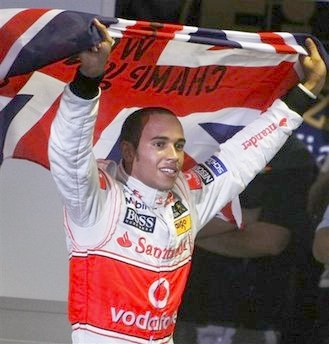
Being a fan of Formula One motor racing, I’d like to congratulate Lewis Hamilton on becoming the youngest Formula One champion ever. Hailing from Great Britain, Hamilton won the driver’s championship in dramatic fashion in the Grand Prix of Brazil by passing a competitor in the last corner of the last lap and thereby claiming fifth place, just enough to win the championship over his nearest rival by one point.
However, Hamilton’s age is not his biggest distinction in his championship. He is also the first Black driver to be crowned the F1 champion. Just like a well-known candidate running for President of the United States, Hamilton is actually half White and half Black and just like Barack Obama, has endured many high-profile incidents of racism as he has risen in national and international prominence in recent years.
Now that Hamilton has achieved his ultimate goal of winning the Formula One championship, I certainly hope that by the end of tomorrow, we can celebrate another significant similarity in the careers of Lewis Hamilton and Barack Obama.
Below is another announcement about an online survey in need of Asian American respondents:
My name is Young-Ran Lee, research scholar. I am working with Dr. Im, Ph D, MPH, RN, Professor, School of Nursing, University of Texas, Austin. We are currently conducting an Internet survey study entitled The Use of Internet Cancer Support Groups among Asian Americans Living with Cancer.
In the study, an Internet survey and an online forum using a Web site will be conducted to get information on the use of Internet Cancer Support Groups of Asian American cancer patients. This study is funded by the Center for Health Promotion and Disease Prevention Research in Underserved Populations (CHPR) and the Expedited Proposal-Enhancement Grants (EP-EG).
We really hope that you permit to advertise about our research to your organization or friends or patients. Could you help us? Your helping will be greatly appreciated.
If someone is a cancer patient aged at least 18 years who can read and write English and whose self-reported ethnic identity is Asian American, she/he is invited to join the study. Her/his involvement in the study will consist of the following: (a) about 30 minutes are usually needed to complete the Internet survey; and (b) online forums will be conducted with the 9 topics for 1 month, should she/he agree to participate in and are selected for the additional online forum discussion.
Reimbursement for individual participation will be made by providing $10 gift certificate per internet survey participant and $50 gift certificate per online forum participant.
As we all know by now, this presidential election is likely to be one of the most historic and significant ones in recent American history. With that in mind, it’s probably not surprising to know that this election has also captivated the attention of many people from all around the world. So which candidate do people from other countries favor? As Andrew Lam at New America Media reports, the answer probably isn’t that surprising:
The Economist . . . has an interesting interactive map of the world showing which candidate would win if people in various countries voted in the American election. The total cast so far shows 86 percent for the Obama/Biden ticket and 14 percent for McCain/Palin.
Here are samples of a few countries: Russia: 86 percent for Obama and 14 percent for McCain. Germany: 88 percent for Obama and 12 percent for McCain. Vietnam: 91 percent for Obama and 9 percent McCain. . . .
This finding is consistent with several other polls. The BBC conducted a poll on September 10 and found that global citizens preferred Obama 4-to-1, out of 22,000 people surveyed in 22 foreign countries.
A Reader’s Digest magazine poll, released Oct 6, asked 17,000 people in 17 countries – including the U.S. – whom they would like to see elected president. It concluded: “It’s a good thing for John McCain that only American citizens can vote in U.S. presidential elections. If the election were held overseas, or even in the rest of North America, the Republican nominee wouldn’t stand a chance.”
Besides being overwhelmingly for Obama, the polls also found that – on the average – more than half surveyed are fixated on the American election. Basically, the world is following the American election with vested interest, as if it were the World Cup. World poverty and environmental issues rank top as their concerns.
The trouble for Senator McCain is that he is perceived overseas as continuing the legacy of George W. Bush administration – one in which preemptive strikes are the norm, and whose unilateral actions helped isolate it from the world. . . . McCain becoming the next president would mean the American empire remaining steadfast on its warpath, and therefore, keeping the world out of balance.
The collective voice of the world seems to be pretty clear in terms of their preference for Obama over McCain to be the U.S.’s next President. For McCain supporters who scoff at such preferences, they should remember that these countries around the world include many of the U.S.’s best allies.
In other words, the U.S. does not live in a global vacuum. The world is getting smaller, every country is increasingly interconnected to every other country, and globalization is happening all around us, and the go-it-alone politics of the past will not work any longer.
The rest of the world seems to recognize these facts and they apparently feel that Obama does as well, much more so than McCain.
Below is another announcement about an online survey in need of Asian American respondents:
My name is Chia-Chun Li, a research assistant and doctoral student in UT-Austin, and now working with Dr. Im. Dr. Eun-Ok Im is conducting an Internet study on the physical activity attitudes among diverse ethnic groups of middle-aged women (40-60 Y/O), and we believe that Asian American women will benefit from participating in this study. Their participation can make our data more complete; besides, Asian women’s opinions and experiences are very imperative and cannot be neglected.
The purpose of this study is to explore attitudes of midlife women from four ethnic groups [Hispanic, Non-Hispanic (N-H) White, N-H African Americans, and N-H Asians] toward physical activity while considering the relationships between their attitudes and their actual participation in physical activity within the ethnic-specific contexts of their daily lives.
Your involvement will consist of the following: (a) about 30 minutes are usually needed to complete the Internet survey questionnaire; and (b) the online forums will be conducted for 6 months, should you agree to participate in the additional online forum discussion. Your participation is asynchronous (you can visit the online forum site and read and post messages at your convenience).
You will receive a gift certificate of 10 dollars for filling out the Internet survey, and an additional gift certificate of 50 dollars for participating in the additional online forum (only those who participate in the additional online forum for 6 months will be provided with this additional gift certificate). To get reimbursed for the online forums, you have to post at least one message per topic.
Chia-Chun Li, MSN, RN,
Graduate Research Assistant, doctoral student
School of Nursing, University of Texas at Austin
1700 Red River, Austin, TX 78701
E-mail: chiachunli@mail.utexas.edu
Phone: (512) 475-6352
Eun-Ok Im, PhD, MPH, RN, CNS, FAAN, Professor
School of Nursing, The University of Texas at Austin
1700 Red River, Austin, TX, 78701
website: http://buda.nur.utexas.edu/EOIM/
As the 2008-2009 season of the National Basketball Association (NBA) prepares to start later this week, NBA fans should already know that when Yao Ming began playing in 2002, he opened up professional basketball to aspiring Chinese back in China, and to Chinese Americans as a potential fan and marketing segment for his team, the Houston Rockets, and the NBA in general.
Following in his footsteps is Yi Jianlian, the second high-profile NBA player to come from China. After playing his rookie season last year for the Milwaukee Bucks, Yi was traded and is now set to play for the New Jersey Nets.
The Nets happen to be located in the New York City metropolitan area, home to an estimated 650,000 Chinese Americans. As the NY Times reports, these numbers and the potential revenue from the Chinese American fan base in squarely in the minds of the Nets organization:
Yi’s name recognition runs high, and people in Chinatown said they would go watch him, if time and funds allow it, but would not necessarily go out of their way to cross the Hudson River. . . .
The Nets are hopeful that Yi connects with the nearly 650,000 Chinese-Americans in the New York area and beyond, reeling in a coveted new fan base. And like Yao, the Houston Rockets center, Yi carries global appeal in hailing from the world’s most populous nation. . . .
“He has to build a relationship with the community,†said Sunny Moy, president of the Asian American Youth Center. “Right now, everybody is more into Yao because Yi is still nearly a rookie. Yi is a good player, I’ve seen him play, but he has to donate tickets, connect with the kids in order to have an effect.†. . .
The Nets are offering a four-game package aimed at the Chinese-American community for games against the Rockets, the Golden State Warriors, the Los Angeles Lakers and the Cleveland Cavaliers. The Rockets and the Lakers feature the league’s two other Chinese players in Yao and the rookie Sun Yue.
The Nets hired a multicultural marketing agency and are planning game-night promotions that include a night serving as Yi’s interpreter and a celebration of the Chinese New Year.
As I’ve said before, whether Americans like/want it or not, the world is getting smaller and the many manifestations of globalization will only continue to become more prominent in American society. In this case, it comes in the form of the Nets trying to market Yi to the Chinese Americans in the NYC metro area and the 1.3 billion Chinese back in China.
It’s also nice to see Asian athletes continue to become more popular in professional sports. At the same time, as I’ve also said in the past, it would also be nice if Asian American (as opposed to international Asian) athletes get to enjoy the same kind of popularity.
Fortunately, with the recent rise and fame of athletes like professional golfer Anthony Kim, to name the most recent example, we (hopefully) seem to be moving slowly in that direction.
I’ve written several times recently about how the issue of race has affected the presidential campaign. Much of the conventional wisdom, on which many of my posts are based, is that Whites who hold racist views would never consider voting for Obama. However, as CBS News reports, a new study argues that “racism” not so cut and dry and that quite surprisingly, many Whites who hold racist views actually support Obama:
The poll asked voters whether they agreed with the statement that “African Americans often use race as an excuse to justify wrongdoing.” About a fifth of white voters said they “strongly agreed.” Yet among those who agreed, 23 percent said they’d be supporting Obama.
“This result is reasonable if you believe that race is not as monolithic an effect as we might easily assume,” Franklin said, noting that 22 percent of those who “strongly disagreed” said they’d be supporting McCain. . . .
Some argue that elements of Obama’s story and persona make him specifically acceptable to voters who hold broadly negative views of African Americans. “Not all whites associate the generic African American with Obama,” said Ron Walters, an aide to Jesse Jackson’s presidential campaigns. “They give him credit for having half a Caucasian ancestry, and give him credit for his education, and give him credit for his obvious ability to take complex subjects and parse them.” . . .
“Obama’s personality – his speech, his look – he provides [white voters] with a non-threatening way to move forward on this issue, and that’s a very positive development,” said David Waymire.
Those last two paragraphs that I quoted above are worth highlighting. They suggest that while many Whites hold racist views of African Americans, they don’t see Obama as a “typical” African American — he is not uneducated, or on welfare, or a street criminal like what they tend to see in the media.
Instead, they see Obama as “not like the rest of them” — he breaks the mold of their traditional, stereotypical image of Blacks.
In fact, my guess is that many Asian Americans have probably been in situations in which Whites may be criticizing Asians/Asian Americans but will turn to them and say, “But you’re not like them — you’re different.”
Obama seems to be in that position. Combined with economic concerns being at the topic of the list for many White voters, that may explain why so many Whites who would otherwise have quite racist views of Blacks are willing to support Obama.
So the question becomes, is this situation good or bad for American society? Does the fact that so many “racist” Whites see Obama as an “exceptional” Black mean that the glass is half full or half empty?
To be honest, I’m still thinking this through. In the meantime, let me know what you think, and whether that means American society is becoming less racist, or just more of the same kind of racism.
I’ve received several emails seeking to publicize the candidacy of various Asian American political candidates around the country, so I’ve decided to group them all together in this post.
As always, these links are provided for informational purposes only and do not necessarily imply my endorsement of the candidate and/or his/her beliefs and policies.
Today is Blog Action Day — an effort among bloggers around the world to use this day to draw attention to a social issue that affects all of us, regardless of our race, ethnicity, nationality, or politics. The theme for this year is poverty and for my contribution to this effort, I would like to take a break from focusing primarily on Asian Americans and instead, give a basic lesson in Poverty 101.
Poverty is almost inevitable in any type of economy but because of the nature and structure of the American economic and political system, American poverty seem to be more likely, persistent, and damaging. According to the Census Bureau, as of 2007, the official poverty rate is around 12.5%, which translates into about 37.3 million people living below the official poverty line.
However, many scholars and critics argue that the official rate underestimates the true extent of poverty in the country. In simple terms, the government’s official poverty line is based on their estimate of what it would cost to provide an individual or a family with a “minimally nutritional diet” (MND), multiplied by three (with the assumption that families spend about 1/3 of their income on food).
But critics argue that an MND was intended only for emergency situations, not long-term use and that an adequately nutritional diet would cost more (much more these days as the cost of groceries continues to rise). Further, most low-income families spend less than 1/3 of their income on food — more like 1/5.
Instead, in today’s economic climate, most low-income families need to divert more of their income to other expenses that have risen significantly in recent years, such as fuel/gas, housing, child care, health care, and education, to name just a few.
Therefore, if these considerations were put into effect to create a new poverty line, it would likely show that the real poverty rate would increase from the “official” amount of 12.7% to something closer to 20% (and instead of 37.3 million Americans living in poverty, there would really be about 61 million).
So who are the poor these days? The traditional image that most Americans generally have of someone in poverty is the down-and-out homeless person, sleeping in back alleys and under freeway bridges. But the reality is very different. As scholars will tell you, increasingly, people who live in or very close to poverty generally look like average Americans — you and me.
In fact, sociologists are increasingly focusing on “The New Poor” — people who have been displaced from blue collar jobs and who don’t have the skills/qualifications necessary for well-paying jobs. In today’s postindustrial economy, there aren’t a lot of jobs in the middle levels anymore; the jobs being created are increasingly located either at the bottom or the top (this what sociologists call the “segmented labor market”).
You need lots of education and skills for the jobs at the top and the jobs at the bottom simply don’t pay enough, are not stable enough, or don’t offer any meaningful benefits to allow workers to achieve any social mobility. This situation makes the “New Poor” different from the “Old Poor” — the opportunities to escape poverty are becoming increasing scarce.
Further, many of the “new poor” are among the “Working Poor“: even having a full-time job is not a guarantee from living in poverty. For example let’s use one scenario: a single parent with two kids who works 40 hours/week, for 50 weeks/year, at $7.60/hour (remember that federal minimum wage is $6.55) would still live below the poverty line.
In fact, studies show that one-seventh of all poor people work full-time for the entire year. Some estimates point out that there are about 15 million Americans who work regularly but who still below or near the poverty line. Once again, the reason why poor people who work cannot seem to escape poverty is because they generally work at low-paying dead end jobs at the bottom of the labor market.
The working poor are at a further disadvantage because since they work, they are not eligible for public assistance such as subsidized housing, medical care, and food stamps — they are penalized for trying to be productive citizens. In fact, in contrast to the stereotype of the “welfare queen,” only about 1/4 of all poor families receive any form of public assistance (payments or non-cash such as food stamps, free or reduced lunches, public housing, or Medicaid). In other words, the vast majority of poor people receive absolutely zero public assistance at all.
In further contrast to “traditional” perceptions of the poor, recent Census reports also note that for first time in U.S. history, most people in poverty live in suburbs, not central cities. Also, in terms of age, the group with the highest poverty rates are children (17.6% of all poor are children, or about 13 million) and among all poor people, 36% are children. Children are also the group most likely to be “severely poor” — living in families that are below half the poverty line.
What all of this means is that poverty is much more complex than what we normally see portrayed in movies, television, and other popular media. And increasingly, poverty is an issue that affects not just low-income Americans, but average middle-class Americans as well.
I’ve written elsewhere about how class/wealth inequality is getting worse in the U.S. and how the gap between the rich and everyone else keeps getting bigger. To sum up this situation, you should know that:
Today, the richest 1% of American households own about 40% of all wealth in the country
Stated differently, the richest 1% of U.S. families have more wealth than the entire bottom 95% of Americans combined.
Since 1979, the median family income for the bottom 60% has barely risen at all while for the richest 1%, it’s gone up 201%.
After adjusting for inflation, in the bottom 60% of U.S. families have less wealth today than in 1973
I hope you can recognize the magnitude of that last point — the bottom 60% of American families are doing worse today than in 1973 — they’ve experienced downward mobility. In other words, for the first time in a very long time, perhaps ever in American history, today’s generation of workers are likely to be doing worse than their parents.
This should explain why so many average, middle class families are struggling to make ends meet these days — why so many can’t seem to escape debt, or to pay their bills on time, and are basically living from paycheck to paycheck.
In other words, these days poverty is not just about the destitute. Their situations are clearly severe, but increasingly, poverty is affecting the middle class — “ordinary” Americans who are used to a comfortable lifestyle. And with the economy going down the toilet like it’s been doing, it’s likely to get worse before it gets better. One of my best friends recently told me that because of the recent economic troubles, he’s had to close his restaurant and declare bankruptcy.
Sadly, his situation is become all too common in American society. While I wish I could have written a positive and uplifting post about poverty for Blog Action Day, I will say that we can take action to begin addressing this problem — starting with Election Day on November 4 and who you will choose to be our next President.