The views and opinions expressed on this site and blog posts (excluding comments on blog posts left by others) are entirely my own and do not represent those of any employer or organization with whom I am currently or previously have been associated.
Academic Version: Applying my personal experiences and academic research as a professor of Sociology and Asian American Studies to provide a more complete understanding of political, economic, and cultural issues and current events related to American race relations, and Asia/Asian America in particular.
Plain English: Trying to put my Ph.D. to good use.
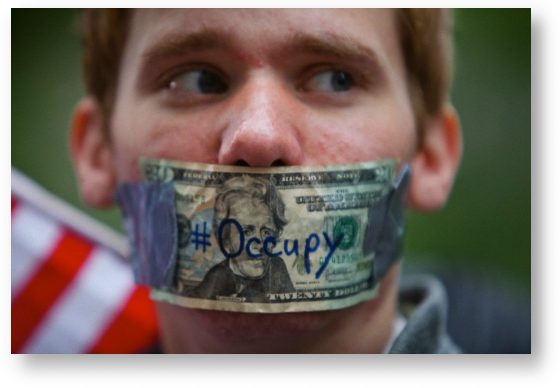
By now, I presume that you have heard of the Occupy Wall Street protests that began about a month ago, in which a small but fast-growing group of Americans camped outside of the large financial buildings in the Wall Street area of lower Manhattan to protest, among other things, the rising social inequality in U.S. society. The protests have since spread to numerous cities around the country (and apparently around the world) and at present, seem to be growing in popularity and media coverage.
One angle to look at is how the Occupy Wall Street movement may be the Left’s version of the Tea Party movement. While I have not looked into this particular aspect in detail, at first glance I think it is very interesting and even ironic that although this Occupy Wall Street movement shares much in common — at least philosophically — with the Tea Party movement, many of the latter’s prominent supporters have chosen to criticize the Occupy Wall Street movement. To my casual eye, this only highlights the hypocrisy of the Tea Party and confirms for me that is is less concerned about social change than it is about opposing President Obama and what he represents — namely the changing demographic, racial, and cultural face of U.S. society.
But beyond that, an even more interesting aspect of the Occupy Wall Street movement for me is its intentionally decentralized nature and how its most prominent informal leaders have specifically said that they do not feel that it is necessary or useful to articulate an overarching, single goal or unifying message for the movement. Below is a video clip from CBS News that discusses the movement’s reluctance to articulate a unified, central message.
Conventional sociological theory generally states that for a social movement to survive and have a realistic chance at achieving success, it needs to move beyond a single event and become more like a formal organization in terms of having a unifying message, clear leadership and personnel coordination, and well-developed administrative functions and capabilities. In other words, the early stages of a mass movement generally involve a sense of unrest or agitation, one or perhaps a series of events, a broad articulation of grievances, and an initial mobilization of collective action, media attention, and inevitably, some form of resistance or opposition.
But unless a movement can then develop strong leadership, mobilize resources, and sustain collective action, it is at this point where most social movements die. The Civil Rights Movement is often used as a model of how collective grievances eventually turned into a successful and sustained social movement through formalization, resource mobilization, organized division of labor, and political institutionalization. In fact, one of the most widely used books in the Sociology of Social Movements is Aldon Morris’ The Origins of the Civil Rights Movement that details how it evolved from collective grievances into arguably the most significant social movement in modern human history.
As applied to the Occupy Wall Street movement, conventional thinking dictates that it is eventually going to reach the point where it will either become more formalized, or it will flame out and pass into history. In this sense, the Occupy Wall Street movement’s choice to purposely remain unstructured and informal does not give me much confidence that it will be successfully sustained.
On the other hand, something also tells me that times have changed since the 1960s and that much like the rest of U.S. society, the cultural and technological landscape has evolved rather dramatically in the last 50 years or so. Obviously, back then resources such as cell phones, digital cameras, the internet, Twitter, and Facebook did not exist. Back then, communication and dissemination of information were slower, more crude, and more prone to confusion. If anything, knowing these limitations that existed 50 or so years ago makes the success of the Civil Rights Movement even more awe-inspiring.
In fact, scholars have described these types of social movements before and have called them New Social Movements (unfortunately creativity in naming things is not always a strong suit for academics). These New Social Movements tend to have decentralized leadership and organizational structures and instead relying on networks of groups that are affiliated or support their cause. They also tend to engage in nontraditional tactics — conventional protests but also TV ads, billboards, and extensive use of information technology and the internet. Some prominent examples of New Social Movements in recent history include the environmental, animal rights, anti-globalization, and peace/anti-war movements.
Today, with the widespread advent and dispersion of technological resources such as cell phones, digital imaging, and the internet, mass communication is infinitely quicker and more direct. Sociologists have started to write about just how much modern technology has affected and changed how human beings interact with each other on a daily basis. As applied to social movements, undoubtedly technology has made it much easier, quicker, and more effective to coordinate activities and disseminate all types of information.
In that sense, the Occupy Wall Street movement may not need to become formalized and organized into a hierarchy or bureaucracy in order to survive and become successful. The difference and advantage that they have today over their predecessors of 50 years ago is technology and the multitude of ways to dissemination information and to coordinate activities.
While technology itself cannot sustain a social movement, combined with the determination of participants and the fundamental importance and significance of the core issue of rising social inequality, the Occupy Wall Street movement may just be the right movement at the right time.
Here are some more announcements, links, and job postings about academic-related jobs, fellowships, and other opportunities for those interested in racial/ethnic/diversity issues. As always, the announcements and links are provided for informational purposes and do not necessarily imply an endorsement of the organization or college involved.
(New) Debates on Belonging:
A Graduate Student Conference on Contemporary Issues in Immigration
Keynote Speaker:
Dr. Richard Alba, Distinguished Professor of Sociology, CUNY Graduate Center
Friday, October 14, 2011
8:00am-6:00pm
Graduate Center – City University of New York
365 Fifth Avenue (at 34th Street), New York, NY
Hosted by the CUNY Graduate Center’s Immigration Working Group (IWG). Registration is FREE. Please register for the conference. All information, including agenda, panels, and abstracts, is available at http://www.gc-immigration.org/gcimmigrationconference. Lunch will be served.
Conference Overview:
With increasing frequency, questions of belonging have dominated the news and public debates on immigration: from the recent introduction of anti-immigrant legislation in many states to the spirited organizing around the DREAM Act and the controversy sparked by Park51’s proposal for a Muslim community center near Ground Zero. The prominence of such issues highlights both the fiercely contested nature of belonging in the United States, as well as how diverse groups – whether veteran or newly arrived, documented or undocumented, majority or minority, religious or secular – mobilize and advocate for their claims. While Congress debates and defers decisions on immigration reform on the national level, the question of belonging has distinctly regional and local manifestations. Immigrants and their children are claiming their place in American society, in its schools, workplaces and neighborhoods.
This interdisciplinary conference will bring together graduate students whose own research bear on these issues. (New) Debates on Belonging explores the many facets of immigrant belonging, incorporation and boundary drawing. Topics include, but are not limited to:
Place/region (communities, new destinations, urban areas)
Policy/activism/public health
Cross-national and historical comparisons
Culture and the arts
Citizenship
Dimensions of difference: gender, race, sexuality, religion, the body
Social institutions: labor and the economy, education, family, the media
Transnationalism
The second generation
Cosponsors:
CUNY Immigration Studies Initiative; CUNY Middle Eastern and Middle Eastern American Center; CUNY Sociology Dept.; CUNY Sociological Students’ Association; CUNY Center for Latin American, Caribbean, and Latino Studies.
The Carter G. Woodson Institute for African-American and African Studies and the Department of Sociology at the University of Virginia seek to fill a joint position in race and ethnicity. The position, open to applicants at the Assistant Professor (tenure-track) rank, is to begin August 25, 2012. Candidates with comparative, historical, or global approaches are particularly encouraged to apply.
Fields of specialization include but are not restricted to the following: race and the sociology of knowledge; race, immigration and labor; socioeconomic and racial/ethnic differences in health and mortality; urban ethnography, and urban inequality and poverty. The candidate’s tenure home will be the Department of Sociology, but teaching will be evenly split between the two units. Qualified applicants must hold a Ph.D. by the time of appointment.
To apply candidates must submit a Candidate Profile through Jobs@UVa (https://jobs.virginia.edu), search on posting number 0608419, and electronically attach the following: CV, cover letter, contact information for three references, statement of teaching philosophy and statement of research interest. Review of applications will begin by October 14, 2011, and applications will be accepted until the position is filled.
Inquiries should be addressed to the Chair of the Search Committee: Milton Vickerman (mv8d@virginia.edu). Questions regarding the application process in Jobs@UVa should be directed to: Brenda Tekin (bt8x@virginia.edu).
Midwest Sociological Society Annual Meeting
Mar 29 – April 1, 2012
Minneapolis, MN
Negotiations in Resettlement: The Immigrant in the U.S.
This panel invites 250-word abstracts of papers that explore the myriad of ways that immigrants negotiate the social, cultural, economic and political realities and often difficulties inherent in the resettlement process. What moral and material resources do immigrant individuals, families and/or groups strategically employ as mechanisms to assist them in navigating some of the obstacles present in the process of incorporation into American society? We are interested in all facets of the immigrant experience, including, but not limited to the impact of race, ethnicity, class, gender and sexuality on the choices immigrants make in terms of where they choose to resettle and how they shape what the resettlement process looks like.
Please submit your abstract by October 24, 2011 on the Midwestern Sociological Society’s website. If you have questions, contact either Tiffany Davis tdavis46@csu.edu or Erika Busse buss0101@umn.edu.
The Department of History at Oregon State University invites applications for a tenure-track position in the history of the United States in the World, to begin Fall 2012. Assistant Professor preferred; Associate Professor possible. The successful candidate will have the Ph.D. in History and specialize in the United States in a global context, American international relations, and/or transnational history. Candidates should demonstrate a serious commitment to both scholarship and teaching. Teaching responsibilities include the U.S. history survey and upper-division and other appropriate courses in one or more areas of specialization.
To apply, submit letter of application and current C.V. via our application website at https://jobs.oregonstate.edu, and three letters of reference to:
Professor Marisa Chappell, Chair, US in the World Search Committee,
History Department, Oregon State University
306 Milam Hall
Corvallis, OR 97331
Full consideration will be given to candidates whose applications are complete by November 1, 2011.
The University of Maryland at College Park invites inquiries, nominations, and applications for the position of Director of the Asian American Studies Program (AAST). The ideal candidate should possess a strong record of scholarly research and publication; experience developing interdisciplinary curriculum and instructional programs in Asian-American Studies; the ability to manage budgetary and personnel matters; and skills for obtaining and managing extramural funding and development. Most importantly, we seek a dynamic individual who possesses an intellectual and programmatic vision as well as the interpersonal and consensus-building skills necessary for its realization.
The Director will administer and teach in the Asian American Studies program, an interdisciplinary undergraduate minor program that focuses on the histories, communities, and cultures of Asian Americans. Applicants should possess the ability to work with scholars and students in diverse areas in order to build intercampus collaboration, set a campus-wide agenda for innovative Asian American Studies education and research, and manage the financial and operational aspects of the program. Developing strong ties between the University of Maryland and the surrounding community will also be important.
Candidates must have an earned doctorate or other terminal degree, a substantial record of innovative scholarship, excellent teaching, and demonstrated qualities of academic leadership, with academic credentials commensurate with the appointment to the rank of associate or full professor. We are open to candidates from the humanities, history, and the social sciences. The position of Director is a full-time appointment in AAST; the Director will hold tenure in an appropriate department within the university. The Director reports to the Associate Provost for Academic Affairs and Dean for Undergraduate Studies. Salary is negotiable, commensurate with qualifications and experience.
For best consideration, applications should be submitted by Nov. 30, 2011, but the position will remain open until filled. Contact Julie Greene, Professor of History and Chair of the Search Committee, at jmg@umd.edu, with any questions about this search or to nominate individuals for the position. Apply online at jobs.umd.edu (position number 111974). Please include a cover letter, cv, and list of three references with contact information. Ask references to submit letters independently to jobs.umd.edu.
>Preview Performance: “Chinglish” by David Henry Hwang
The Asian American Legal Defense and Education Fund (AALDEF) would like to invite you to a special benefit preview on Tuesday, Oct. 25, at 8pm, of David Henry Hwang’s new play on Broadway, Chinglish. David will join us for a Q&A after the performance, so you won’t want to miss this wonderful AALDEF event!
Chinglish is a romantic comedy about an American businessman who arrives in a bustling Chinese province looking to score a lucrative contact for his family’s sign-making firm. He soon finds that the complexities of such a venture far outstrip the expected differences in language, customs and manners–and calls into question even the most basic assumptions of human conduct.
David Henry Hwang, a Tony Award-winning playwright (M. Butterfly) and AALDEF’s 1989 Justice in Action award recipient, said, “Chinglish was born from the many visits I’ve made to China over the past five or six years to witness the exciting changes there. During one visit, I toured a new arts center where everything was first-rate–except for the ridiculously translated English signs. It was at that moment that I thought of writing this play.”
Chinglish, which had its world premiere at Chicago’s Goodman Theatre this past summer, got rave reviews. The Chicago Tribune called it a “shrewd, timely and razor-sharp comedy,” that is “surely Hwang’s best work since “M. Butterfly.”
Join us to catch a sneak peek of this new Broadway show before it opens on Oct. 27. We have a limited number of orchestra seats at a specially discounted price of $90 per ticket. Reserve your Chinglish tickets now by calling 212.966.5932 x212 or emailing events@aaldef.org. (Reservations are final only after payment has been received.)
Thanks so much for your continued support of AALDEF, and I look forward to seeing you at our Chinglish theater event on Oct. 25!
Located in the Little Tokyo business district within downtown Los Angeles, the Japanese American National Museum seeks to promote understanding and appreciation of America’s ethnic and cultural diversity by sharing the Japanese American experience. It is the largest museum in the United States dedicated to sharing that unique experience as an integral part of U.S. history and to preserving the rich heritage and cultural identity of Japanese Americans. In December 2010, the Museum was awarded the National Medal from the Institute of Museum and Library Services, the nation’s highest honor for museums and libraries across the country.
Responsibilities:
Reporting to the Museum’s Board of Trustees, the President & CEO will bring critical leadership to the Museum with responsibility for the overall performance of the institution. The successful candidate will be a visionary and inspirational leader, with responsibility for enhancing both the external face of the institution and the internal operations that will allow the Museum to meet its educational and programmatic objectives in an increasingly challenging economic environment and to continue to grow and fulfill its mission.
The President & CEO participates as an ex-officio member of a national board, working with the Board in charting the course of the Museum’s response to changing audiences, donors, members, and other stakeholders throughout the United States (including Hawaii) and Japan. The Candidate will also interface with the Museum’s Board of Governors, chaired by Secretary Norman Y. Mineta (a current trustee) and formerly chaired by Senator Daniel K. Inouye; Governors serve as regional ambassadors for the Museum.
The President & CEO will supervise a staff of approximately 40 full-time equivalent employees. He/She is responsible for an approximately $7 million annual budget. A significant portion of the President & CEO’s responsibility will be leading and working closely with the Museum’s staff to maintain current and prospective relationships with donors, volunteers and stakeholders and establish new relationships with those constituencies.
Leadership, Management and Oversight
Lead the organization, setting the voice and tone from the top and providing vision for future growth and success
Serve as the key liaison between the Board of Trustees and the Museum’s staff and work with the chairs of the Board and its various committees in developing meeting agendas and materials
Manage and oversee all program planning, organizing, operating and staffing activities
Manage overall financial oversight and monitoring, including budget discipline
Foster and monitor the quality of the Museum’s activities to assure excellence as defined by the Board
Form strategic alliances and partnerships, when appropriate to achieve the Museum’s goals
Manage the development and review of appropriate metrics to measure the performance, impact and results of programs
Recommend long-range plans that support the Museum’s philosophy and strategic objectives
Financial Management, Fundraising and Community Affairs
Represent the Board and the Museum to the community
Oversee marketing and public relations programs
Assure the sound fiscal operation of the Museum, including timely, accurate and comprehensive preparation of an annual budget and its implementation
Develop and oversee a robust fundraising and development department (including joint development efforts with the Museum’s boards), and actively participate in those efforts
Work closely with the development team in sustaining and establishing relationships with foundations, government agencies, and private donors
Human Resources
Establish objectives through the selection, supervision, professional development, motivation and evaluation of personnel
Review personnel positions and organizational structure to ensure the efficient, timely and effective work of the organization with personnel appropriate for the position
Specify staff roles and responsibilities, evaluate performance regularly and hold staff accountable for results
Implement and maintain appropriate salary structures
Traits and Characteristics
The ideal candidate will be a charismatic, inspirational and energetic leader who takes initiative and has the ability to articulate the mission of the Museum to its various constituencies. The successful candidate will have a passion for the cultural and historical foundations of the Museum, specifically in helping communicate the lessons learned from the World War II incarceration of persons of Japanese descent. He/She will be an excellent communicator with strong interpersonal and relationship-building skills. The successful candidate will have the ability to develop and implement policies, procedures, and systems necessary to elevate the Museum’s programming, including the Museum’s National Center for the Preservation of Democracy and the Museum’s educational outreach initiatives in targeted regions, while overseeing the big picture and overall impact of the Museum on the community.
Although the successful candidate will most likely have solid leadership experience in the field of Museum management, it is also possible that the individual might come from another career background in the nonprofit, public or for-profit sectors. He/She will have a minimum of seven to ten years of management experience that demonstrates the ability to conceptualize, plan, implement, administer, evaluate, communicate, and develop resources with a strong emphasis on past results. Knowledge of the history of Japanese Americans would be helpful.
Education
An undergraduate degree is required; an advanced degree is preferred.
Compensation
Salary and benefits commensurate with qualifications and experience will be provided. Relocation assistance is negotiable.
To Apply
Please direct inquires, nominations, and applications, including resume and a compelling letter of interest in confidence to:
Karin Stellar
Morris & Berger
500 North Brand Boulevard, Suite 2150
Glendale, CA 91203
Telephone 818-507-1234 – Fax 818-507-4770
kstellar@morrisberger.com
Electronic submission is encouraged
The Museum is an Equal Opportunity Employer. Personnel are chosen on the basis of ability without regard to race, color, religion, sex, national origin, disability, marital status or sexual orientation, in accordance with federal and state law.
My name is Aellon Krider and I am a Linguistic Recruiter with TransPerfect Translations. I am currently recruiting English into native Vietnamese translators located in the U.S. interested in long term freelance collaboration. We are looking for candidates experienced in health care or life sciences to join our network of certified linguists.
Applicants must:
Be a native speaker Vietnamese
Have a college degree and 5 years translation experience OR advanced degree and 3 years translation experience
Be able to produce documented proof of educational background
Be located in the U.S.
We are always looking to expand our qualified linguist resources, and would be interested in collaborating. If you are able to put me in contact with any other translators as well, I would greatly appreciate the referrals.
Thank you very much,
Aellon Krider
Linguistic Resources Coordinator
TransPerfect
t +1 212.689.5555 x1222 | skype: tpt_akride
The Center for the Study of Race, Ethnicity, and Gender in the Social Sciences (REGSS), an affiliate of the Social Science Research Institute at Duke University, is pleased to announce the establishment of the Samuel DuBois Cook Postdoctoral Fellowship. Cook, a political scientist, was the first black tenured professor at Duke University and served as a member of the Duke University Board of Trustees from 1981-1993 and is now a Trustee Emeritus.
REGSS seeks to provide a context where scholars interested in examining the constructs of race, ethnicity, and gender from an interdisciplinary perspective can engage each other in dialogue and collaboration. Our questions and our methodologies draw on disciplinary backgrounds that include economics, history, political science, psychology, public policy, and sociology. Scholars interested in the study of race, ethnicity, and the intersection of gender with race and ethnicity, are invited to apply for this one-year fellowship. Individuals working in the field of comparative race are also encouraged to apply. Postdoctoral fellows teach one course during the year, present their research at one of the center’s monthly research colloquia, and devote the rest of their time to research and writing.
Fields: Applications for study in any social science discipline are welcome. Please specify your home discipline and/or the discipline in which you received your Ph.D.
Stipend: $40,000 per fellowship period. Health benefits are available. Some funds are available for research expenses, including conference travel.
Fellowship Period: August 1, 2012 – May 15, 2013.
Eligibility: The primary criterion for selection is evidence of scholarship or scholarly interest in the study of race, ethnicity, or the intersection of gender with race and ethnicity. Applicants must complete all requirements for the doctoral degree by August 2012. Preference will be given to individuals who are within five years of their degree, but more senior applicants will be considered.
Application materials: Applicants must submit an application letter (including email address) in which the applicant clearly identifies the area or discipline of proposed research, curriculum vitae, sample publications and/or dissertation chapters, three letters of recommendation, a statement of research plans and a description of the course you prefer to teach. The research statement should be a separate document and not included in a cover letter. If recommendation letters accompany application materials they should be in a sealed envelope. Please indicate in application letter if you are legally authorized to work in the United States. Also, indicate whether you now, or in the future require sponsorship for employment visa status (e.g., Green Card, H-1B, TN, J-1.)
All materials should be sent to the address below and must be postmarked by January 16, 2012. Submitted material will not be returned to the applicant. Incomplete applications will not be considered.
REGSS Postdoctoral Fellowship Program
Duke University
Social Science Research Institute
Box 90420 / Erwin Mill
Durham, NC 27705
Telephone (919) 681-2702
http://regss.ssri.duke.edu
Question should be directed to:
Professor Paula D. McClain (pmcclain@duke.edu) or Professor Kerry L. Haynie (klhaynie@duke.edu)
The following is a list of recent academic journal articles and doctoral dissertations from scholars in the social sciences and humanities that focus on race/ethnicity and/or immigration, with a particular emphasis on Asian Americans. As you can see, the diversity of research topics is a direct reflection of the dynamic and multidimensional nature of people’s lives, experiences, and issues related to race/ethnicity and immigration.
The academic journal articles are generally available in the libraries of most colleges and universities and/or through online research databases. As always, works included in this list are for informational purposes only and do not imply an endorsement of their contents.
Eckstein, Susan, and Thanh-Nghi Nguyen. 2011. “The Making and Transnationalization of an Ethnic Niche: Vietnamese Manicurists.” International Migration Review 45(3):639-674.
Abstract: The article addresses how Vietnamese immigrant women developed an urban employment niche in the beauty industry, in manicuring. They are shown to have done so by creating a market for professional nail care, through the transformation of nailwork into what might be called McNails, entailing inexpensive, walk-in, impersonal service, in stand-alone salons, nationwide, and by making manicures and pedicures de riguer across class and racial strata.
Vietnamese are shown to have simultaneously gained access to institutional means to surmount professional manicure credentializing barriers, and to have developed formal and informal ethnic networks that fueled their growing monopolization of jobs in the sector, to the exclusion of non-Vietnamese. The article also elucidates conditions contributing to the Vietnamese build-up and transformation of the niche, to the nation-wide formation of the niche and, most recently, to the transnationalization of the niche. It also extrapolates from the Vietnamese manicure experience propositions concerning the development, expansion, maintenance, and transnationalization of immigrant-formed labor market niches.
Cort, David. 2011. “Reexamining the Ethnic Hierarchy of Locational Attainment: Evidence from Los Angeles.” Social Science Research 40(6):1521-1533.
Abstract: Because of a lack of data, the locational attainment literature has not incorporated documentation status into models examining group differences in neighborhood quality. I fill this void by using the Los Angeles Family and Neighborhood Survey, which permits the identification of undocumented respondents, allowing a reexamination of the ethnic structure of locational attainment in this important immigrant-receiving city.
Results first suggest that while undocumented Latinos live in the poorest quality communities, blacks live in neighborhoods that are similar to native-born Latinos and better than foreign-born Asians and Latinos. Second, the effects of education are strongest for blacks, allowing the highly educated an opportunity to reside in communities that are of better quality than educated Latinos and Asians.
Thus, undocumented Latinos replace blacks at the bottom of the locational attainment hierarchy, allowing educated blacks in Los Angeles to reside in better neighborhoods than blacks in the nation at large.
Emeka, Amon. 2011. “Non-Hispanics with Latin American Ancestry: Assimilation, Race, and Identity among Latin American Descendants in the U.S.” Social Science Research 40(6):1547-1563.
Abstract: In the 2006 American Community Survey (ACS), 6% of respondents with Latin American ancestry answered ‘no’ when asked whether they were Hispanic themselves. Conventional definitions of the Hispanic population exclude such respondents as ‘not Spanish/Hispanic/Latino’ even though they are self-identified Latin American descendants. Since their exclusion may bias our assessments of Hispanic social mobility, it is important to know more about them.
Non-Hispanic identification is most common among Latin American descendants who (1) list both Latin American and non-Latin American ancestries, (2) speak only English, and (3) identify as White, Black, or Asian when asked about their ‘race.’ Ancestry and racial identity are considerably more influential than respondents’ education, income, place of birth, or place of residence. These findings support both traditional straight-line assimilation and a more recent “racialized assimilation†theory in explaining discrepant responses to the ethnicity and ancestry questions among Latin American descendants.
Conger, Dylan, Amy E. Schwar, and Leanna Stiefel. 2011. “The Effect of Immigrant Communities on Foreign-Born Student Achievement.” International Migration Review 45(3):675-701.
Abstract: This paper explores the effect of the human capital characteristics of co-ethnic immigrant communities on foreign-born students’ math achievement. We use data on New York City public school foreign-born students from 39 countries merged with census data on the characteristics of the immigrant household heads in the city from each nation of origin and estimate regressions of student achievement on co-ethnic immigrant community characteristics, controlling for student and school attributes.
We find that the income and size of the co-ethnic immigrant community has no effect on immigrant student achievement, while the percent of college graduates may have a small positive effect. In addition, children in highly English proficient immigrant communities test slightly lower than children from less proficient communities. The results suggest that there may be some protective factors associated with immigrant community members’ education levels and use of native languages.
Lee, Sharon M., and Barry Edmonston. 2011. “Age-at-Arrival’s Effects on Asian Immigrants’ Socioeconomic Outcomes in Canada and the U.S.” International Migration Review 45(3):527–561.
Abstract: Age-at-arrival is a key predictor of many immigrant outcomes, but discussion continues over how to best measure and study its effects. This research replicates and extends a pioneering study by Myers, Gao, and Emeka [International Migration Review (2009) 43:205–229] on age-at-arrival effects among Mexican immigrants in the U.S. to see if similar results hold for other immigrant groups and in other countries. We examine data from the 2000 U.S. census and 2006 American Community Survey, and 1991, 2001, and 2006 Canadian censuses to assess several measures of age-at-arrival effects on Asian immigrants’ socioeconomic outcomes.
We confirm several of Myers et al.’s key findings, including the absence of clear breakpoints in age-at-arrival effects for all outcomes and the superiority of continuous measures of age-at-arrival. Additional analysis reveals different age-at-arrival effects by gender and Asian ethnicity. We suggest guidelines, supplementing those offered by Myers et al., for measuring and studying age-at-arrival’s effects on immigrant outcomes.
Here are some more announcements, links, and job postings about academic-related jobs, fellowships, and other opportunities for those interested in racial/ethnic/diversity issues. As always, the announcements and links are provided for informational purposes and do not necessarily imply an endorsement of the organization or college involved.
The Department of American Studies & Ethnicity, Dornsife College of Letters, Arts and Sciences, University of Southern California, in Los Angeles, California, is currently seeking to hire a Department Chair, at the rank of Professor with tenure. We are looking for a senior scholar with a
distinguished record of interdisciplinary research and publication and a commitment to teaching and graduate student mentorship.
The department is interested in scholars from the social sciences or the humanities whose work demonstrates an engagement with issues of race, gender, sexuality, either in the U.S. or transnationally in the fields of American and Ethnic Studies. Such a scholar will have a national and international profile, a dynamic understanding of where the field is heading, and will have some previous administrative experience to bring to this position. This is a unique and nationally recognized department that offers exciting opportunities and is open to benefiting from the vision of an established, innovative and imaginative leader in the field of American and Ethnic Studies.
To apply please send letter of interest and CV by October 1, 2011 to: Macarena Gomez-Barris, Interim Chair, Department of American Studies and Ethnicity, Kaprielian Hall (KAP) 462, Los Angeles, CA 90089-2534, preferably by email to asehiring@dornsife.usc.edu. In order to be considered, applicants must also submit an electronic USC application.
International Conference on Diversity in Organizations, Communities, and AND Nation
University of British Columbia, Vancouver, Canada
11-13 June 2012
The Diversity Conference has a history of bringing together scholarly, government and practice-based participants with an interest in the issues of diversity and community. The conference examines the concept of diversity as a positive aspect of a global world and globalised society. Diversity is in many ways reflective of our present world order, but there are ways of taking this further without necessary engendering its alternatives: racism, conflict, discrimination and inequity. Diversity as a mode of social existence can be projected in ways that deepen the range of human experience.
The conference will seek to explore the full range of what diversity means and explore modes of diversity in real-life situations of living together in community. The conference supports a move away from simple affirmations that ‘diversity is good’ to a much more nuanced account of the effects and uses of diversity on differently situated communities in the context of our current epoch of globalization. The International Diversity Conference will take place in Vancouver, a city both with a past marked by racial conflict and a rich heritage of diversity.
As well as impressive line-up of international plenary speakers, the conference will also include numerous paper, workshop and colloquium presentations by practitioners, teachers and researchers. We would particularly like to invite you to respond to the conference Call-for-Papers. Presenters may choose to submit written papers for publication in The International Journal of Diversity in Organizations, Communities and Nations. If you are unable to attend the conference in person, virtual registrations are also available which allow you to submit a paper for refereeing and possible publication.
In addition to organizing the Diversity Conference, Common Ground publishes papers from the conference and we do encourage all conference participants to submit a paper based on their conference presentation for peer review and possible publication in the journal. Whether you are a virtual or in-person presenter at this conference,
we also encourage you to present on the conference YouTube Channel. In addition, we publish books at http://www.ondiversity.com in both print and electronic formats.
We would like to invite conference participants to develop publishing proposals for original works, or for edited collections of papers drawn from the journal which address
an identified theme. Finally, please join our online conversation by subscribing to our monthly email newsletter, and subscribe to our Facebook, RSS, or Twitter feeds at http://www.ondiversity.com.
The deadline for the next round in the call for papers (a title and short abstract) is 6 October 2011. Future deadlines will be announced on the conference website after this date. Proposals are reviewed within two weeks of submission. Full details of the conference, including an online proposal submission form, are to be found at the conference website.
Yours Sincerely,
Prof. Jock Collins
University of Technology, Sydney, Australia
For the Advisory Board, International Conference on Diversity in Organizations, Communities and Nations and The International Journal of Diversity in Organizations, Communities and Nations.
The Department of Sociology and Criminal Justice invites applications for a tenure-track assistant professor position to begin in August 2012 (teaching load is 3-2). This position requires a specialization in Race and Ethnic Relations. Additional specialization in Theory is desirable.
Applications must include an application letter, CV, writing sample, evidence of teaching effectiveness, graduate transcripts, and three letters of recommendation. Letters of recommendation and graduate transcripts should be sent to Search Committee Chair, Department of Sociology and Criminal Justice, SAC 204, Villanova University, 800 Lancaster Ave., Villanova, PA 19085. All other material must be submitted online at http://jobs.villanova.edu.
Review of applications begins October 15, 2011 and continues until the positions are filled. Candidates must have a Ph.D. in Sociology by the time of appointment. Villanova is a Catholic university sponsored by the Augustinian Order located in the culturally diverse Philadelphia metropolitan area. An AA/EEO employer, Villanova seeks a diverse faculty committed to scholarship,service, and excellent teaching who understand and support the University’s mission, including the search for social justice.
The Department of Sociology at Texas A&M University invites applications for an associate or full professor in the area of Racial and Ethnic Relations. We seek candidates who have a record of notable accomplishment in research and scholarship, a commitment to excellence in teaching, and potential to provide senior leadership to research programs linked with the Racial and Ethnic Studies Institute. Candidates in all research areas within Racial and Ethnic Studies are encouraged to apply but preference is given to candidates who have research expertise in demography or health disparities and/or whose program of research would draw effectively on the resources of the Texas Census Research Data Center.
Texas A&M is a large and expanding research university located in Bryan/College Station, a growing metropolitan community with a clean environment, attractive amenities and a low cost of living and close proximity to the large metropolitan areas of Austin, Dallas, Houston and San Antonio. It holds the unusual distinction of being a land, sea, and space grant university. The Sociology Department is large, collegial, and intellectually and demographically diverse. Major research areas include Race, Class and Gender; Crime, Law and Deviance; Culture; Demography; Political and Economic Sociology; and Social Psychology. The department’s undergraduate program has over 400 majors and the doctoral program has about 90 students. Over the past decade, the department has experienced significant investments including the addition of faculty positions at both the senior and junior levels.
The sociology department is pivotal in support for and involvement with the Race and Ethnic Studies Institute and the newly established Texas Census Research Data Center (TXCRDC). The TXCRDC is one of only 11 such centers in the United States and significant for providing exceptional access to confidential federal data files relevant for conducting research on topics including, but not limited to, population, health, income and wealth, economic activity, and business and organizations.
Applicants should submit a letter describing their research and teaching interests, a curriculum vita, and examples of their publications of scholarly works. Address correspondence to: Mark Fossett, Chair of the Sociology Search Committee, Department of Sociology, Texas A&M University, 77843-4351 (m-fossett@tamu.edu). Review of applications will begin on October 15th and continue until the position is filled. Texas A&M University is an Affirmative Action/Equal Opportunity Employer and seeks to be responsive to the needs of dual career couples.
Brooklyn College of the City University of New York invites applications for two tenure-track positions at the rank of Assistant Professor of Sociology to begin September 2012. Ph.D. in sociology required by the time of appointment. Position #1: Specialization in the areas of urban policy, stratification, and quantitative research methods. The candidate will be expected to teach at least one quantitative methods course each semester and contribute to the Department’s substantive courses in urban social welfare policy. We offer quantitative methods courses at both the undergraduate and graduate levels. Teaching assignments may also include the social science course in the college’s core curriculum, as well as courses dual listed with Africana Studies. The Department of Sociology seeks to expand its ongoing collaboration with the Center for the Study of Brooklyn, Brooklyn College’s urban policy research institute.
Position #2: Specialization in the areas of race and ethnicity, stratification, and social theory. The candidate will be expected to teach at least one social theory course each semester and contribute to the Department’s substantive courses in race and ethnicity and inequality. We offer classical and contemporary social theory courses at both the undergraduate and graduate levels. Teaching assignments may also include the social science course in the college’s core curriculum, as well as courses dual listed with Africana Studies.
For both positions, we are seeking candidates who are committed to undergraduate and graduate education at a public, urban institution that serves a highly diverse student body. Letters of application should specify how the candidate’s research and teaching interests can speak to, and make use of, Brooklyn’s uniquely rich and vibrant social context. Review of applications begins October 15th, 2011. A curriculum vita, statement of research interests and teaching philosophy, three letters of reference, and supportive documents (syllabi, student evaluations of teaching, samples of scholarship, etc.) should be sent to Michael T. Hewitt, Assistant Vice President for Human Resource Services, Department of Sociology, Brooklyn College-CUNY, 2900 Bedford Ave., Brooklyn, NY 11210-2889.
The American Bar Foundation sponsors fellowship programs for postdoctoral scholars, doctoral candidates, graduate and undergraduate students. All fellowships are held in residence at the ABF’s offices in Chicago. To submit an online application for an open fellowship opportunity at the American Bar Foundation, visit the ABF website.
ABF Doctoral Fellowship Program: The American Bar Foundation is committed to developing the next generation of scholars in the field of law and social science. The purpose of the fellowships is to encourage original and significant research on law, the legal profession, and legal institutions.
Law and Social Science Dissertation Fellowship and Mentoring Program (LSS Fellowship) The Law and Society Association, in collaboration with the American Bar Foundation and the National Science Foundation, has launched the Law and Social Science Dissertation Fellowship and Mentoring Program (LSS Fellowship) which is designed to foster scholars in the Law and Society tradition and whose scholarship is on Law and Inequality.
ABF Summer Research Diversity Program: This program of summer research fellowships is designed to introduce undergraduates from diverse backgrounds to the rewards and demands of a research-oriented career in the field of law and social science. Click here for more information.
Below are some recently-released books that highlight the connections between past and present in the lives of Asian Americans. As scholars and philosophers will tell you, knowing where a particular group or nation has been is the first step towards knowing where they are going. As always, a book’s inclusion is for informational purposes only and does not necessarily mean a full endorsement of its contents.
The first half of the twentieth century witnessed a wave of Filipino immigration to the United States, following in the footsteps of earlier Chinese and Japanese immigrants, the first and second “Asiatic invasions.” Perceived as alien because of their Asian ethnicity yet legally defined as American nationals granted more rights than other immigrants, Filipino American national identity was built upon the shifting sands of contradiction, ambiguity, and hostility.
Rick Baldoz explores the complex relationship between Filipinos and the U.S. by looking at the politics of immigration, race, and citizenship on both sides of the Philippine-American divide: internationally through an examination of American imperial ascendancy and domestically through an exploration of the social formation of Filipino communities in the United States. He reveals how American practices of racial exclusion repeatedly collided with the imperatives of U.S. overseas expansion. A unique portrait of the Filipino American experience, The Third Asiatic Invasion links the Filipino experience to that of Puerto Ricans, Mexicans, Chinese and Native Americans, among others, revealing how the politics of exclusion played out over time against different population groups.
Weaving together an impressive range of materials–including newspapers, government reports, legal documents and archival sources—into a seamless narrative, Baldoz illustrates how the quixotic status of Filipinos played a significant role in transforming the politics of race, immigration and nationality in the United States.
Both a history of an overlooked community and a well-rounded reassessment of prevailing assumptions about Chinese miners in the American West, In Pursuit of Gold brings to life in rich detail the world of turn-of-the-century mining towns in the Northwest. Sue Fawn Chung meticulously recreates the lives of Chinese immigrants, miners, merchants, and others who populated these towns and interacted amicably with their white and Native American neighbors, defying the common perception of nineteenth-century Chinese communities as insular enclaves subject to increasing prejudice and violence.
While most research has focused on Chinese miners in California, this book is the first extensive study of Chinese experiences in the towns of John Day in Oregon and Tuscarora, Island Mountain, and Gold Creek in Nevada. Chung illustrates the relationships between miners and merchants within the communities and in the larger context of immigration, arguing that the leaders of the Chinese and non-Chinese communities worked together to create economic interdependence and to short-circuit many of the hostilities and tensions that plagued other mining towns.
Peppered with fascinating details about these communities from the intricacies of Chinese gambling games to the techniques of hydraulic mining, In Pursuit of Gold draws on a wealth of historical materials, including immigration records, census manuscripts, legal documents, newspapers, memoirs, and manuscript collections. Chung supplements this historical research with invaluable first-hand observations of artifacts that she experienced in archaeological digs and restoration efforts at several of the sites of the former booming mining towns.
In clear, analytical prose, Chung expertly characterizes the movement of Chinese miners into Oregon and Nevada, the heyday of their mining efforts in the region, and the decline of the communities due to changes in the mining industry. Highlighting the positive experiences and friendships many of the immigrants had in these relatively isolated mining communities, In Pursuit of Gold also suggests comparisons with the Chinese diaspora in other locations such as British Columbia and South Africa.
Prisons and Patriots provides a detailed account of forty-one Nisei (second-generation Japanese Americans), known as the Tucsonians, who were imprisoned for resisting the draft during WWII. Cherstin Lyon parallels their courage as resisters with that of civil rights hero Gordon Hirabayashi, well known for his legal battle against curfew and internment, who also resisted the draft.
These dual stories highlight the intrinsic relationship between the rights and the obligations of citizenship, particularly salient in times of war. Lyon considers how wartime civil disobedience has been remembered through historyohow soldiers have been celebrated for their valour while resisters have been demonized as unpatriotic. Using archival research and interviews, she presents a complex picture of loyalty and conflict among first-generation Issei and Nisei.
Lyon contends that the success of the redress movement has made room for a narrative that neither reduces the wartime confinement to a source of shame nor proffers an uncritical account of heroic individuals.
Relative Histories focuses on the Asian American memoir that specifically recounts the story of at least three generations of the same family. This form of auto/biography concentrates as much on other members of one’s family as on oneself, generally collapses the boundaries conventionally established between biography and autobiography, and in many cases—as RocÃo G. Davis proposes for the auto/biographies of ethnic writers—crosses the frontier into history, promoting collective memory.
Davis centers on how Asian American family memoirs expand the limits and function of life writing by reclaiming history and promoting community cohesion. She argues that identity is shaped by not only the stories we have been told, but also the stories we tell, making these narratives important examples of the ways we remember our family’s past and tell our community’s story.
In the context of auto/biographical writing or filmmaking that explores specific ethnic experiences of diaspora, assimilation, and integration, this work considers two important aspects: These texts re-imagine the past by creating a work that exists both in history and as a historical document, making the creative process a form of re-enactment of the past itself. Each chapter centers on a thematic concern germane to the Asian American experience: the narrative of twentieth-century Asian wars and revolutions, which has become the subtext of a significant number of Asian American family memoirs.
When Eleanor Swent began teaching English as a Second Language in 1967 at a school for adults in Oakland, California, she soon learned that many of the Asian immigrants in her classes had remarkable tales to tell of struggles in their homelands and their efforts to make new lives in America. This oral history, based on interviews Swent conducted with her students over thirty years, documents the Asian immigrant experience as never before.
Here are the stories of desperate individuals who swam to escape from China to Macao and Hong Kong; of Chinese daughters considered worthless by their families; of political refugees from Vietnam; of ethnic Chinese who fled by boat from Vietnam; of refugees from the genocide in Cambodia. As these remarkable new Americans learn different words and customs, they also enlarge our national vision, enriching our culture while assuring us that human dignity can rise above terrible circumstances.
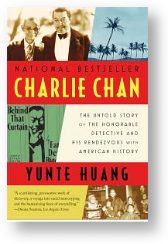
Hailed as “irrepressibly spirited and entertaining” (Pico Iyer, Time) and “a fascinating cultural survey” (Paul Devlin, Daily Beast), this provocative first biography of Charlie Chan presents American history in a way that it has never been told before. Yunte Huang ingeniously traces Charlie Chan from his real beginnings as a bullwhip-wielding detective in territorial Hawaii to his reinvention as a literary sleuth and Hollywood film icon.
Huang finally resurrects the “honorable detective” from the graveyard of detested postmodern symbols and reclaims him as the embodiment of America’s rich cultural diversity. The result is one of the most critically acclaimed books of the year and a “deeply personal . . . voyage into racial stereotyping and the humanizing force of story telling.”
Here are some more announcements, links, and job postings about academic-related jobs, fellowships, and other opportunities for those interested in racial/ethnic/diversity issues. As always, the announcements and links are provided for informational purposes and do not necessarily imply an endorsement of the organization or college involved.
As a reminder, the 2011 Advancing Justice Conference will be held in San Francisco on October 27-28, 2011. This year’s conference will pay tribute to the rich history of activism that makes the Bay Area such a special place for all communities, but especially Asian Americans and Pacific Islanders. This year’s conference will include exciting and diverse workshops on:
Civil & Human Rights
Capacity Building
Youth Leadership & Community Organizing
Immigrant Integration & Civic Participation
What does “Advancing Justice” mean to you? Visit the Advancing Justice Facebook page, click Like, and answer in ONE comment for your chance to win free registration to Advancing Justice Conference! Answers accepted until Friday 9/23 and the winner will be announced 9/26.
The National Asian Pacific American Bar Association (NAPABA) is the national association of Asian Pacific American (APA) judges, law professors, law students, and lawyers with over 60 affiliated local bar associations nationwide. NAPABA promotes the professional development of its members and advocates for justice, equity, and opportunity for APAs. NAPABA’s program initiatives include increasing diversity in the legal profession, supporting APA judicial nominees, and promoting pro bono and community service efforts. NAPABA is located in downtown Washington, D.C., approximately four blocks from The White House.
About NAPABA’s Internship
NAPABA’s intern will work closely with the Programs Associate to support NAPABA by:
Conducting research on issues affecting APAs and the legal profession
Assisting with coordinating the activities of NAPABA’s committees including the civil rights, immigration, legislative, and labor and employment committees
Accompanying the Executive Director, Policy Director, and/or Programs Associate to various events and meetings
Assisting with NAPABA’s 23rd Annual Convention in Atlanta, GA with the opportunity to attend
Assisting with administrative tasks including answering phone calls, faxing, and copying
Performing other tasks to support NAPABA staff as necessary
This internship is generally unpaid; a small stipend for local travel may be provided. NAPABA supports and encourages applicants’ efforts to seek academic credit for their work.
Qualifications
Applicants should be self-motivated and hard-working, with an ability to work with a diverse staff. Excelling writing skills and attention to detail are a must. Undergraduates with an interest in law and/or public policy are encouraged to apply.
The University of Michigan’s Department of Screen Arts and Cultures (SAC), the Department of Asian Languages and Cultures (ALC) and the Program in American Culture (AC), invite applications for as many as two positions in “Asian Screen Arts and Culture” and/or “Asian American Screen Arts and Culture” beginning September 1, 2012. Scholars of cinema, television and digital media are invited to apply.
The position(s) in “Asian Screen Arts and Culture,” would be jointly appointed between SAC and ALC, and the position(s) in “Asian American Screen Arts and Culture,” would be jointly appointed between SAC and AC. These university-year appointments are possible at both junior and senior ranks. Successful candidates are expected to teach a range of courses, from introductory undergraduate lecture courses through graduate seminars; to supervise doctoral dissertations; and to participate actively in the programs of the departments as well as in area studies initiatives within a larger university community that encourages interdisciplinary efforts.
For all positions, the Ph.D. is required prior to appointment. Evidence of excellent teaching and research abilities is essential. Please submit a letter of application, CV, statement of teaching philosophy and experience, evidence of teaching excellence (if any), and a statement of current and future research plans. Junior candidates may submit a placement dossier with representative publications or writing sample and at least three letters of recommendation. Senior candidates should send the names of suggested reviewers.
Please send applications to Asian/Asian American Screen Arts Search Committee, Department of Screen Arts and Cultures, University of Michigan, 6330 North Quad, 105 S. State Street, Ann Arbor, MI 48109-1285. To be assured consideration, applications must be received by September 15, 2011. The University is supportive of the needs of dual career couples.
The Department of Sociology in the Maxwell School of Citizenship & Public Affairs, Syracuse University, invites applications for a tenure-track Assistant Professor position to begin Fall, 2012. We seek a scholar with a strong program of research on race, cultural interrelations, and / or racial inequalities whose work fits within a broad agenda for multidisciplinary research on African Americans and / or black immigrants in urban contexts.
Preference will be given to candidates who can contribute to other strengths in the department, which include sociology of education, work, family, health, aging, gender, sexuality, and social policy, and to those whose interdisciplinary interests complement the broader Maxwell mission. Candidates must have a Ph.D. in Sociology or a related discipline by the time of appointment and must show success in or strong promise of scholarly achievement and productivity, as well as a commitment to graduate and undergraduate teaching. Faculty members have the opportunity to affiliate with one of the Maxwell School’s research institutes or a number of other interdisciplinary centers and programs.
We will begin reviewing applications on October 15th and continue until the position is filled. For consideration, interested candidates must apply at www.sujobopps.com by completing a brief faculty summary. Candidates must upload to the online system a letter of interest, vita, and one publication or writing sample; other materials will be requested if needed. In addition, on the online system, applicants must identify three people who will be asked to provide letters of recommendation.
2011 Asian American Women in Leadership Conference:
What Can We Learn from Asian American Women Leaders?
About the Conference
ASPIRE and the Simmons Institute for Leadership and Change are pleased to present the 2011 Asian American Women In Leadership (AAWIL) Conference on November 5, 2011 celebrating the theme of: What Can We Learn from Asian American Women Leaders?
The 2011 AAWIL Conference will celebrate the significant contributions of Asian American women leaders and the inspirational lessons we can learn from their experiences. This conference aims to affirm the importance of empowering Asian American women and to create a bridge for our next generation of leaders through exploration of personal and professional growth in a context relevant to Asian American women. Speakers with diverse personal and professional backgrounds will share stories about the challenges they faced, stereotypes they overcame, and the paths they choose to gain success.
Attendees will participate in workshops that:
Develop and strengthen skills to grow personally and professionally in school, workplace, and the community
Recognize and celebrate different types of leadership and inspirational women
Discuss ways to advance the visibility of Asian American women in leadership roles
Provide a sense of community and connectedness for Asian American girls and women to network, build relationships, and learn from each other
Energize and equip attendees to broaden their horizons and seek out future career and leadership opportunities
The AAWIL Conference aims to set forth strategic dialogue on the importance of leadership for Asian American girls and women. Specifically, the conference is designed to:
Explore various aspects of leadership, particularly as it relates to Asian American women
Evaluate the effectiveness of different leadership skills and styles
Energize and equip attendees to seek out future leadership opportunities
Create cross-generational networks among attendees that will extend discussions and relationships beyond the scope of the conference
Raise awareness about ASPIRE, its missions and value to Asian American girls and women
The Association for Asian American Studies (AAAS) will be holding their annual conference on April 11-14, 2012 in Washington DC. As I’ve written about before, I always enjoy attending the AAAS annual conference and find it to be a very welcoming and inspiring opportunity to connect with other academics and activists who are also interested in Asian American Studies and contributing to the Asian American community. Below is their Call for Submission:
The theme, “Expanding the Political: Power, Poetics, Practices,” refers to the location of the meetings in Washington, DC, the seat of politics and power in the United States. Asian Americans play an increasing role in U.S. and international politics in their roles as voters, politicians, and policy makers. At the same time, we wish to highlight the everyday and informal political practices of Asians in America as they use art, academics, and activism to engage — and change — the world around them.
We invite submissions that address formal politics and informal politics in their multiple dimensions. We welcome presentations that explore traditional conceptions of “politics†and political action on topics such as electoral politics, Asian Americans in the government, activism and social movements, and political interests and issues. Do Asian Americans constitute a political block (or have they ever)? How can we interpret the increasing presence of Asian American Republican politicians? Is “Asian America” a useful political category?
Simultaneously, we hope the conference will expand our conception of the political to other areas including, but not limited to, the politics of: commemoration and memorialization; war and peace; dynamics within/across/outside Asian American communities, communities of color, and multiracial Asians; immigration, refugee status, citizenship, and national belonging; the relationship between Pacific Island Studies and Asian American Studies; Asian settler colonialism; empire and race. What generative political work emerges in the conversation between academics, activists, and artists? How do Asian Americans contend with the politics of the everyday?
We encourage submissions representing all the disciplines covered in Asian American Studies and from individuals engaged in political work, broadly speaking, outside the academy, including politicians, artists and activists. We especially encourage panels incorporating a range of institutional and extra-institutional locations, from students to senior scholars, and from painters to policy makers.
Complete panel submissions (with a minimum of three papers and a maximum of four, with a moderator) that attend to the conference theme and reflect this heterogeneity will be given priority, but we will consider individual submissions as well. In addition to panels, workshops, and roundtables, this year we introduce an inaugural invitation for chaired WORKING PAPER sessions dedicated specifically to this year’s conference theme.
For these sessions, panelists will submit longer papers (15-25 pages) prior to the conference, and sessions will be devoted to intensive commentary and discussion on a set of 2-3 papers with a shared theme. A faculty expert on the theme will chair each session and deliver detailed feedback to each author. This format will foster a deeper scholarly exchange and engagement, and showcase the common intellectual threads that run through our diverse research projects. We encourage scholars from various ranks to submit their papers to the Working Paper sessions.
We accept electronic submissions. Paper and panel applicants must be members of the Association for Asian American Studies and all presenters must register and submit their conference fee to be included in the printed conference program. Please check the “WORKING PAPERS†box if you would like your paper or panel submission to be considered for the Working Papers chaired sessions.
Relevant information, including the membership form and submissions guidelines, is available at the Association for Asian American Studies Web site. We look forward to seeing you at the 2012 Association for Asian American Studies conference in Washington, DC! Submissions due by: October 8, 2011 (extended for original deadline of Oct. 1).
If the online submission system does not work, please submit your proposal via email, with the subject header: AAAS 2012 Conference Proposal and your last, first name to: piaseng@illinois.edu. To submit a proposal via fax please send your proposal to 217-265-6235. For both fax and email submissions, please make sure to fill out the cover page with contact information for all panelists.
For those who are east of the west coast, you may have heard of the East of California section (EoC) of the Association for Asian American Studies, for those academics who — as its name implies — are located east of California. The EoC section has their own Call for Papers below:
Call for Papers: East of California Section-Sponsored Panels for the AAAS Conference Submission Deadline: September 20, 2011
Based on the conference theme, “Expanding the Political: Power, Poetics, Practices,” the East-of-California Section seeks to sponsor the following three panels at the 2012 AAAS Conference in Washington, DC. We invite faculty, graduate students and community members who are involved in Asian American politics and art to submit proposals to one of these panels by emailing a 250-word abstract and a two-page CV to Mark Chiang (mchiang00@gmail.com) and Eric Hung (msumeric@gmail.com) by September 20, 2011.
Panel: Asian Americans and Conservative Politics East of California
Asian American voters have become increasingly “Democratic-leaning†in federal elections over the past two decades. Simultaneously, a number of Asian Americans have become highly visible in conservative politics. Not only have Dinesh D’Souza and Elaine Chao served in the Reagan and second Bush administrations, Bobby Jindal and Nikki Haley have become governors of Louisiana and South Carolina. Additionally, Michelle Malkin has become a prominent conservative pundit on Fox News.
This panel seeks papers that address the rise of Asian Americans in conservative politics—the Republican Party, neoliberal and libertarian organizations, the Tea Party—east of California. What led to this rise? What are its implications for Asian American identity and Asian American Studies? What impacts have these figures made on the Conservative movement? What roles has religion played in this trend? Is it an inevitable result of increased assimilation?
Panel: Asian American Political Art
This panel seeks papers that address the relationship between art (broadly defined), politics and Asian America. We are particularly interested in studies of visual art, film, dance, music and literature that engage with the formal political system or the political process. Potential topics include:
Methodological issues raised by political art
Art as a tool of political legitimation or resistance
Propagandistic works about Asian America or Asian immigration
Art’s impact on the terms of debate and political actions
The role of community in the creation and use of political art
Panel: Questions of State
What role does the state play in Asian American politics, culture and community? We seek papers that address any aspect of the state, from historical studies of Asian American actors in the political system or state apparatus (government employees, politicians, lobbyists and others), to theoretical reflections on the contemporary transformations of the state and its impact on ideological struggles over political hegemony, to investigations of the state’s place in the global economy and how that shapes Asian American subjects or communities. What kinds of power still operate through the state and where are Asian Americans located in relation to that power? Is the state still an essential site of political or cultural struggles, or is it becoming increasingly marginal to transnational movements or organizations?
Today the U.S. and the rest of the world commemorates the 10th anniversary of the 9/11 terrorist attacks. Many media outlets, think tanks and research institutions, organizations, and individual commentators have offered their own analyses of what transpired on that day 10 years ago and what has happened since. Like those of many Americans, my reflections are complex and even contradictory.
On the one hand, I still mourn those who suffered on that eventful day, in the years since, and continue to suffer today. I also applaud the ways in which, at least for a while, we came together as Americans, united by our fierce loyalty to fundamental principles upon which this country was founded. On the other hand, I also feel that we as Americans have given given into fear too much and that has allowed many of our institutions to inflict needless hostility against innocent people inside the U.S. and around the world.
To hopefully serve as a teaching and learning resource about the issues related to this 10th anniversary, I humbly offer the following retrospective of posts related to 9/11, the war on terrorism, and the treatment of Arab and Muslim Americans (or those perceived to be by the rest of society) since Sept. 11, 2001 (in chronological order).
Immediately after the 9/11 attacks, hate crimes based on racial/ethnic or religious identity increased, but then declined. This post from 2005 analyzes why they began increasing again.
Looking at the sincerity and prospects of efforts by the Bush administration to reach out to Arab and Muslim Americans and improve relations with them.
Members of both groups reflect on the unfortunate similarity of being the targets of racial profiling by their own country as it fights wars with others who look like them.
Special issue of Asian American Literary Review commemorates the 10th anniversary of 9/11 from the point of view of South Asians, Arabs, Middle Easterners, and Muslim Americans.
Here are some more announcements, links, and job postings about academic-related jobs, fellowships, and other related opportunities for those interested in racial/ethnic/diversity issues. As always, the announcements and links are provided for informational purposes and do not necessarily imply an endorsement of the organization or college involved.
The Asian American Justice Center is searching for up and coming youth advocates to represent the 2011-2012 Youth Advisory Council class. Flex your social entrepreneurship to address issues of racial equity pertinent to the Asian American Pacific Islander (AAPI) community. Due Sept 15. Apply online now or contact ochow@advancingequality for more info.
Call for Proposals: Immigration & Entrepreneurship Conference
Immigration & Entrepreneurship: An Interdisciplinary Conference, co-sponsored by:
The Center for the History of the New America (University of Maryland)
Maryland Technology Enterprise Institute (University of Maryland)
The German Historical Institute (Washington, D.C.)
Conveners: Prof. David B. Sicilia and Prof. David F. Barbe, University of Maryland, College Park; Prof. Dr. Hartmut Berghoff, German Historical Institute and University of Göttingen
The United States has long been an immigrant society as well as an entrepreneurial society. This is no coincidence: immigrants launch new enterprises and invent new technologies at rates much higher than native-born Americans. As the volume of in-migration again approaches that of the “new immigration” at the turn of the twentieth century, it is time to measure how immigrants have shaped the American economy in the past and how immigration policy reform in 1965 has fostered the transformation of business and economic life in the United States.
How have newcomers shaped and in turn been shaped by American economic life?
There are striking parallels between nineteenth-century immigration and contemporary immigrant entrepreneurship. Then, as now, immigrants brought considerable education, ambition, and capital, yet often were marginalized or excluded from mainstream opportunities by law, custom, and prejudice. Particular immigrant groups ultimately dominated particular industries and services. Immigrant entrepreneurs built and circulated through trans-Atlantic, trans-Pacific, and at times global networks of people, capital, and know-how.
However, the two eras of heavy migration also differ in significant ways. Newcomers from East and South Asia and Latin America have supplanted Eastern and Southern European immigrants who dominated in the late nineteenth century, and German and Irish immigrants who arrived in the early nineteenth century. And whereas many recent immigrants, like their predecessors a century ago, have worked in low-skilled occupations, in construction, or have created small businesses, a significant portion of recent immigrants have arrived with advanced degrees and have launched businesses in the most advanced sectors of the economy, from Silicon Valley to Rte. 128, from biotech to the digital economy.
The Center for the History of the New America, the Maryland Technology Enterprise Institute, and the German Historical Institute invite proposals from scholars working in a variety of disciplines – including but not limited to history, sociology, economics, business administration, entrepreneurial studies, anthropology, and cultural studies – to submit research paper proposals. Comparative studies across time and place are especially welcomed.
The conference will engage these and related research topics:
immigrant group styles and patterns of entrepreneurship
immigrant entrepreneurship and U.S. economic development
geography of ethnic entrepreneurship
journeys of successful high-tech entrepreneurs
immigrant entrepreneurs as small proprietors
succeed and failure narratives and other discourse surrounding
ethnic immigrant entrepreneurship
barriers to immigrant entrepreneurial success
policy implications of historical and contemporary research on immigrant entrepreneurship
For full consideration, please submit a 200-word abstract and a short c.v. to immigrant-ent@umd.edu by September 15, 2011. The conference will take place in College Park, MD, and Washington, D.C. in mid-September 2012. Presenters will be given accommodations and a travel stipend. Selected conference presenters will be invited to publish their work in an edited scholarly volume of essays that will grow out of the conference.
WHAT: Be the Change (BTC) is a national day of service organized by South Asian Americans Leading Together (SAALT) to commemorate the spirit of leadership through service. With this, we hope to inspire South Asian communities and their allies to strengthen their commitment to public service! Last year nearly 4,000 people volunteered from across the country!
HOW CAN I HELP?: You can participate in whatever volunteer activity you like – anything from youth empowerment to environmental justice! Register for BTC and local coordinators will contact you with the activities they have planned.
WHO MAKES IT HAPPEN: Many volunteers just like you including South Asian community members, activists, professionals, students, and allies!
HOW YOU CAN REGISTER: Please register to volunteer in your local city or campus.
WHO SHOULD I CONTACT FOR MORE INFO?: Please contact the National BTC Coordinator at btc@saalt.org or call SAALT at (301) 270-1855.
CAN I STILL ORGANIZE THIS FOR MY LOCAL COMMUNITY?: Yes! Please contact the National BTC Coordinator at btc@saalt.org . SAALT will provide you many resources to implement a meaningful service project for you and your community!
Amerasia Journal invites faculty to nominate exceptional graduate student essays (masters and doctoral level) in the interdisciplinary field of Asian American and Pacific Islander Studies for the Lucie Cheng Prize. The winning article will be published in Amerasia Journal, and $1000 will be awarded.
The Lucie Cheng Prize honors the late Professor Lucie Cheng (1939-2010), a longtime faculty member of UCLA and the first permanent director of the UCLA Asian American Studies Center (1972-1987). Professor Cheng was a pioneering scholar who brought an early and enduring transnational focus to the study of Asian Americans and issues such as labor and immigration. Submission: Nomination must be submitted via email by the graduate advisor no later than October 1, 2011 and include:
Graduate Advisor Name, Title, Institution, and Contact Information
National Academy of Education/Spencer Dissertation Fellowship Program seeks to encourage a new generation of scholars from a wide range of disciplines and professional fields to undertake research relevant to the improvement of education. These $25,000 fellowships support individuals whose dissertations show potential for bringing fresh and constructive perspectives to the history, theory, or practice of formal or informal education anywhere in the world. Fellows will also attend professional development retreats and receive mentorship from NAEd members and other senior scholars in their field.
This highly competitive program aims to identify the most talented emerging researchers conducting dissertation research related to education. The Dissertation Fellowship program receives many more applications than it can fund. This year, up to 600 applications are anticipated and about 20 fellowships will be awarded. Additional guidelines and the fellowship application form are available from our website. Deadline: October 3, 2011.
Summer 2012 BORDERS Awards in Immigration Research
The National Center for Border Security and Immigration (BORDERS) led by The University of Arizona is pleased to invite faculty and young researchers to submit proposals for its summer research funding competition in Immigration Research. Applicants will submit proposals utilizing data from the New Immigrant Survey (NIS) to examine immigrants’ integration and participation in American civic culture.
Awards will be given based on the innovativeness and quality of the proposed research for faculty ($30,000/project) and young researchers – postdoctoral fellows or doctoral students ($12,000/project). Teams are encouraged to apply. Project findings will be presented to academics and government policymakers at the conclusion of the award. This peerâ€reviewed competition is open to U.S. citizens researching in any social scienceâ€related field.
Application deadline: October 28, 2011. For more information, contact Riley McIsaac rmcisaac@borders.arizona.edu
The National Center for Border Security and Immigration (BORDERS) is a Department of Homeland Security (DHS) Center of Excellence (COE) led by The University of Arizona. As a consortium of 15 premier institutions, BORDERS is dedicated to the development of innovative technologies, proficient processes, and effective policies that will help protect our Nation’s borders, foster international trade, and enhance longâ€term understanding of immigration dynamics.
There is nothing more powerful than the stories of Asian Americans and Pacific Islanders. Our stories define who we are, and they reflect our impact on the community around us. At the White House Initiative on AAPIs, we seek to amplify these voices nationally. We are pleased to announce the first ever White House Initiative Video Challenge, called What’s Your Story?”
We’re calling on you to produce a video, up to three minutes long, telling us who you are and how you have impacted those around you. In your video, answer the questions: How have your unique experiences shaped who you are today? And in what ways are you making a difference in your community? Everyone is welcomed to participate.
We will review the submissions and post a select number of entries on the White House website. In addition, we’ll invite a group of exceptional AAPI leaders to share their stories in person at the White House this fall as special guests in a White House Initiative on AAPIs event. To learn more about the challenge, watch our call-out video below:
To submit your video and learn more about the challenge, go to www.whitehouse.gov/whatsyourstory. The deadline for video submissions is midnight on November 1, 2011. Thank you and we look forward to hearing your stories.
Sincerely,
The White House Initiative on Asian Americans and Pacific Islanders
Join us on Facebook at www.facebook.com/WhiteHouseAAPI
Follow us on Twitter at www.twitter.com/WhiteHouseAAPI
If you have any questions, email us at WhiteHouseAAPI@ed.gov
The National Academy of Education /Spencer Postdoctoral Fellowship Program
supports early-career scholars working in critical areas of educational scholarship. Fellows will receive $55,000 for one academic year of research, or $27,500 for each of two contiguous years, working half time. Fellows will also attend professional development retreats and receive mentorship from NAEd members and other senior scholars in their field.
Applicants must have had their PhD, EdD, or equivalent research degree conferred between January 1, 2006, and December 31, 2011. This fellowship is non-residential, and applications from all disciplines are encouraged. Up to twenty NAEd/Spencer Fellowships will be awarded. Additional guidelines and the fellowship application are available from our website. Deadline: November 4, 2011.
National CAPACD is seeking undergraduate or graduate students to work with a dynamic, progressive nonprofit organization committed to advancing the well-being of Asian American and Pacific Islander communities through advocacy, organizing and leadership development.
Interns will have the opportunity to meet community and congressional leaders, engage in substantive research and writing, organize and/or attend local and national events, participate in AAPI social justice networks and learn about AAPIs in nonprofits and community development. Interns will support National CAPACD’s work, which may entail but is not limited to opportunities to engaging and building the capacity of community organizations across the country and planning outreach events.
Policy and Communications
National CAPACD is utilizing its website and portfolio of new media tools to strengthen its advocacy work with member organizations across the country. The intern will work with the Policy team to ensure messaging for campaigns and policy working groups are enhanced by the new media tools and technology.
Planning for the National Convenings
Intern will play a role in supporting the Policy and Program team to prepare for the Annual National Convention and Community in the Capital.
Development/Fundraising and Nonprofit Management
Intern will support the development/fundraising/nonprofit management arm of the organization’s operations to ensure database for the organization is comprehensive and accurate to reflect the organization’s 110 member organizations.
Qualifications
Candidates must be committed to serving low-income AAPI communities and enrolled in an academic program at a college or university. Excellent verbal and written communication skills, strong analytical ability, and research experience are desired.
To apply, visit our website to download the application form. Deadline: Rolling basis, until positions are filled.
As the nation prepares to commemorate the 10th anniversary of 9/11, there are many different ways to think about how those events have affected the Asian American community in the past decade. One important contribution comes from the academic journal The Asian American Literary Review, which has just released a special issue of testimonies, essays, and dialogues written by community activists, writers, and scholars that explore the the political, legal, and civil rights repercussions for most directly affected: South Asians, Arabs, Middle Easterners, and Muslim Americans. An excerpt of their press release and their table of contents are below:
Asian American Literary Review Releases Special Issue Commemorating Tenth Anniversary Of Sept. 11
As the tenth anniversary of September 11th, 2001 approaches, how can we reflect on that day and its aftermath when so many of the voices of affected communities remain unheard? In the interests of broadening the public conversation, The Asian American Literary Review (AALR) is publishing a special commemorative issue that gives voice to those too frequently unheard.
AALR’s Special Issue: Commemorating the Tenth Anniversary of Sept. 11 features a Sikh American musician on the traumas of experience, before and after; an Indian American lawyer on defending Guantánamo detainees; a Pakistani American Muslim feminist on teaching September 11th; an Afghan American poet on envisioning the first Afghan American literary anthology; an Arab American scholar on why Arab American fiction matters; and organizers and participants on the 10-year anniversary of Desis Organizing, the first gathering of NYC South Asian activists and artists. . . .
Rajini Srikanth, Introduction
Section 1: Witness and Grieving
Sonny Singh, Testimony
Anouska Cheddie, Testimony
Samina Najmi, “Teaching as a Pakistani American Muslim Feminist”
Unais Ibrahim, Shahara Ahmed, and Tauseef Kazi, Testimony
Kazim Ali, “September 14th”
Varun Sriram, “My Airport Story”
Siddharth Shah, “Terrorized Nervous Systems and Islamophobic Backlash: The Case for Neurobiological and Psychosocial Countermeasures”
Rishi Reddi, “On Being South Asian Post 9/11”
Mary Husain, Rakhshanda Saleem, Sunaina Maira, and Veena Dubal, “Forum | On 9/11 as ‘Rupture'”
Sudha Acharya, Testimony
Theresa Thanjan, Testimony
Elizabeth OuYang, Testimony
DJ Rekha, Postcard & Testimony
Anant Raut, “I Guess You Had to Be”
Vijay Prashad, “Dear Uncle Swami”
Visuals from Visible Collective
Section 2: New Formations, New Alignments
Adem Carroll, Testimony
Tito Sinha and Chaumtoli Huq, “Laying the Groundwork for-Post 9/11 Alliances: Reactions Ten Years Later on Desis Organizing”
Zohra Saed, Testimony
Pico Iyer, “Ten Years On”
Angie Chuang, “Six Syllables: Searching for Home, and the Post-9/11 Metaphor, in Kabul”
Pawan Dhingra, “Post-9/11 Vacancies: Race, Economics, and Indian American Motel Owners”
Deepa Iyer, Gary Okihiro, Jack (John Kuo Wei) Tchen, Sunita, S. Mukhi, Jennifer Hayashida, Abla Harara, Nadia Firozvi, and Robert Ji-Song Ku, “Forum | On the Desi America-Asian America Split and New Alignments Between South Asian, Arab, Middle Eastern, and Muslim Americans”
Tram Nguyen, “On Suspects and Belonging: Post-9/11 America”
Khin Mai Aung, Testimony
Magid Shihade, “On 9/11 and the War on ‘Terror’: Names, Numbers, and Events”
Elora Chowdhury, “Unsuspecting Connections: Reactions on Teaching ‘Becoming South Asian’ to Non-South Asians in Post-9/11 America”
Vasudha Desikan, Testimony
Saru Jayaraman, Testimony
Subhash Kateel by Parag Khandhar, “The Long View: An Interview”
Visuals from Tomie Arai
Section 3: We Live in Echo
Dinu Ahmed and Moumita Zaman, “A Dialogue on Khadijah’s Caravan”
Mazen Naous, “Why Arab American Fiction Matters”
Amitava Kumar, Harold Ja e, Anis Shivani, and Shailja Patel, “Forum | On Literature Post 9/11”
Zohra Saed, Testimony
Ronak Kapadia, Prerana Reddy, Naeem Mohaiemen, Vivek Bald, Aimara Lin, Uzma Z. Rizvi, and Aziz Huq, “Collectives in Post-2001 New York: A Conversation with
Visible Collective”
Madhulika Khandelwal, Testimony
Purvi Shah, Hossannah Asuncion, Tamiko Beyer, April Heck, R.A. Villanueva, and Kelly Zen-Yie Tsai, “A Public Art, A Re-membered Poetry, A Community Constellation: A Dialogue on the Kundiman Project Together We Are New York”
Shahid Buttar and Dan S. Wang, Testimony
Giles Li and Sham-e Ali Nayeem, “On the DVD Ten Years Later: Asian American Performers Reflect on 9/11”
In recent years, it has become more common to see Asian American actors in mainstream U.S. advertisements and commercials. This trend is notable for a two reasons. First, it represents a significant change from decades past, in which Asian American faces were almost completely absent from such advertising campaigns. Alternatively, when they were included, more often than not, Asian Americans were depicted in racially offensive and stereotypical caricatures, many of which were based on Orientalist perceptions of Asians and Asian Americans as exotic, mysterious, dangerous, inferior, and/or hypersexual.
Second, this increased visibility of Asian Americans in mainstream advertising seems to reflect the growing political, economic, and cultural influence of Asian countries and of Asian Americans within the U.S. Within the current climate of increased globalization, economic instability, and demographic changes, Asian Americans, other racial/ethnic minorities, and immigrants are in a unique position to leverage their individual and community resources to make important contributions to help move the U.S. forward into the 21st century.
With this in mind, and with the recognition that the Asian American population has an estimated $452 billion in purchasing power, advertisers and their corporate clients are increasingly including Asian American actors in their ads and commercials. As summarized on Asian American-focused sites like 8Asians.com, recent examples of television commercials that feature Asian Americans include eSurance, Target, Verizon, Staples, Hewlett Packard, Subaru, and McDonalds, to name just a few.
However, even though the level of blatant Orientalist stereotypes has declined, there are still numerous examples in which perceptions of Asian culture and Asian Americans as exotic, mysterious, and slightly dangerous are used in the advertising industry. For example, to the right is a relatively recent advertisement for the Motorola Razr cellphone that appeared in mainstream U.S. magazines such as Newsweek. Unfortunately, its Orientalist depictions are clear, particularly as applied to Asian women in clearly sexualized terms.
Specifically, the ad uses a woman of Asian descent dressed in an outfit that suggests a ninja-like image and striking a subtly menacing pose in which, rather than a sword, she wields a “Sharper Than Ever” Razr cellphone in her right hand, implying that the user of it can become a dangerous weapon in the figurative sense. Further, the woman’s curvaceous figure, Cleopatra-like eye makeup, skin-tight outfit, and long flowing hair again builds on the Orientalist image of Asian woman as seductive and sexually alluring. The result of these historical and ongoing Orientalist images of Asian Americans is that they are seen only within a narrowly-confined box of popular images and racially-tinged caricatures, rather than as normal citizens or even as Americans.
Opportunities and Dangers Ahead
In more recent years, portrayals of Asian Americans in mainstream ads and commercials has generally been less prone to such Orientalist images. Nonetheless, even as more advertisers incorporate more Asian Americans into their marketing campaigns, there is still the danger of promoting stereotypes, as the above-discussed Motorola Razr advertisement exemplifies. Further, a recent article by journalist Paul Farhi in the Washington Post describes a recent television commercial in which a White customer learns about a few multipurpose cellphone from an Asian American Staples sales clerk:
When Asian Americans appear in advertising, they typically are presented as the technological experts — knowledgeable, savvy, perhaps mathematically adept or intellectually gifted. They’re most often shown in ads for business-oriented or technical products — smartphones, computers, pharmaceuticals, electronic gear of all kinds.
The stereotypical portrayal reinforces a marketing concept known as the “match up†theory, which states that consumers respond more favorably to products advertised by an actor or spokesperson who “fits†the product. Just as consumers expect cosmetics to be sold by a supermodel or athletic equipment by a professional athlete, in the minds of the U.S. public, Asian Americans are strongly associated with technical know-how. . . . Variations on the theme have appeared in numerous TV commercials in recent months:
Staples advertises its computer-repair service with images of laptops flying like gulls into one of its stores. When one of the laptops crash-lands, the fix-it technician who comes to its “rescue” is an Asian American.
CVS’s TV ads feature a lab-coated pharmacist of Asian descent dispensing advice about medication to a baffled Caucasian lady.
A mother and her teenage son shopping at Best Buy learn that the store offers “Geek Squad” techies, who are packaged and displayed like life-size action figures on the store’s shelves. One of the tech guys is an Asian American.
IBM’s commercials feature brainy IT consultants, including a young Asian American woman who talks up the company’s efforts to create “a smarter planet.”
The article goes on to note that recent advertisements (such as this one from Staples) that feature Asian American actors can be a double-edged sword. That is, on the one hand, it is encouraging to see more Asian American faces in the mainstream media and in positions of authority or knowledge, rather than in the kind of blatantly demeaning and offensive roles that Asian American are used to seeing about themselves. On the other hand, the predominance of such roles that cast Asian Americans as tech experts has the danger of creating another narrowly-defined, one-dimensional stereotype – of Asian Americans as technically proficient, but nothing more.
In other words, to market to Asian Americans, advertisers and their corporate clients should remember that the history, culture, and socioeconomic characteristics of the Asian American population is complex, three-dimensional, and intricate. Like all other racial, ethnic, cultural, or religious groups, the Asian American experience cannot be reduced into a limited set of media and popular culture images, no matter how seemingly “positive” such portrayals may appear to be. Similar to model minority perceptions of Asian Americans, we need to both recognize the successes as well as the ongoing challenges and multiple levels of diversity within the Asian American community.
Indeed, when it comes to this trend of incorporating more Asian Americans into mainstream ads and commercials, there needs to be a diversity and wide range of images and marketing approaches that highlight both the unique characteristics and contributions that are specific to the Asian American population but that no not rely on Orientalist stereotypes, in addition to “race-neutral” ones that illustrate that Asian Americans are just regular, normal citizens and reflect their identity and position in society – just another part of the American mainstream.
Toward this goal, Asian Americans can have also a direct impact in facilitating positive change. Some time ago, I had with a student in which she mentioned that, as an advertising major, she also has a strong commitment to use her experiences and training to work toward greater racial equality and justice for Asian Americans and people of color. But she also expressed reservations about entering the advertising industry with its history of portraying people of color in very narrow and even stereotypical ways.
One of the things that I told her was that if students like her self-select out of these kinds of industries, everything will just be perpetual status quo and no positive change would ever occur. Instead, I encouraged her to bring her determination toward activism and passion for social change with her into the advertising industry, build a critical mass with others who share similar goals, and to fight for the change that she wants to see happen.
Here are some more announcements, links, and job postings about academic-related jobs, fellowships, and other related opportunities for those interested in racial/ethnic/diversity issues. As always, the announcements and links are provided for informational purposes and do not necessarily imply an endorsement of the organization or college involved.
University of Cincinnati. The Department of Sociology invites applicants for three tenure-track positions in urban inequality to begin September 1, 2011. Two positions will be at the Assistant Professor level and one at the Associate Professor level. Assistant Professor candidates should have the potential for becoming leading scholars and generating external research funding. A PhD in Sociology by July 30, 2012 is required. Associate Professor candidates should have substantial scholarly reputations and a record of garnering external funding. For all positions,
excellence in teaching is expected.
Along with current faculty, these positions will comprise a cluster of faculty with interests in urban inequality. Hence, preference will be given
to candidates with a primary scholarly focus in urban inequality. Secondary scholarly interests in family, gender, health/medicine, immigration, race/ethnicity, social movements, or work are desirable. The Department of Sociology is interested in increasing racial and ethnic diversity, so candidates of color are especially encouraged.
The Department of Sociology within the Division of Social Sciences at the University of California, San Diego is committed to academic excellence and diversity within the faculty, staff, and student body. In that commitment, we seek candidates for a faculty position in the Sociology of Race and Ethnicity whose research, teaching, or service has prepared them to contribute to our commitment to diversity and inclusion in higher education. We are open to a wide variety of theoretical and methodological approaches. Preference will be given to scholars at the Assistant Professor level, but excellent candidates in other areas or at other levels will also be seriously considered.
Applicants are asked to submit a CV and samples of their written work, and should ask three referees to send letters of reference. Because a primary consideration for this position will be strong demonstrated accomplishments and a desire to play a leadership role contributing to diversity, equity, and inclusion, applicants are asked to summarize in a personal statement their past experiences and leadership in equity and diversity, or their plans to make contributions in the field. For applicants interested in spousal/partner employment, please visit the UCSD Partner Opportunities Program website.
Application deadline is September 30, 2011.
Applicants should submit all application materials electronically via UCSD’s Academic Personnel On-Line RECRUIT (Preferred method). Please select the following recruitment: SOCIOLOGY Assistant Professor (10-175) JPF00021. If you wish to send hard copies of original publications, please mail to: John Evans, Chair, Department of Sociology-MC 0533, University of California, San Diego, 9500 Gilman Drive, La Jolla, CA 92093-0533.
The University of California is creating a dynamic new university campus and campus community in Merced, California, which opened in September 2005 as the tenth campus of the University of California and the first American research university built in the 21st century. In keeping with the mission of the University to provide teaching, research and public service of the highest quality, UC Merced will be providing new educational opportunities at the undergraduate, masters and doctoral levels through three academic schools: Engineering, Natural Sciences and Social Sciences/Humanities/Arts.
The School of Social Sciences, Humanities and Arts invites applications from exceptional scholars for one position at either the Full/Associate or Assistant Professor level in Sociology. Preference will be given to scholars who specialize in the study of Race and Ethnicity, with a substantive focus on immigration and immigrant experiences, economic inequality, labor markets, health and well-being, or education. We are seeking an individual with demonstrated excellence in both research and teaching. We currently have an undergraduate program in sociology and will be starting a graduate program soon. Applications must be submitted online by October 1, 2011, and must include the following: cover letter, cv, statement of research, teaching statement, 3 writing samples, and a list of 3 references. Assistant candidates (only) should have references send letters to sha.ref.soc11-12@ucmerced.edu.
For more information about the position, contact Nella Van Dyke: nvandyke@ucmerced.edu. To apply, please visit the UC Merced employment website.
The University of California, Berkeley invites applications for a position as an Assistant Professor (tenure-track) in any of the following three areas: (1) Diversity and Identity; (2) Legal or Philosophical Frameworks for Diverse Democracies; and (3) Diversity, Civil Society and Political Action, or some combination thereof. The anticipated starting date is July 1, 2012. The search is part of the interdisciplinary Haas Diversity Research Center and will be conducted under the auspices of the Diversity and Democracy cluster of this Center.
Candidates are expected to have a Ph.D. or J.D. degree (preferably by July 1, 2012) in one of the following disciplines: law, philosophy, political science, or sociology; they should have a research and teaching portfolio that examines how our legal, political, and social institutions and practices adapt (or fail to adapt) to an increasingly multi-racial, multi-ethnic population. Special consideration will be given to candidates who work in any of the following areas: (1) the content and contestation of group identities; (2) the normative and legal implications of racial and ethnic diversity within democratic societies; (3) the civic and political engagement of diverse electorates within local, national, and transnational contexts.
This search will be conducted with the participation of the Departments of Sociology, Political Science, and Philosophy, and the School of Law (including its Jurisprudence and Social Policy Program). The successful candidate will hold a faculty appointment in a department to be determined by the candidate’s preferences, disciplinary training, and departmental fit. Applications must include a letter of interest, a CV, three letters of reference, and up to three significant writing samples. Please direct referees to the University’s statement on confidentiality. Qualified women and members of underrepresented minority groups are strongly encouraged to apply.
All documents should be submitted on-line to the Diversity and Democracy Search Committee. Review of applications will begin on September 30, 2011; applications must be received by October 14, 2011 to assure it will receive full consideration.
The Department of Sociology at the University of Pennsylvania invites applications for a tenure-track Assistant Professor position in the sociology of race. We seek candidates with exceptionally strong research skills, who are also committed to undergraduate and graduate teaching.
Applications should be submitted online. Applications should include a curriculum vitae, a statement of research and teaching, and contact information for three individuals who have agreed to provide a letter of reference. Candidates are encouraged to apply by October 31, 2011.
The Department of African American Studies in the Weinberg College of Arts and Sciences at Northwestern University invites applications for a two year Postdoctoral Fellowship. PhD must be completed by September 1, 2012. Recent Ph.D.s (degree granted during or after 2010) with a commitment to the field of African American and/or African Diaspora studies are encouraged to apply.
This two year fellowship is residential and provides a competitive stipend and benefits, a visiting appointment in the Department of African American Studies (including teaching of one or two classes in the Department), and participation in the intellectual life of the Department and University.
Applicants should submit one copy (postmarked no later than December 30, 2011) of:
a current curriculum vitae
a letter of application detailing the research project to be undertaken during the fellowship years
a sample of scholarly writing
evidence relating to the quality of teaching (syllabi and teaching evaluations)
three letters of recommendation (including one letter from the dissertation advisor) to
Department of African American Studies
Northwestern University
1860 Campus Drive, Crowe 5-128
Evanston, IL 60208-2210
Attn: Postdoctoral Fellowship Search
All inquiries should be addressed to Suzette Denose at 847-491-5122 or s-denose@northwestern.edu.