The views and opinions expressed on this site and blog posts (excluding comments on blog posts left by others) are entirely my own and do not represent those of any employer or organization with whom I am currently or previously have been associated.
Academic Version: Applying my personal experiences and academic research as a professor of Sociology and Asian American Studies to provide a more complete understanding of political, economic, and cultural issues and current events related to American race relations, and Asia/Asian America in particular.
Plain English: Trying to put my Ph.D. to good use.
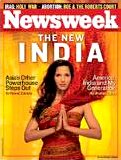
Newsweek Magazine’s feature article this week is entitled “India Rising” and similar to their article about China last year, describes the political, economic, and cultural emergence of India on the international global stage:
Fascinated by the new growth story, perhaps wary of Asia’s Chinese superpower, searching to hedge some bets, the world has woken up to India’s potential. But does it really know this complex, diverse country? Just as important, does India know what it wants of the world?
The marketing slogans wouldn’t work if there were no substance behind them. Over the past 15 years, India has been the second fastest-growing country in the world—after China—averaging above 6 percent growth per year. Growth accelerated to 7.5 percent last year and will probably hold at the same pace this year. Many observers believe that India could well expand at this higher rate for the next decade. . . .
A much-cited 2003 study by Goldman Sachs projects that over the next 50 years, India will be the fastest-growing of the world’s major economies (largely because its work force will not age as fast as the others). The report calculates that in 10 years India’s economy will be larger than Italy’s and in 15 years will have overtaken Britain’s.
By 2040 it will boast the world’s third largest economy. By 2050 it will be five times the size of Japan’s and its per capita income will have risen to 35 times its current level. Predictions like these are a treacherous business, though it’s worth noting that India’s current growth rate is actually higher than the study assumed.
At the same time, the article also notes that India is not without its problems, specifically poverty, slums, crumbling roads, underdeveloped infrastructure, huge HIV-positive population, etc. The article also notes that India’s growth is qualitatively different from that of China’s, where the central government controls virtually all aspects of economic activity, whereas in India, it’s largely a free market-driven system and the advantages and disadvantages involved therein.
Interestingly, the article also notes that in a recent international survey, Indians had the highest favorable impression of the U.S. of any country (except for the U.S. itself of course). I find this remarkable because if you asked the typical American if s/he has a favorable impression of India, I’m willing to bet that most Americans would answer no.
Why not? Mainly because of the outsourcing phenomenon and sensationalized reports of American workers losing their jobs to lower-paid workers in India. In many American industries, India is portrayed as some kind of depraved scavenger, sneaking up on unsuspecting Americans and waiting to grab whatever it can and run.
How ironic indeed, that Indians apparently admire Americans so much, but not the other way around.
Newsweek Magazine has an article describing Jet Li’s latest movie “Fearless,” a bio-pic of Huo Yuanjia, one of China’s most revered kung fu masters. The article notes that this is likely to be Jet Li’s last kung fu movie:
In an age when talented mainstream actors like Chow Yun Fat and Ziyi Zhang can dance their way through spectacular action scenes with the aid of wire work and computer animation, action stars like Li and Jackie Chan — who made their names through sheer physical prowess — are being crowded out.
Long interested in Buddhism, he was baptized as a monk in 1998 and says his faith compelled him to end his kung fu career. The desire to retire intensified after the 2004 tsunami. With his wife, the actress Li Chi, and their two daughters, he was vacationing in the Maldives when the giant wave struck. As they rushed from the beach, a piece of furniture injured his foot.
They headed inland to another hotel but had no way to contact anyone for several days. “When we came out from hiding, everywhere we went we saw death,” he says. “I realized that life is unpredictable. I want to spend the time I have on things more meaningful.”
I have to admit that I am a fan of these new “wire-fu” movies, but I think it would be a shame if Jet Li quits making kung fu movies because of them. At the same time, I admire his self-determination and sense of personal priorities. It is certainly true that we should always enjoy life in its current moment, since there is never any guarantee of what the future will bring.
Nonetheless, Jet Li has meant a lot to many Asian Americans. Many of us see him as the only genuine heir to Bruce Lee’s legacy. It would be unfortunate if we were to lose out on his talents and inspiration.
On February 2, I attended Asian Pacific American Legislation Day at the State Capitol in Olympia, Washington. An annual event, it drew a large, organized crowd of Asian Americans from all over Washington. People heard Governor Gregoire give an upbeat speech, and afterwards disbursed in the drizzle to seek out their district representatives. The idea was to put the concerns and interests of a diverse Washington Asian American community into the hands of citizens, and send them to meet face to face with their representatives.
Before attending the event, I studied the APA Legislative Agenda, which outlined issues important to immigrants and minorities across the state. I came across and item called SB 6499, which was sponsored by Pam Roach, the Republican State Senator from the 31st district. It called for new voter identification laws, including birth certificates and proof of citizenship in order to vote.
Then I saw something really interesting. According to the APA schedule, there was no meeting set with Senator Roach to discuss this issue, which is of paramount importance to Asians and other immigrant and minority groups.
On February 1, I called the Senator’s office. A staffer didn’t know what APA Legislation Day was. I asked for clarification. Potentially two thousand Asians from all over Washington, the Governor speaking, Senator Roach sponsored SB 6499, you don’t know what it is?
I was told that no one had asked for a meeting with Senator Roach. I checked with APA. I was told they had requested a meeting, but had not heard back yet. I left my name and number with the staffer. No return call.
The morning of February 2, as I drove down Interstate 5 in the early morning downpour, I called the Senator’s office again. I re-introduced myself. I was told no one had told them about APA Day until someone called yesterday. I explained that someone was I. I was assured no one else had asked for a meeting.
I was told Senator Roach had a very busy schedule. I asked if that meant no meeting would be scheduled. I re-iterated the concerns about the Senator’s bill, and how it would affect thousands of her constituents. I was told to stop by around 1:30PM. It was suggested by the staffer we might catch her between meetings.
Indeed, Senator Roach was gracious enough to meet with members of APA, including Maxine Chan and Kelli Nakayama of International Community Health Services, and Franklin Yi of the Korean American Voters Alliance. After explaining to us that SB 6499 was essentially going nowhere, she assured the group that her concern in such legislation was making sure it was valid citizens who voted in elections. After the 2004 Washington Governor’s race, there was a lot of activity in Olympia involving voter verification.
Maxine Chan explained that there already existed specific social and logistical barriers to immigrant and minority voters, and additional bureaucracy could disproportionately affect that group. She also mentioned the language barrier, which often resulted in discrimination and difficulty at polling places. That was when the whole thing turned into a bad horror film.
Senator Roach responded by saying she was sympathetic with the whole language barrier, and that no one should be discriminated against at the polls. She went on to explain that she was an advocate of early English proficiency education, particularly for immigrant children so that they might grow up accent free. She spoke of a future of no accents, which would alleviate a host of problems.
By shedding foreign sounding accents, she thought people would face less discrimination. It was in their best interest. She then turned to Franklin Yi, a Korean immigrant whom she knew as a constituent, and pointed out his foreign accent. However, she jokingly vouched for Franklin, because she knew him.
I, Maxine and Kelli sat stunned. We thanked her for meeting with us, and she thanked us for coming, saying her door was always open. We went out and stood in the rain, dumbfounded. Had she really said that? Did I just hear what I thought I heard?
Clearly, Maxine, Kelli and I were “okay†with Senator Roach because we had shed our foreign accents. Is that what had earned us the right not to be discriminated against? I began to think back on some of the well meaning, institutionalized racism I had encountered in my life as an “accent free†Chinese American.
“You didn’t sound Asian on the phone.â€
“You don’t act like a foreigner.â€
“I’m not talking about you, though. You’re different.â€
“You’re so Americanized.â€
And so on, and so on.
What perhaps is most frightening about this story is that I believe Pam Roach loves her country and loves democracy. What does that say about how far we have come, how far we have to go?
About the author: Andrew Tsao works as a television and theater company director, and a lecturer on film directing and acting. He currently lives in Bellevue, WA. You can also visit his personal website and read his blog.
Toyota wants to be just another good ‘ol boy — they’ve recently announced that they will join Ford, Chevrolet, and Dodge as automobile manufacturers competing in the NASCAR Nextel Cup racing series. You may remember that this is the most popular racing series in the western hemisphere, anchored by the world famous Daytona 500 that took place yesterday.
You may also remember that NASCAR has strong roots in the American South and is generally considered to be a virtually all-White sports environment. As such, as a recent post on AutoBlog notes, the reaction to Toyota’s announcement has been mixed:
“I’m not going to root for the cars,†said fan Al High when asked about Toyota’s entry. “I’m going to root for the drivers.” Another fan, Glen Barber, said “it doesn’t bother me they’re in racing. … It’s just another nose piece (front of car) and a brand name.â€
But fan Glen Wilkinson was definitely not accommodating. “It won’t be NASCAR,†he stated. “It will be ‘Japanese car’.†And while he’s aware that Toyota has plants in the U.S. building vehicles (called ‘transplants’) he added, “I know we got a plant up there (in Georgetown), but it’s not American. I think they ought to just ship it out of here, anything that’s not American-made.”
Toyota is apparently aware of the situation and sees participation in NASCAR as a further extension to its American factories, employment, and reputation. Said said Jim Farley, vice president of marketing for Toyota Motor Sales, U.S.A., “we (Toyota) hope, if we do it right, it’s a way to be seen as a part of America, not just a company with a big check.
In that same AutoBlog post, some of the comments from readers point out that while Toyota’s plants are hiring more American workers and paying out larger bonuses, “American” automakers like Ford, GM, and Chrysler are laying off workers and giving out smaller bonuses. In other words, it all comes back to the question, “What constitutes ‘American’?”
That is, Toyota has several factories in the U.S. that employ thousands of American workers, are profitable, and contribute to the U.S.’s economy. Not to mention that the Toyota Camry has been the best-selling passenger car in the U.S. for the past several years. The only hangup that some people apparently have is that it is not an “American-owned” company, although it doesn’t seem to bother Americans that Chrysler is owned by Mercedes-Benz from Germany.
This episode is still to be played out of course, once Toyota actually starts racing in NASCAR, but alas, it is just another example of the ethnocentric and xenophobic mentality that still prevails too often in the U.S.: only Whites — and culture predominantly associated with Whites — deserve to be considered as “real” Americans.
It takes a lot to wow film critics and audiences at the prestigious Sundance Film Festival. But apparently, a new independent film about Vietnamese American refugees is doing just that, recently receiving rave reviews among the film festival attendees::
Director Hà m Tran’s “Journey from the Fall†got it first test before a non-Vietnamese audience at the Sundance Film Festival, passing with flying colors. . . . The plight of the post-war Vietnamese was not lost on the crowd. As the screening ended, the audience stood to give the movie a standing ovation.
Producer Lâm Nguyen, 30, was taken by surprise. “I was astounded. Usually audiences at film festivals, especially an A-list festival like Sundance, are very jaded. You will get applause, but to get a standing ovation? That was incredible,†he said. . . . Now, to have the buzz generated at Sundance to transfer to another important audience: distributors.
As the article describes, the film chronicles the struggles of a South Vietnamese family split up by the fall of Sà i Gòn and each side’s desperate journey to reunite with the other. The article also notes that when the screening was over, there was hardly a dry eye left in the theater, with emotions overflowing among Vietnamese and non-Vietnamese alike.
Big props to Lâm Nguyen, Hà m Tran, and everybody associated with this film. If you’re in SF soon, make sure to check it out. I also hope that the film finds a distributor because I personally cannot wait to see it.
Is it hypocritical that American companies that supposedly champion freedom of speech and exchange of information also aid in censorship overseas? In the context of recent criticisms against American Internet powerhouses such as Microsoft, Yahoo, etc. helping the Chinese government censor information, the company that is apparently at the forefront of the censorship, somewhat surprisingly, is Google:
Several of the biggest media and technology companies have come under attack for helping the Chinese government police the Web. Yahoo provided information about its users’ e-mail accounts that helped the authorities convict dissidents in 2003 and 2005, Chinese lawyers say.
Microsoft closed a popular blog it hosted that offended Chinese censors. Cisco has sold equipment that helps Beijing restrict access to Web sites it considers subversive. But few have cooperated as openly as Google. Google’s local staff works closely with Chinese officials to ensure that search results from Google.cn do not include information, images or links to Web sites that the government does not want its people to see.
Google.com, the company’s main international search engine, is still available in China, though it often operates inefficiently because it produces links that cannot be opened inside China’s firewall. Google.cn, Google says, works faster and serves its users better — and Google places a blunt but discreet disclosure of censorship on the bottom of Web pages that include elided search results.
Even so, critics say, the service violates Google’s motto, “Don’t Be Evil.” They say the company has lent its expertise and good name to blocking information on religion, politics and history that the Communist Party feels might undermine its monopoly on power.
Echoing other Internet giants like Yahoo, Google’s defense is that censorship is the practical reality of doing business in China and that the far greater reward is helping to shape China’s emerging Internet landscape:
Google officials characterized the censorship concessions in China as an excruciating decision for a company that adopted “don’t be evil” as a motto. But management believes it’s a worthwhile sacrifice.
“We firmly believe, with our culture of innovation, Google can make meaningful and positive contributions to the already impressive pace of development in China,” said Andrew McLaughlin, Google’s senior policy counsel.
As an interesting side note, a group of former Chinese communist leaders issued an open letter criticizing the current attempts in China to censor information. Quite interesting indeed.
Nonetheless and once again, we arrive at the age-old dilemma — capitalism or conscience? Profits or professional dignity? I understand Google’s perspective and rationale for cooperating with China’s censorship demands, but nonetheless, I am very disappointed that a company like Google who prides itself on democracy, freedom of speech, and other idealistic-sounding principles caved in and placed money before its founding principles.
Alas, as Darth Vader might say, “You don’t know the power of capitalism!“
As news organizations like CNN are reporting, there is another allegation of domestic spying for China:
The man, identified as Ko-Suen Moo of Taipei, is charged with being a covert Chinese agent, and working with a Frenchman to try to ship sophisticated high-tech military equipment from the United States to China.
Moo and Serge Voros of Paris have been indicted in Miami, Florida with attempting to export an F-16 aircraft engine, Black Hawk helicopter engines, cruise missiles, and air-to-air missiles to China.
The accused in this case appears to be a Taiwanese national, rather than a Taiwanese American. Nonetheless, it is inevitable that these latest allegations will only serve to cast more suspicion on Asian Americans as a whole, with our loyalties as Americans getting called into question one more time.
A recent article from the Christian Science Monitor describes bilateral efforts between the U.S. and Viet Nam to strengthen not only economic, but also military ties between the two former enemies, mostly in an effort to offset the rise of China as a global superpower:
Vietnam has agreed to send Army officers on a US training program, and has hosted US warships at its ports. Last year, after Prime Minister Phan Van Khai made a state visit to Washington, the two sides agreed to share intelligence on terrorism, drugs, and other transnational threats.
Vietnam is also considering joining UN peacekeeping operations as a prelude to seeking a non-permanent seat on the security council. Hanoi last year sent a joint military-civilian delegation to Haiti to observe the UN mission there, according to a senior Western diplomat, and has agreed to commit to international peacekeeping “when circumstances allow.” . . .
“For Vietnam to step forward [on security cooperation], they have to step forward in two directions. They don’t want to be roped into a US containment policy towards China…. They want the US to remain engaged [in Asia], but they don’t want to get too close,” says Carl Thayer, a veteran Vietnam-watcher at the Australian Defense Force Academy.
Vietnam’s balancing act is echoed by other Southeast Asian countries that want to share in the benefits of China’s economic rise without losing sight of the disquiet it provokes among US policymakers who are suspicious of Beijing’s military buildup.
International geo-politics at its best — the U.S. and Viet Nam both “using” each other to offset China’s increasing power and potential for domination on the international stage. Whatever the motivations, I can see how this developing relationship might result in positive outcomes for both sides, and for Asian Americans.
That is, the U.S. gets another “friend” in Asia and trade continues to grow between the two countries, which will hopefully serve to improve the overall quality of life in Viet Nam. Viet Nam gets to elevate its global status somewhat and in the process of participating in more regional and international activities, may actually facilitate less political repression at home.
And finally, warmer relations between the two countries may reflect well on Vietnamese Americans (and by implication, many Asian Americans) as allies within the U.S. That being said, international relations can be prone to sudden changes and instability, so nobody should take anything for granted at this point.
Inside Higher Education has an article that describes an increasingly common trend among colleges and universities these days: looking to India to attract students, form distance learning ventures, and to tap other education-related resources:
India has long been a place of study for scholars of the region’s history, religions and cultures. And India has long been a major supplier of foreign students for American colleges, but the numbers have shot up dramatically in the last decade, such that India now sends more students to the United States than any other country. . .
For American higher education, “India is the next China,†says Philip Altbach, director of Boston College’s Center for International Higher Education. In many ways, Altbach and others say, India logically should have been attractive to American colleges looking for partners years ago. India has long had a large share of well educated students who speak English and an interest in technology — and the government is democratic.
But that government has historically been dubious of American institutions, and bureaucratic roadblocks were numerous for any American university leader trying to do much more than visit. In the past few years, however, India’s government has become much more receptive — and while complicated regulations are by no means gone, they are not seen as insurmountable.
The article goes on to list several recent examples of American universities forming agreements and ventures with various institutions in India. In particular, the article singles out the University of Southern California as a leader in developing and maintaining educational and economic ties with India.
I’ve written before that many economists and observers predict that India will eventually lose its stranglehold on being the international center for outsourcing. Nonetheless, as this article shows, India still has plenty of resources to draw upon in its continuing efforts to modernize and connect itself more directly into American institutions, in this case education.
In other words, despite some possible bumps along the road, India’s march toward becoming an economic — and possible educational — superpower continues to gather steam.
The Washington Post has an article that describes different ways in which immigrant residents of the U.S. are increasingly becoming a potentially powerful and sought-after constituent group for many politicians around the country. The article focuses specifically on the situation in the Baltimore-Washington D.C. area:
Pollsters and political consultants say it will probably be a few years before foreign-born residents are major factors in statewide elections. But candidates this year aren’t taking any chances. . . .
“These are people you simply cannot ignore,” said Isiah Leggett, former chairman of the Maryland Democratic Party and a candidate for county executive. “Not only are they voting, they are giving money and volunteering, so I think candidates who ignore them do so at their own peril.” . . .
“As a percentage of the statewide likely vote, these immigrant populations will still be in the modest single digits, but when you look within the greater Washington marketplace, particularly Montgomery County, these new immigrants can tip the balance,” said Keith Haller, a Maryland independent pollster.
This is just another example of what demographers have been saying all along — the U.S. population is gradually becoming less of a predominantly White, native-born population and the proportions of Americans who are non-White or foreign-born continues to increase each year. Native-born Whites will still be the largest and most powerful group of course, but they are likely to cease being a numerical majority in the next few decades.
Of course, this kind of demographic change is not going to occur without some resistance or conflict. Groups in power are not going to give up their power without a fight. Further, people of color and immigrants still have a long way to go to even begin approaching the level of institutional power held by native-born Whites.
But as the article describes, their presence is becoming increasingly significant within American society and whether native-born Whites like it or not, they will have to eventually deal with that reality, sooner or later.
A recent article from the Pacific News Service describes a practice that apparently is increasingly common in Korea: parents paying American (almost always White) couples to adopt their children so that their kids can enjoy a better educational opportunities and supposedly a better life in the U.S.:
One out of three Korean parents are willing to send their children abroad for the sake of a better education. . . .Putting a child up for adoption in the United States allows Korean parents to skirt around normal immigration procedures, a drawn-out process with no guarantee of approval. Parents generally seek retired American couples, whose own children often have left and have room to spare.
The American couples receive an agreed-upon sum of money in exchange for adopting the child and providing food and housing. Couples receive upwards of $30,000, with additional payments as necessary to cover room and board for each child they adopt. In return, the child gains legal status in the United States, as well as the privilege of attending American schools. The Korean birth parents relinquish all legal claims to their children, sending them instead to grow up in a house with people they have never met. . . .
Despite the benefits, some young Koreans adopted in this manner have shown signs of emotional distress, reflected in their schoolwork and behavior at home. . . . Peter Chang, who heads the Korean Family Center in Los Angeles, says kids like this “often grow up feeling betrayed by their parents.”
I’ve written before about the incessant, almost obsessive drive among many Asians and Asian Americans to be materially successful. Unfortunately, I see this emerging phenomenon as another example of that drive taken to extreme and dysfunctional ends.
Unlike the vast majority of young Korean parents who relinquish custody of their very young children to be adopted, the Korean parents who pay Americans to adopt their child obviously have money, otherwise they wouldn’t be able to complete this transaction. And I suspect that these Korean parents think that they’re doing their children a favor so that they can have a better life.
However, adoptions at a young age frequently involve significant emotional turmoil and feelings of abandonment on the part of the child. Think of how these emotional difficulties are intensified when the child is older and has already formed a bond with his/her natural parents. I can certainly see how emotional distress can be a common consequence among those adopted children.
In the end, it’s hard for me to see how this arrangement is beneficial. I suppose there is a chance that the adopted child may have a better life in the U.S., but at what emotional cost? As a developed industrial society, is life in Korea that bad for parents to resort to this extreme? I try to be as non-judgmental as possible but this phenomenon just strikes me as unhealthy and a recipe for disaster in so many ways.
As I’ve said before, the drive for material success has to have its limits and to me, the limit in this case is when you risk permanently damaging a child’s emotional security just so s/he may be able to earn a little more money over the course of their life.
The Associated Press/Yahoo News describes an increasingly common phenomenon occurring in Japan: Americans adopting the traditional Japanese custom of publicly apologizing for its misdeeds and mistakes:
Taking a cue from Japanese culture, in the past few weeks a raft of U.S. officials — from the U.S. military, the U.S. Embassy, and the departments of State, Agriculture and Defense — have gone before Japanese officials to humbly ask for forgiveness. The reasons have been serious.
In one instance, a U.S. sailor was accused of beating a Japanese woman to death outside Tokyo. In the other, a shipment of American beef violated Japanese food safety rules, prompting a halt to further imports. In both cases, American officials have gone out of their way to pour on the regret — challenging stereotypes among a people who consider themselves the world’s premier apology artists. . . .
The contrite attitude apparently was well-received by the Japanese. “I’ve never seen Americans being so apologetic,” said a Japanese Foreign Ministry official. Niceties aside, the American effort to satisfy the Japanese makes hard-nosed diplomatic sense — the U.S. can hardly risk a blowup of anti-American sentiment as it realigns its military position in Japan.
As the article suggests, there are obvious ulterior motives for this recent spate of apologies by Americans to the Japanese — military support and cooperation, and economic interests. Nonetheless, it is encouraging to see that at least temporarily, American officials are casting off the arrogant, bullying, imperialistic attitude that gives the U.S. such a bad reputation around the world, in favor of a more reflective and (hopefully) sincere approach to dealing with the Japanese.
Now if American officials can transfer this new attitude to its treatment of other nations and its own minority groups inside the U.S. . . .